Red Clover for Menopause: How Strong Is the Evidence?
Red clover has shown promise in some menopause trials, but the results aren’t consistent enough to count on it for hot flashes.
Red clover may help some women with hot flashes, but trials have produced mixed results, and menopause guidance does not recommend herbal supplements as a treatment for them. 42 If symptoms are disrupting your day or sleep, there are better-supported hormone and nonhormone options. A history of hormone-sensitive disease, pregnancy, or breastfeeding makes the safety conversation especially relevant. 127
Why red clover sounds promising
Red clover contains isoflavones, plant compounds that are structurally similar to estrogen. That gives the supplement a plausible reason to be studied for menopause symptoms, but it doesn’t make it an estrogen replacement. What matters is whether women feel better in well-designed trials, and whether the benefit is reliable enough to outweigh uncertainty about safety. 7
For hot flashes, the answer is not reliably. A systematic review of 11 randomized trials in peri- and postmenopausal women found fewer hot flashes, on average, in red clover groups than in control groups. The pooled difference did not meet the review’s threshold for statistical significance, and the authors flagged methodological flaws and substantial differences among the studies. Other trials have found no meaningful advantage over placebo. The National Institutes of Health’s National Center for Complementary and Integrative Health (NCCIH) describes the hot-flash results as inconsistent, with some studies at high risk of bias. 457
That distinction matters when you’re deciding what to try. A promising result in one study doesn’t tell you that a supplement on a store shelf will ease your hot flashes. The Menopause Society’s 2023 review does not recommend supplements or herbal remedies for menopause-related hot flashes; it found better support for other treatments. 2
Does it help with night sweats, sleep, or mood?
There are encouraging findings, but far less certainty. In a red-clover-specific review, two trials reported improvement in night sweats compared with control groups. A separate review of trials during the menopausal transition and early postmenopause identified one red clover trial that reported improvements in hot flashes, mood, pain, and cognitive symptoms. The reviewers said larger studies and better symptom measurement were needed to see whether such findings hold up. 43
It’s also easy to mistake a finding about plant supplements as a group for a finding about red clover. A 2024 review pooled trials of soy, red clover, and many other plant-derived products and found improvements in overall symptom scores compared with placebo. Because that result combines different ingredients, it cannot tell you how much benefit to expect from red clover alone. The authors also noted that the studies varied and that stronger research was needed. 6
If your main concern is vaginal dryness or discomfort rather than hot flashes, red clover isn’t a well-established answer to that question. The Menopause Society’s hormone therapy guidance identifies treatments specifically for bothersome genitourinary symptoms that persist despite over-the-counter measures, including low-dose vaginal estrogen and other prescription options. That’s a different treatment conversation from trying to reduce hot flashes. 1
What the studies don’t settle about safety
The estrogen-like structure of red clover is a reason to ask questions, not proof that it acts like prescribed estrogen in the body. Trials included in one review did not show a significant overall increase in endometrial thickness, a measure of the uterine lining. But that finding does not establish long-term safety or answer whether red clover is suitable for someone with an estrogen-dependent cancer or another hormone-sensitive history. 74
If that history applies to you, bring it up before treating red clover as the safer alternative. The same goes if you’re already using a menopause treatment: this evidence does not establish how combining it with red clover would affect benefits or risks. Red clover supplements may also be unsafe during pregnancy or breastfeeding, so findings from menopausal women shouldn’t be carried over to those stages of life. 7
Product choice adds another uncertainty. Herbal products can differ in quality, purity, and ingredients, and the clinical results do not identify a best brand or show that one bottle will match what was studied. A label can tell you what a manufacturer says a product contains; it cannot, by itself, resolve the mixed evidence for symptom relief. 87
Put the possible benefit beside your other options
How much uncertainty is acceptable depends partly on what the symptoms are costing you. If an occasional hot flash is a nuisance, you may weigh an unproven supplement differently than you would if night sweats regularly break up your sleep. But red clover shouldn’t be mistaken for a treatment with the same evidence as menopause hormone therapy, which remains the most effective option for hot flashes for appropriate candidates. Its benefits and risks depend on factors including age, time since menopause, medical history, and the type of therapy. 1
If you want to avoid hormones or they aren’t appropriate for you, that doesn’t leave red clover as the only option. The Menopause Society recommends several nonhormone approaches for hot flashes, including cognitive behavioral therapy, clinical hypnosis, and certain prescription medicines. Those recommendations are for hot flashes specifically, not a promise that every option treats every menopause symptom. 2
A useful conversation starts with three concrete points: Which symptom needs relief most? How often is it affecting sleep or daily life? Is there anything in your health history or current treatment that changes the choice? If you’re considering red clover, bring the specific product you’re looking at into that conversation. The question isn’t simply whether it’s “natural.” It’s whether an uncertain benefit is worth choosing over an option with stronger evidence for the symptom you actually have. 278
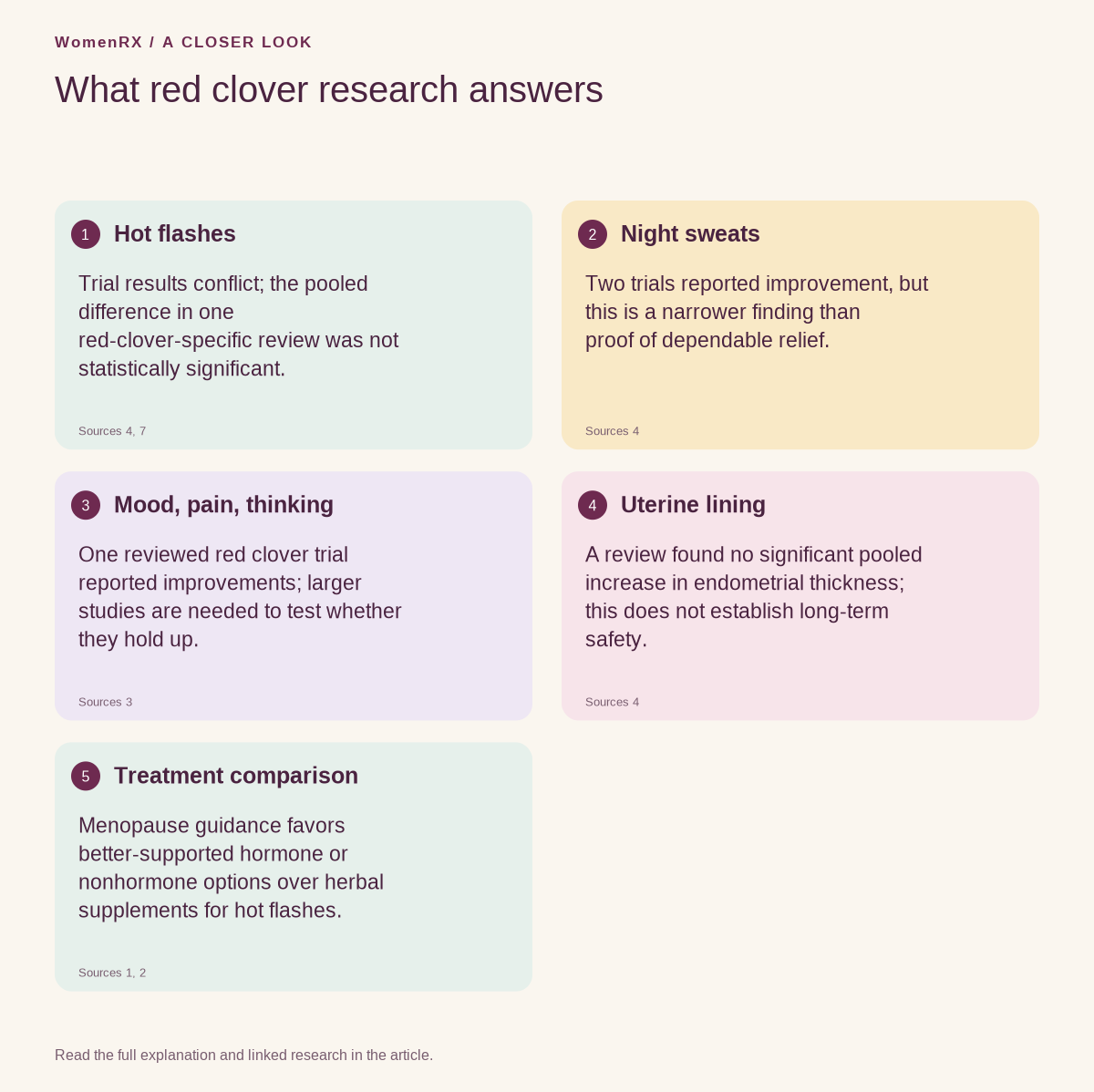
What red clover research answers
Hot flashes: Trial results conflict; the pooled difference in one red-clover-specific review was not statistically significant.47
Night sweats: Two trials reported improvement, but this is a narrower finding than proof of dependable relief.4
Mood, pain, thinking: One reviewed red clover trial reported improvements; larger studies are needed to test whether they hold up.3
Uterine lining: A review found no significant pooled increase in endometrial thickness; this does not establish long-term safety.4
Treatment comparison: Menopause guidance favors better-supported hormone or nonhormone options over herbal supplements for hot flashes.12
Read the figure as text
Different symptoms have different amounts of evidence, and a symptom result is not a long-term safety result.- Hot flashes: Trial results conflict; the pooled difference in one red-clover-specific review was not statistically significant.47
- Night sweats: Two trials reported improvement, but this is a narrower finding than proof of dependable relief.4
- Mood, pain, thinking: One reviewed red clover trial reported improvements; larger studies are needed to test whether they hold up.3
- Uterine lining: A review found no significant pooled increase in endometrial thickness; this does not establish long-term safety.4
- Treatment comparison: Menopause guidance favors better-supported hormone or nonhormone options over herbal supplements for hot flashes.12
More questions, answered
Does red clover raise estrogen levels?
Red clover contains compounds structurally similar to estrogen, but that doesn’t mean taking it produces the effects of estrogen therapy. A review found uncertain hormone-measure results across trials with substantial limitations. Those measurements cannot establish symptom relief or safety for an individual woman. 74
Are the findings the same for perimenopause and postmenopause?
Not necessarily. Reviews include women in both stages, but the mixed results do not establish that red clover works equally well at each stage. If your periods are still changing, don’t assume a result from postmenopausal participants predicts what you’ll experience. 46
Sources you can check
- The 2022 hormone therapy position statement of The North American Menopause Society.“The 2022 Hormone Therapy Position Statement of The North American Menopause Society” Advisory Panel. · Menopause (New York, N.Y.) · 2022Return to first citation
- The 2023 nonhormone therapy position statement of The North American Menopause Society.Menopause (New York, N.Y.) · 2023Return to first citation
- Effects of isoflavones and amino acid therapies for hot flashes and co-occurring symptoms during the menopausal transition and early postmenopause: a systematic review.Thomas AJ, Ismail R, Taylor-Swanson L, Cray L, Schnall JG, Mitchell ES, Woods NF. · Maturitas · 2014Return to first citation
- Effects of red clover on hot flash and circulating hormone concentrations in menopausal women: a systematic review and meta-analysis.Ghazanfarpour M, Sadeghi R, Latifnejad Roudsari R, Mirzaii Najmabadi K, Mousavi Bazaz M, Abdolahian S, Khadivzadeh T. · Avicenna journal of phytomedicine · 2015Return to first citation
- Nonhormonal therapies for hot flashes in menopause.Carroll DG. · American family physician · 2006Return to first citation
- Efficacy of plant-derived dietary supplements in improving overall menopausal symptoms in women: An updated systematic review and meta-analysis.Oh MR, Park JH, Park SK, Park SH. · Phytotherapy research : PTR · 2024Return to first citation
- Red Clover: Usefulness and Safety | NCCIHAccessed 2026-09-25Return to first citation
- Herbal remedies and complementary medicines for menopause symptoms - NHSAccessed 2026-09-25Return to first citation