Red Clover for Menopause: Does Timing Matter?
Studies don’t establish a best time of day to take red clover, and its benefits for hot flashes remain uncertain.
There’s no evidence-based best time of day to take red clover for menopause symptoms: the clinical studies reviewed assessed whether red clover preparations helped, not whether morning or evening use worked better. Results for hot flashes are mixed, and the North American Menopause Society does not recommend supplements or herbal remedies for vasomotor symptoms. If you’re considering a product, review its use with a clinician or pharmacist, especially if you have a hormone-sensitive condition or take medicines. 1 3
What the studies can tell you
Red clover contains isoflavones, plant compounds studied in supplement preparations for menopause symptoms. Research has looked most often at hot flashes, but findings don’t point to a dependable benefit for every woman. A 2015 review of 11 randomized trials found a possible reduction in hot flashes compared with control, but the difference was not statistically significant; the authors also noted methodological problems and substantial variation among studies. 3
Some individual trials have reported improvements. A 2014 systematic review found that one red clover trial reported improvement in hot flashes and several other symptoms. But a positive result in an individual trial is not the same as consistent proof across studies. The review called for larger studies and replication. 2
A 2024 review found improvements when it pooled results from many different plant-derived supplements, including six red-clover studies. Because those overall results combine different plants and products, they don’t establish that red clover itself reliably eases hot flashes. The review also described the evidence as heterogeneous and generally needing more rigorous studies. 5
For that reason, the 2023 North American Menopause Society position statement does not recommend supplements or herbal remedies for vasomotor symptoms such as hot flashes. It identifies other evidence-supported nonhormonal options, and notes that hormone therapy remains the most effective treatment for vasomotor symptoms. 1
A supplement extract isn’t the same as food
The clinical findings discussed here come from trials of red-clover-derived isoflavone preparations. They don’t show that eating a food or drinking a tea containing clover will have the same effect. Nor do they establish that one supplement product is interchangeable with another. The evidence reviewed doesn’t provide a food-based alternative or a product-selection rule. 2 3
If you’re looking at a label, treat the product as a supplement being studied for possible symptom relief, not as a proven hormone treatment. A supplement’s presence on a shelf doesn’t mean it has been shown to work for hot flashes.
Morning or night? The research doesn’t answer that
The studies and reviews described above compared red clover preparations with controls or assessed symptom outcomes. They don’t compare morning use with evening use, or establish a preferred relationship to meals. So claims that a particular time produces “best results” aren’t supported by this evidence. If a clinician or pharmacist says a product is reasonable for you, follow the product instructions they’ve reviewed rather than assuming timing changes its effect.
Check personal safety before trying it
The studies summarized here don’t settle long-term safety or establish how red clover supplements should be used by people with hormone-sensitive conditions. They also don’t identify a reliable list of medicine interactions. That means it’s better not to assume that a plant-based supplement is automatically suitable for you. Discuss the exact product with a clinician or pharmacist if you have a hormone-sensitive condition or take medicines, and ask specifically whether its use fits your health history and treatment plan. 3 4
If hot flashes are disrupting sleep or daily life, you don’t have to rely on a supplement with uncertain results. The 2023 menopause position statement lists several nonhormonal treatments supported by evidence; which options fit depends on your circumstances and preferences. 1
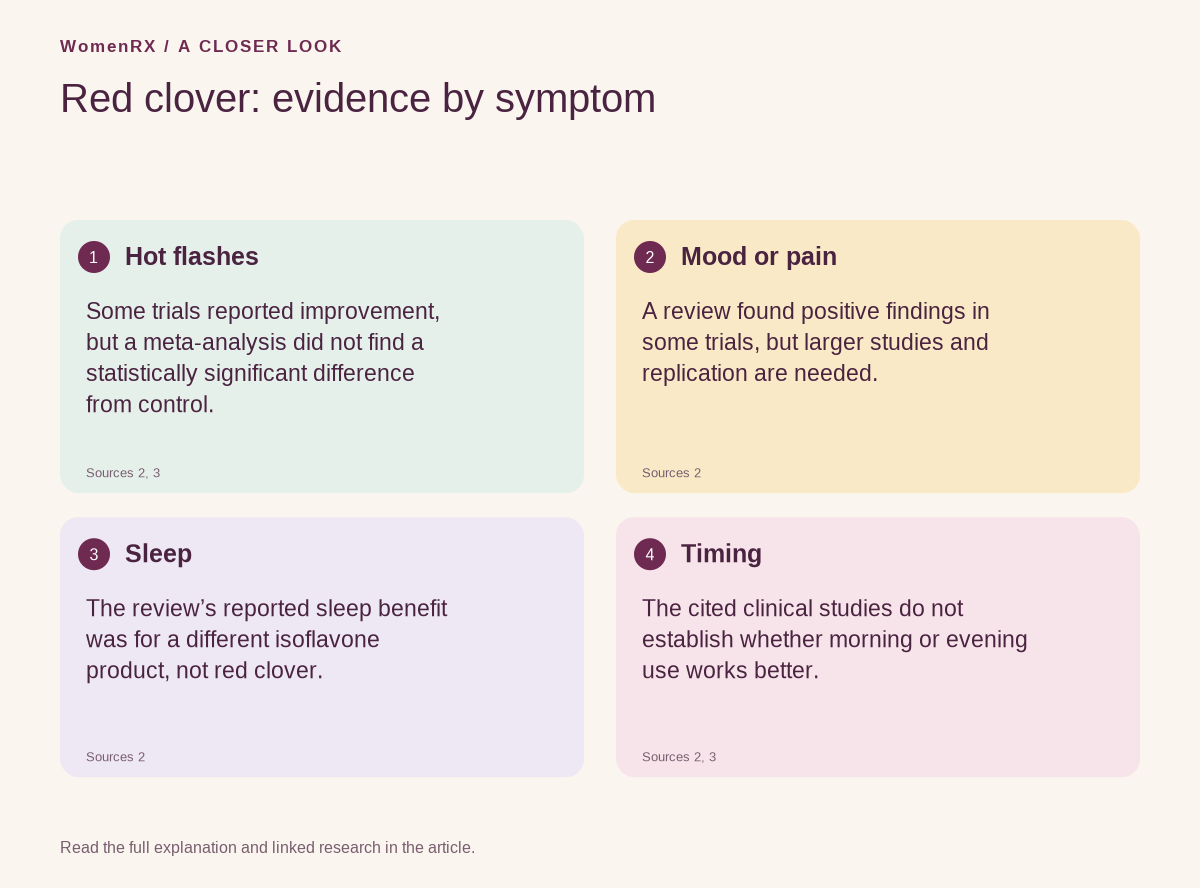
Red clover: evidence by symptom
Hot flashes: Some trials reported improvement, but a meta-analysis did not find a statistically significant difference from control.23
Mood or pain: A review found positive findings in some trials, but larger studies and replication are needed.2
Sleep: The review’s reported sleep benefit was for a different isoflavone product, not red clover.2
Timing: The cited clinical studies do not establish whether morning or evening use works better.23
Read the figure as text
The findings vary by symptom and study type. These differences help show what a supplement claim can, and can’t, promise.- Hot flashes: Some trials reported improvement, but a meta-analysis did not find a statistically significant difference from control.23
- Mood or pain: A review found positive findings in some trials, but larger studies and replication are needed.2
- Sleep: The review’s reported sleep benefit was for a different isoflavone product, not red clover.2
- Timing: The cited clinical studies do not establish whether morning or evening use works better.23
More questions, answered
Does red clover work for symptoms other than hot flashes?
Some trials have reported improvements in mood, pain, or cognitive symptoms, but the findings come from limited studies and need replication. The evidence doesn’t establish red clover as a reliable treatment for those symptoms. 2
Sources you can check
- The 2023 nonhormone therapy position statement of The North American Menopause Society.Menopause (New York, N.Y.) · 2023Return to first citation
- Effects of isoflavones and amino acid therapies for hot flashes and co-occurring symptoms during the menopausal transition and early postmenopause: a systematic review.Thomas AJ, Ismail R, Taylor-Swanson L, Cray L, Schnall JG, Mitchell ES, Woods NF. · Maturitas · 2014Return to first citation
- Effects of red clover on hot flash and circulating hormone concentrations in menopausal women: a systematic review and meta-analysis.Ghazanfarpour M, Sadeghi R, Latifnejad Roudsari R, Mirzaii Najmabadi K, Mousavi Bazaz M, Abdolahian S, Khadivzadeh T. · Avicenna journal of phytomedicine · 2015Return to first citation
- Evaluating the evidence for over-the-counter alternatives for relief of hot flashes in menopausal women.Kelley KW, Carroll DG. · Journal of the American Pharmacists Association : JAPhA · 2010Return to first citation
- Efficacy of plant-derived dietary supplements in improving overall menopausal symptoms in women: An updated systematic review and meta-analysis.Oh MR, Park JH, Park SK, Park SH. · Phytotherapy research : PTR · 2024Return to first citation