Can Red Clover Help Menopause Symptoms?
Red clover studies report mixed results for hot flashes, and a 252-participant trial found no clinically important benefit from the two extracts it tested.
Red clover isoflavones haven’t been shown reliably to ease menopause symptoms. A review found encouraging results in some trials, but it covered several kinds of isoflavones and amino acid preparations. In a 252-participant trial, two specific red clover extracts did not produce clinically important hot-flash relief compared with placebo. The evidence doesn’t establish hormone balancing, stage-specific effects, or long-term safety. 34
Red clover isoflavones have been studied for hot flashes and other symptoms, but the findings don’t establish a dependable treatment. A review found positive results in some trials, while a trial of two named red clover extracts found no clinically important hot-flash benefit compared with placebo. The North American Menopause Society’s 2023 position statement does not recommend supplements or herbal remedies for menopause-related hot flashes. 234
What the hot-flash findings actually show
A systematic review examined 17 trials of isoflavone and amino acid preparations in women during the menopause transition and early postmenopause. Within that review, six of seven trials of isoflavones other than soy reported significant reductions in hot flashes. One trial of red clover isoflavone also reported improvements in mood, pain, and cognitive symptoms. These are findings from individual studies, not proof that red clover reliably improves these symptoms; the review called for larger studies and better outcome measurement. 3
A separate, placebo-controlled U.S. trial enrolled 252 women ages 45 to 60 who were recently postmenopausal and having at least 35 hot flashes a week. Participants received Promensil, Rimostil, or placebo for 12 weeks. At the end, average daily hot flashes had fallen by 5.1 in the Promensil group, 5.4 in the Rimostil group, and 5.0 in the placebo group. The researchers concluded that neither extract had a clinically important effect on hot flashes or other menopause symptoms. 4
These results don’t show why findings vary. The review covered different isoflavone preparations, while the trial tested two specific red clover products. A positive finding for one preparation or symptom doesn’t tell you that another product will work the same way. 34
Why the extract on the label matters
Promensil supplied 82 mg of total isoflavones per day in the trial, while Rimostil supplied 57 mg. Neither showed a clinically important benefit over placebo under the study conditions. Those amounts describe the products tested, not a dose to use or a result that can be applied to every red clover supplement. 4
If you’re comparing products, check whether the label identifies the extract and states the amount of isoflavones. That can help you see whether products are described in comparable ways, but it can’t establish that a product will relieve symptoms. The trials used varied preparations, and their results aren’t consistent. 34
“Balances hormones” is also broader than what these studies demonstrate. The review and trial reported symptom outcomes, such as hot flashes and, in some studies, mood or pain. They don’t establish that red clover balances hormones or treats menopause as a whole. 34
What the safety findings leave unanswered
In the 12-week trial, adverse events were comparable among the two red clover groups and the placebo group. That finding is limited to the trial’s duration and participants. It cannot answer long-term safety questions, identify specific medicine interactions, or determine whether a product is suitable for someone with an estrogen-sensitive condition. 4
If you take medicines or have an estrogen-sensitive condition, show a clinician or pharmacist the exact product label and ask about that product in your situation. The trial results alone don’t settle those questions. 4
If hot flashes are disrupting your life, red clover isn’t the only option. The 2023 North American Menopause Society statement recommends several nonhormone approaches, including cognitive behavioral therapy, clinical hypnosis, and certain prescription medicines. Hormone therapy remains the most effective treatment for vasomotor symptoms, though whether it’s appropriate depends on the person and their circumstances. 12
What red clover trials measured
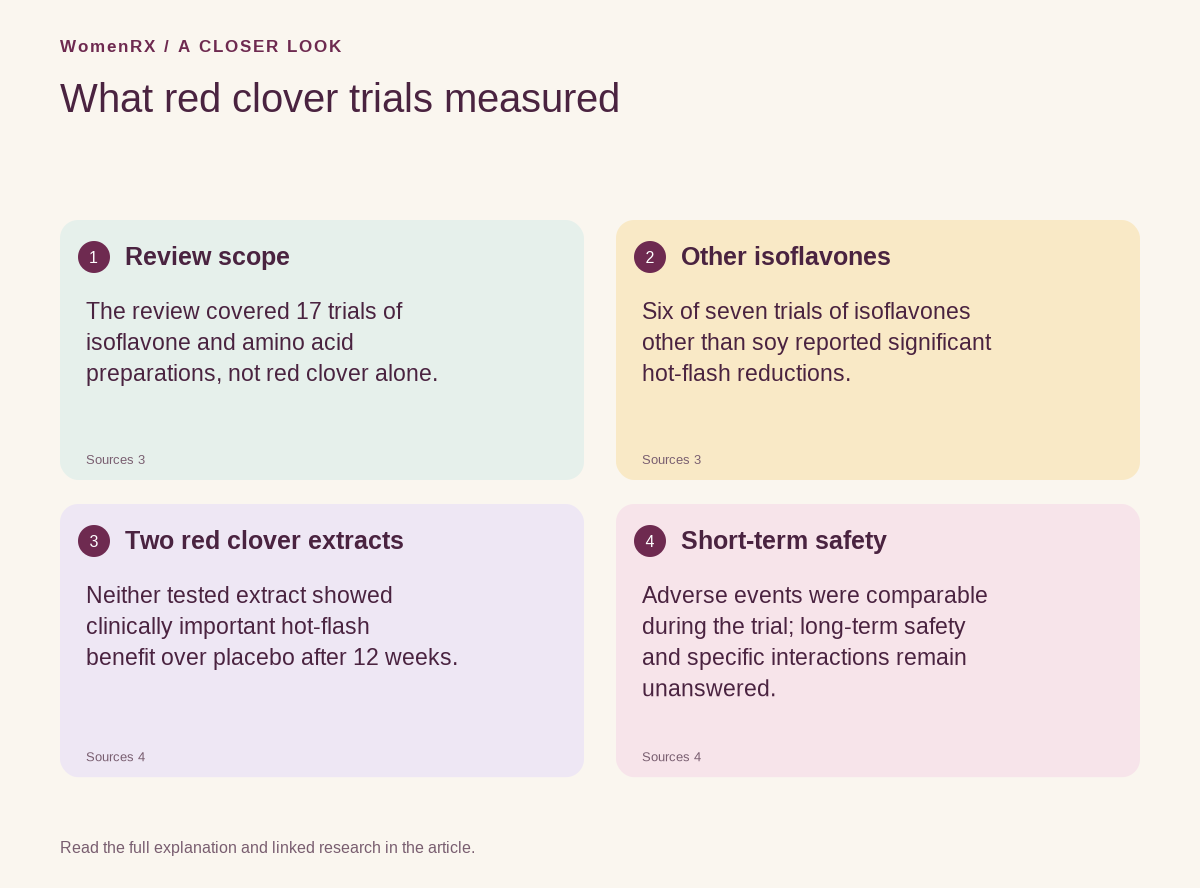
Review scope: The review covered 17 trials of isoflavone and amino acid preparations, not red clover alone.3
Other isoflavones: Six of seven trials of isoflavones other than soy reported significant hot-flash reductions.3
Two red clover extracts: Neither tested extract showed clinically important hot-flash benefit over placebo after 12 weeks.4
Short-term safety: Adverse events were comparable during the trial; long-term safety and specific interactions remain unanswered.4
Read the figure as text
These findings distinguish a review of varied preparations from a trial of two specific red clover extracts.- Review scope: The review covered 17 trials of isoflavone and amino acid preparations, not red clover alone.3
- Other isoflavones: Six of seven trials of isoflavones other than soy reported significant hot-flash reductions.3
- Two red clover extracts: Neither tested extract showed clinically important hot-flash benefit over placebo after 12 weeks.4
- Short-term safety: Adverse events were comparable during the trial; long-term safety and specific interactions remain unanswered.4
More questions, answered
Do red clover results differ before and after menopause?
The review included women in the menopause transition and early postmenopause. The 252-participant trial studied recently postmenopausal women. These studies don’t establish whether red clover works differently at different stages. 34
Sources you can check
- The 2022 hormone therapy position statement of The North American Menopause Society.“The 2022 Hormone Therapy Position Statement of The North American Menopause Society” Advisory Panel. · Menopause (New York, N.Y.) · 2022Return to first citation
- The 2023 nonhormone therapy position statement of The North American Menopause Society.Menopause (New York, N.Y.) · 2023Return to first citation
- Effects of isoflavones and amino acid therapies for hot flashes and co-occurring symptoms during the menopausal transition and early postmenopause: a systematic review.Thomas AJ, Ismail R, Taylor-Swanson L, Cray L, Schnall JG, Mitchell ES, Woods NF. · Maturitas · 2014Return to first citation
- Phytoestrogen supplements for the treatment of hot flashes: the Isoflavone Clover Extract (ICE) Study: a randomized controlled trial.Tice JA, Ettinger B, Ensrud K, Wallace R, Blackwell T, Cummings SR. · JAMA · 2003Return to first citation