Red Clover in Menopause: What Women’s Trials Have Tested
Women’s trials have measured menopause symptoms and quality of life, but results vary by product and study.
Red clover has been studied mainly for menopausal symptoms, including hot flashes, overall symptom scores, mood, pain, and cognitive symptoms. Some small studies and a systematic review reported improvements in certain symptoms, but a larger placebo-controlled trial found no clinically important hot-flash benefit, and another trial found no quality-of-life advantage over placebo. These findings don’t establish broad benefits or disease prevention. 1245
The evidence is mostly about menopause symptoms
Red clover is a source of isoflavones, plant compounds studied for possible effects on menopause symptoms. Clinical trials of red clover have largely enrolled women in the menopausal transition or after menopause. It does not show that red clover provides a general health benefit for all women.
Researchers have tested different products, too: dried red clover leaves, concentrated isoflavone extracts, and combination supplements. Results from one preparation can’t automatically be applied to another.
Hot flashes: one larger trial found little practical difference
The clearest direct test was a US randomized, double-blind, placebo-controlled trial of 252 menopausal women who were having at least 35 hot flashes a week. Participants took one of two red-clover-derived isoflavone extracts or a placebo for 12 weeks. At the end, average daily hot-flash counts had fallen by about five in each group: 5.1 in one extract group, 5.4 in the other, and 5.0 with placebo. The researchers concluded that neither supplement had a clinically important effect on hot flashes or other menopause symptoms. 2
A smaller 12-week randomized trial in 72 healthy postmenopausal women reported a greater decrease in total menopause symptom scores with dried red clover leaves than with placebo. The study used a symptom rating scale, and the reported improvement was in its physical and psychological categories. This is a positive finding, but it comes from a small trial and a different preparation than the concentrated extracts in the larger hot-flash study. 1
Taken together, these studies don’t point to a reliable hot-flash effect across red clover products. A change within a study group also isn’t enough by itself to show that a supplement works: the key comparison is whether women taking it improved more than those taking placebo.
Other symptoms: possible signals, not settled results
A systematic review of controlled trials reported positive findings for mood, pain, and cognitive symptoms in trials of red-clover isoflavones, including a trial using an 80 mg preparation. These findings are possible signals, not proof of consistent effects; the review called for replication in larger studies. 4
Quality of life has also been measured directly. In a randomized, triple-blind trial, 72 menopausal women were assigned red-clover isoflavones or placebo for eight weeks; 55 completed the study. Quality-of-life scores improved from the start of the study in both groups, but the difference between groups was not significant, either overall or in the reported domains. That means this trial did not show a quality-of-life advantage for red clover over placebo. 5
Biomarker changes aren’t proof of disease prevention
A small, 12-week pilot study reported changes in several health-related markers after women took a supplement containing isoflavones from both kudzu and red clover, alongside other nutrients. Because it tested a combination, the results can’t be attributed to red clover alone. And changes in laboratory markers are not the same as showing fewer cases of heart disease or breast cancer. The study did not establish that the supplement prevents either disease. 3
A review of alternative menopause therapies likewise noted that clinical cardiovascular outcomes had not been studied for phytoestrogen products, despite research on some biological markers. 6
What the findings can, and can’t, tell you
The most useful takeaway is that red clover has been tested for specific menopause-related outcomes, with mixed results. A larger placebo-controlled study did not find a clinically important hot-flash benefit, while smaller studies and a systematic review reported possible improvements in some symptoms. A separate trial did not find a quality-of-life advantage over placebo.
When considering a claim about red clover, check what the study actually measured and what product it tested. Evidence about a particular extract or a combination formula is not interchangeable with evidence about dried leaves or another supplement. None of these findings demonstrates that red clover prevents disease or benefits women who were not represented in the menopause studies.
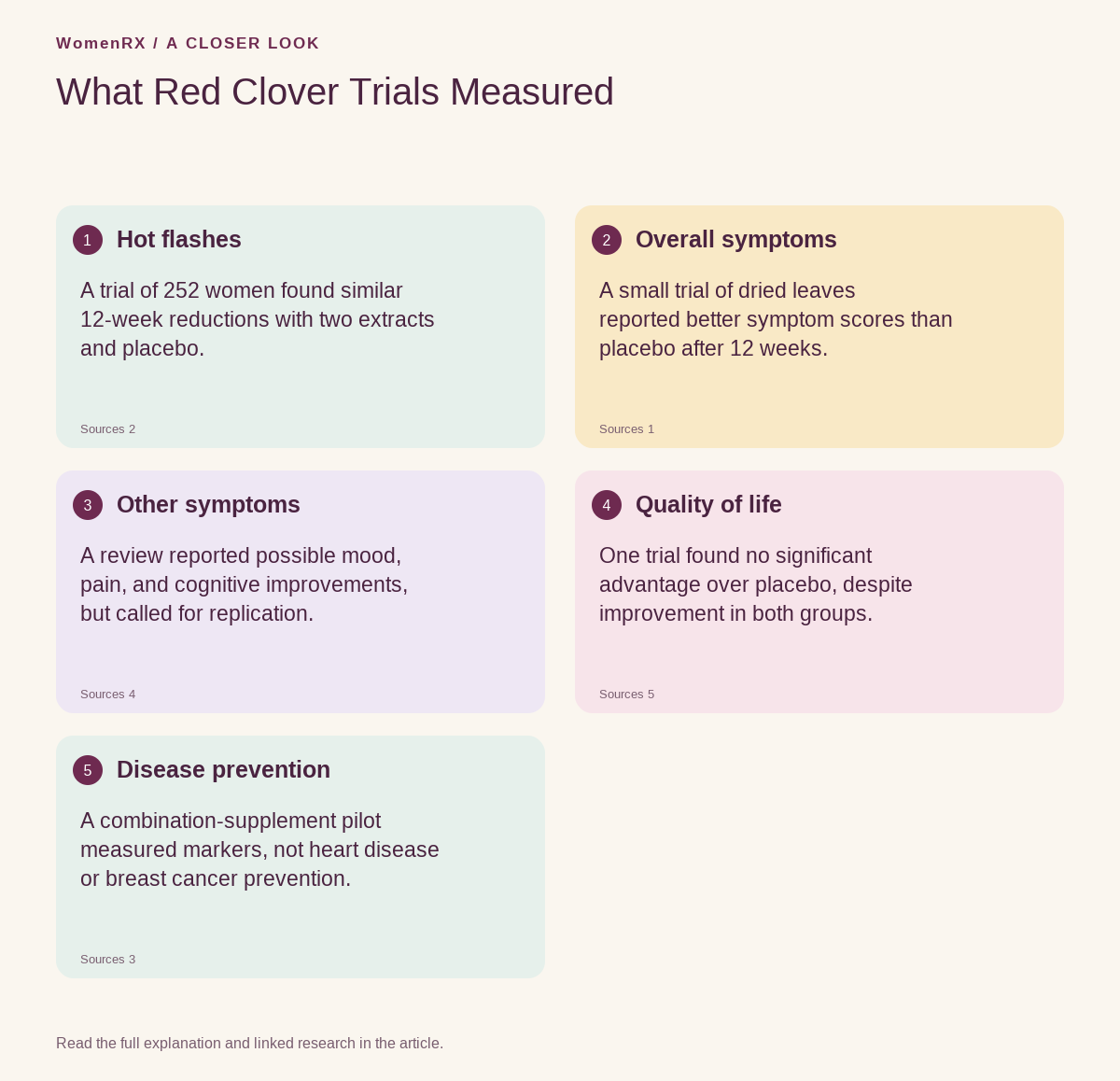
What Red Clover Trials Measured
Hot flashes: A trial of 252 women found similar 12-week reductions with two extracts and placebo.2
Overall symptoms: A small trial of dried leaves reported better symptom scores than placebo after 12 weeks.1
Other symptoms: A review reported possible mood, pain, and cognitive improvements, but called for replication.4
Quality of life: One trial found no significant advantage over placebo, despite improvement in both groups.5
Disease prevention: A combination-supplement pilot measured markers, not heart disease or breast cancer prevention.3
Read the figure as text
The findings differ by outcome and by the red clover preparation tested.- Hot flashes: A trial of 252 women found similar 12-week reductions with two extracts and placebo.2
- Overall symptoms: A small trial of dried leaves reported better symptom scores than placebo after 12 weeks.1
- Other symptoms: A review reported possible mood, pain, and cognitive improvements, but called for replication.4
- Quality of life: One trial found no significant advantage over placebo, despite improvement in both groups.5
- Disease prevention: A combination-supplement pilot measured markers, not heart disease or breast cancer prevention.3
More questions, answered
Does red clover prevent heart disease or breast cancer?
The cited pilot study reported changes in markers, not fewer cases of heart disease or breast cancer, and its supplement combined red clover with kudzu and other nutrients. It cannot establish disease prevention or isolate a red-clover effect. 3
Do all red clover supplements match the trial results?
No. Trials tested different preparations, including dried leaves, concentrated isoflavone extracts, and combination supplements. Findings from one formulation do not establish the effects of another. 123
Sources you can check
- Effectiveness of red clover in alleviating menopausal symptoms: a 12-week randomized, controlled trial.Shakeri F, Taavoni S, Goushegir A, Haghani H. · Climacteric : the journal of the International Menopause Society · 2015Return to first citation
- Phytoestrogen supplements for the treatment of hot flashes: the Isoflavone Clover Extract (ICE) Study: a randomized controlled trial.Tice JA, Ettinger B, Ensrud K, Wallace R, Blackwell T, Cummings SR. · JAMA · 2003Return to first citation
- Clinical effects of a proprietary combination isoflavone nutritional supplement in menopausal women: a pilot trial.Lukaczer D, Darland G, Tripp M, Liska D, Lerman RH, Schiltz B, Bland JS. · Alternative therapies in health and medicine · 2005Return to first citation
- Effects of isoflavones and amino acid therapies for hot flashes and co-occurring symptoms during the menopausal transition and early postmenopause: a systematic review.Thomas AJ, Ismail R, Taylor-Swanson L, Cray L, Schnall JG, Mitchell ES, Woods NF. · Maturitas · 2014Return to first citation
- The effects of red clover on quality of life in post-menopausal women.Ehsanpour S, Salehi K, Zolfaghari B, Bakhtiari S. · Iranian journal of nursing and midwifery research · 2012Return to first citation
- Alternative and complementary therapies for the menopause.Pitkin J. · Menopause international · 2012Return to first citation