Red Clover for Menopause Symptoms: Evidence and Product Labels
Red clover products vary, and research hasn’t established a reliable daily amount or consistent relief for menopause symptoms.
There isn’t an established daily amount of red clover proven to ease menopause symptoms. One review reports an individual trial using 80 mg/day of red-clover isoflavones, not 80 mg of total extract; that study amount isn’t a retail-product recommendation. A review of 11 trials found a possible hot-flash reduction that wasn’t statistically significant. Check whether a label states isoflavone content, and have the specific product reviewed in light of your health history and medicines. 5612
What the menopause research says
Red clover contains isoflavones, plant compounds that can have estrogen-like activity. That gives a reason to study the plant, but it doesn’t make a red clover supplement equivalent to hormone therapy or prove that it will relieve symptoms. 23
In a systematic review and meta-analysis of 11 randomized trials in peri- and postmenopausal women, hot-flash frequency was lower on average with red clover than with control. The difference did not reach statistical significance, and the reviewers noted limitations in the studies, including differences in methods and menopause status. The finding is a possible signal, not dependable proof of relief. 6
A separate systematic review summarized individual trials of different isoflavone preparations. In one red-clover trial, the review reported improvements in hot flashes, mood, pain, and cognitive symptoms. The sleep improvement it described came from a separate Rexflavone trial. These are individual-trial findings, and the review called for larger studies and replication. 5
That review reports that one red-clover trial used 80 mg/day of isoflavones. This is the amount of isoflavones, not the total weight of red clover extract, and it describes a study rather than a recommended amount to take from a retail product. The reviews don’t establish a universal daily amount for menopause symptoms. 56
The North American Menopause Society’s 2023 nonhormone therapy statement does not recommend supplements or herbal remedies for vasomotor symptoms, based on its review of the evidence. It lists options with better support, including cognitive behavioral therapy, clinical hypnosis, and certain prescription medicines. That’s a useful comparison if hot flashes are disrupting your sleep or daily life. 4
How to compare the products on a shelf
Start by looking for the amount of isoflavones per serving, if the label provides it. “Red clover extract” weight and isoflavone amount describe different things: the extract is the plant preparation, while isoflavones are some of its active compounds. A label that gives only extract weight doesn’t tell you how much isoflavone it contains.
Then check how specifically the product describes its extract. Red clover plants can differ in isoflavone content, and extraction methods can change the compounds in a preparation. In laboratory testing, different red clover preparations also showed different estrogenic activity in cells. Those findings help explain why products may not be interchangeable, but they don’t show that one commercial product works better or is safer for people. 12
A clearly stated isoflavone amount can help you understand what the product contains; it cannot tell you whether that amount will help your symptoms. The 80 mg/day amount reported for one trial refers to red-clover isoflavones, not total extract, and it shouldn’t be treated as a recommendation for a retail supplement. 5
Put personal safety in the decision
If you have a history of an estrogen-sensitive cancer or another hormone-sensitive condition, don’t assume red clover is safe because it’s plant-based. Its extracts contain phytoestrogens, and some preparations have shown estrogenic activity in laboratory cells. That is not evidence that a supplement causes harm in people, but the menopause trials and guidance cited here don’t settle safety for every hormone-sensitive history. 24
Bring the specific product label and your current medicines to a clinician or pharmacist for review, especially if a treatment or condition makes hormone-like effects relevant. Don’t use a red clover product as a substitute for a proven treatment without discussing the tradeoff.
A practical comparison is to ask: What symptoms am I trying to ease? Does the label quantify isoflavones, or only total extract? Is there evidence for this exact preparation, or only for red clover products in general? And does my medical history change how I should weigh uncertain benefit against uncertain safety? Those questions can make the decision more grounded than choosing a product by extract weight alone.
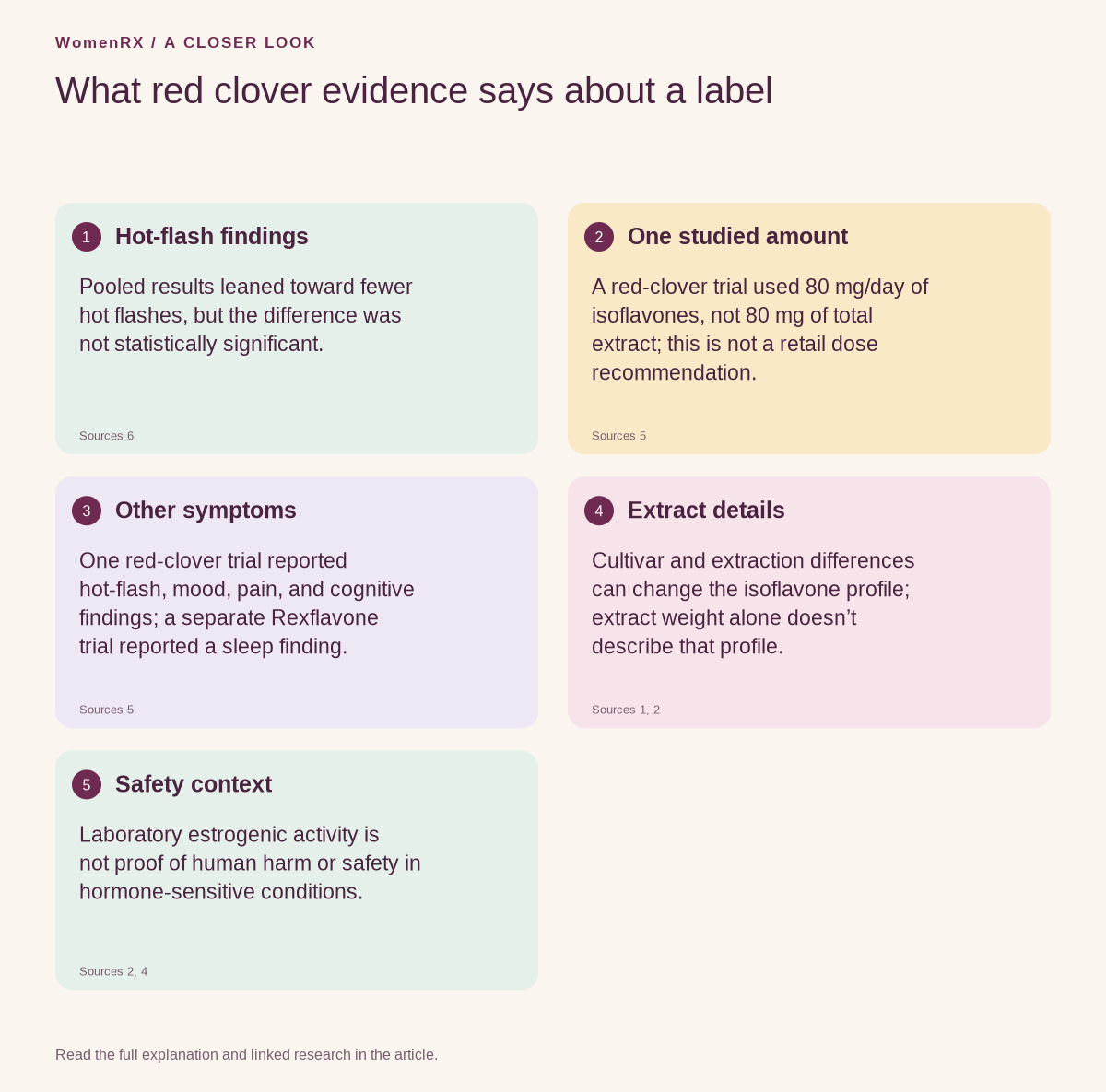
What red clover evidence says about a label
Hot-flash findings: Pooled results leaned toward fewer hot flashes, but the difference was not statistically significant.6
One studied amount: A red-clover trial used 80 mg/day of isoflavones, not 80 mg of total extract; this is not a retail dose recommendation.5
Other symptoms: One red-clover trial reported hot-flash, mood, pain, and cognitive findings; a separate Rexflavone trial reported a sleep finding.5
Extract details: Cultivar and extraction differences can change the isoflavone profile; extract weight alone doesn’t describe that profile.12
Safety context: Laboratory estrogenic activity is not proof of human harm or safety in hormone-sensitive conditions.24
Read the figure as text
Separate the symptom findings and studied amount from the product details a label may or may not provide.- Hot-flash findings: Pooled results leaned toward fewer hot flashes, but the difference was not statistically significant.6
- One studied amount: A red-clover trial used 80 mg/day of isoflavones, not 80 mg of total extract; this is not a retail dose recommendation.5
- Other symptoms: One red-clover trial reported hot-flash, mood, pain, and cognitive findings; a separate Rexflavone trial reported a sleep finding.5
- Extract details: Cultivar and extraction differences can change the isoflavone profile; extract weight alone doesn’t describe that profile.12
- Safety context: Laboratory estrogenic activity is not proof of human harm or safety in hormone-sensitive conditions.24
More questions, answered
Does red clover work like menopause hormone therapy?
No. Red clover is an isoflavone-containing supplement, not an established substitute for hormone therapy. The menopause-symptom evidence is inconsistent, while the North American Menopause Society identifies hormone therapy as the most effective treatment for vasomotor symptoms for appropriate candidates. 34
Sources you can check
- Red Clover Isoflavones as Effective Longevity Agents for Anti-Aging and Regenerative Skin Applications.Gościniak A, Bogusławska K, Szymańska M, Kaproń-Plech B, Trzaskoma P, Szulc P, Cielecka-Piontek J. · Plants (Basel, Switzerland) · 2026Return to first citation
- Auto-hydrolysis of red clover as "green" approach to (iso)flavonoid enriched products.Malca-Garcia GR, Liu Y, Dong H, Nikolić D, Friesen JB, Lankin DC, McAlpine J, Chen SN, Dietz BM, Pauli GF. · Fitoterapia · 2021Return to first citation
- The 2022 hormone therapy position statement of The North American Menopause Society.“The 2022 Hormone Therapy Position Statement of The North American Menopause Society” Advisory Panel. · Menopause (New York, N.Y.) · 2022Return to first citation
- The 2023 nonhormone therapy position statement of The North American Menopause Society.Menopause (New York, N.Y.) · 2023Return to first citation
- Effects of isoflavones and amino acid therapies for hot flashes and co-occurring symptoms during the menopausal transition and early postmenopause: a systematic review.Thomas AJ, Ismail R, Taylor-Swanson L, Cray L, Schnall JG, Mitchell ES, Woods NF. · Maturitas · 2014Return to first citation
- Effects of red clover on hot flash and circulating hormone concentrations in menopausal women: a systematic review and meta-analysis.Ghazanfarpour M, Sadeghi R, Latifnejad Roudsari R, Mirzaii Najmabadi K, Mousavi Bazaz M, Abdolahian S, Khadivzadeh T. · Avicenna journal of phytomedicine · 2015Return to first citation