Red Clover After 40: What Menopause Studies Show
Red clover has been studied for menopausal symptoms, but the results don’t establish a reliable benefit just because you’re over 40.
Red clover is not a well-supported go-to treatment for menopause symptoms. Some small studies of particular red clover preparations reported improvements, while another clinical trial review found no benefit for vasomotor symptoms. 346 The North American Menopause Society does not recommend supplements or herbal remedies for hot flashes. 2 Being over 40, on its own, doesn’t tell you whether red clover will help.
Red clover can sound like a reasonable option if hot flashes or other menopause symptoms are affecting your day. But the research doesn’t show that it reliably helps, and “over 40” is not a menopause diagnosis or a predictor of response. The useful question is narrower: which symptom are you hoping to change, and what evidence exists for the specific red clover product?
What the studies actually measured
Researchers have tested different forms of red clover in women experiencing menopause. The outcomes have included hot flashes and other symptoms collected into menopause rating scales. Those measures can show whether symptoms changed during a study; they do not establish that a supplement prevents long-term health problems.
In one 12-week randomized, placebo-controlled trial, 72 healthy postmenopausal women received either dried red clover leaves or placebo. The red clover group’s total Menopause Rating Scale score fell from 20.41 to 10.08; the placebo group’s score fell from 20.77 to 17.20. The study reported a greater improvement in the red clover group, particularly in vegetative-somatic and psychological symptom categories. That is a result from one small, short study, not proof that red clover will relieve a particular symptom for you. 3
Other findings are mixed. A systematic review of trials of isoflavones during the menopausal transition and early postmenopause reported benefits in some studies, including a red clover preparation that reduced several symptoms. The reviewers also said the findings needed replication in larger studies with better attention to outcome measurement. 6 Separately, a review discussing a randomized trial reported that red clover did not show benefit for menopause-related vasomotor symptoms in that trial. 4
Taken together, a positive result in one study doesn’t cancel out inconsistent results elsewhere. The North American Menopause Society’s 2023 evidence statement does not recommend supplements or herbal remedies for treating vasomotor symptoms such as hot flashes. 2
A red clover label isn’t the same as a studied product
The trials did not all test the same thing. One tested dried red clover leaves; other research discussed isoflavone preparations. A small pilot trial tested a combination supplement containing isoflavones from both kudzu and red clover, along with other ingredients. Its reported symptom changes can’t show that red clover alone caused them. 356
That matters when you’re comparing study headlines with a bottle in a store. A result for one preparation does not establish that another product, with a different mix or form, will have the same effect. The studies also don’t establish a reliable result for every symptom, stage of menopause, or individual.
Does being over 40 change the answer?
No. The research concerns women experiencing menopausal symptoms, including postmenopausal women and women in the transition to menopause. It doesn’t support using age over 40 alone to identify someone who needs red clover or is likely to benefit. If you’re having symptoms, their pattern and impact are more relevant than your age by itself.
These studies assessed symptom scores and symptoms, not long-term outcomes such as preventing bone loss or heart disease. 36 The 12-week trial described above does not establish longer-term safety or benefit. That’s a reason not to treat a short-term symptom study as proof of long-term protection, not proof that no longer-term research exists. 3
How to weigh it against other options
If hot flashes are the concern, red clover is not among the options the 2023 North American Menopause Society statement recommends. It identifies cognitive behavioral therapy and clinical hypnosis, as well as certain prescription treatments, as evidence-supported nonhormonal options. Hormone therapy remains the most effective treatment for vasomotor symptoms, though whether it fits depends on an individual’s situation and preferences. 12
So red clover may be a subject to discuss, but current evidence doesn’t make it a dependable choice or a substitute for treatments with stronger support. Be wary of claims that it works for everyone over 40, treats every menopause symptom, or prevents future disease: the studies summarized here don’t establish those outcomes.
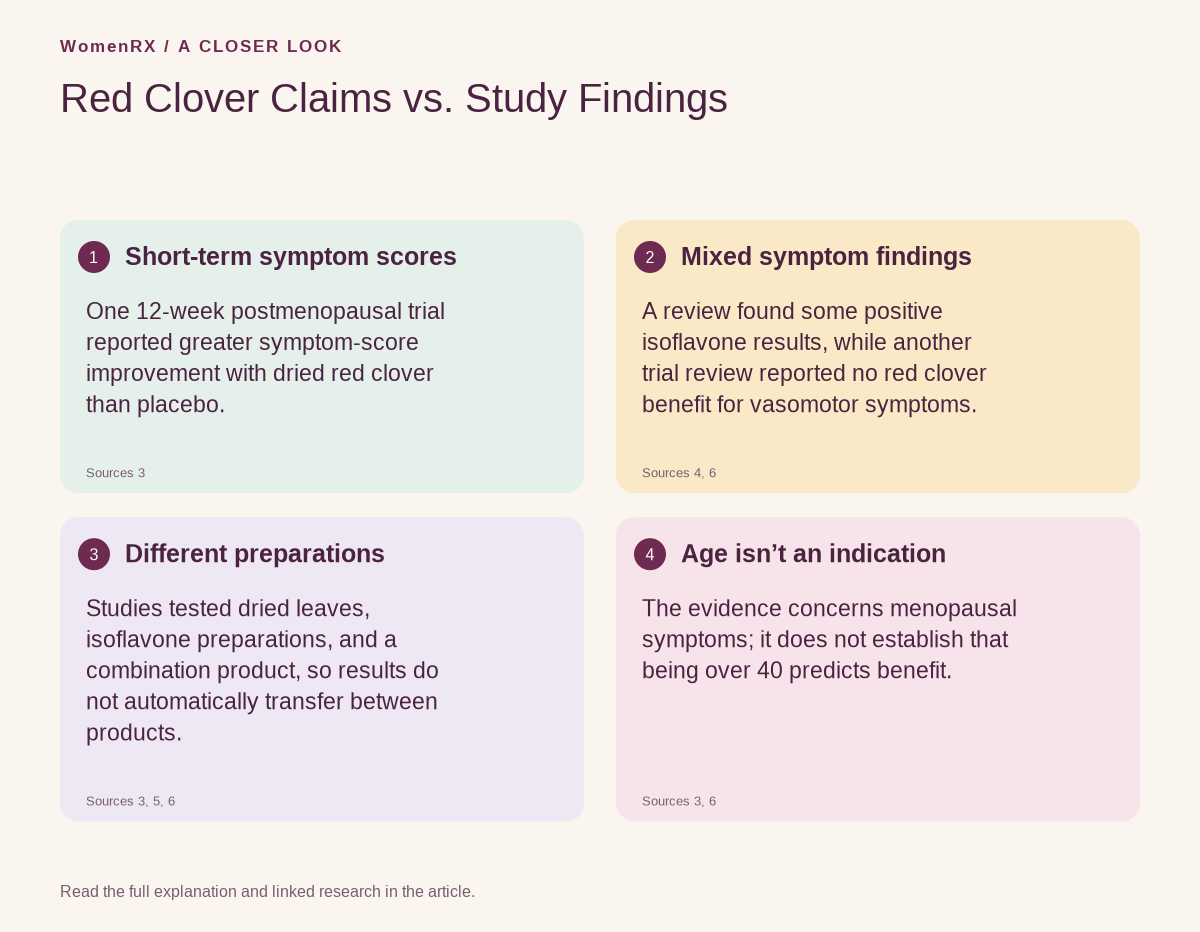
Red Clover Claims vs. Study Findings
Short-term symptom scores: One 12-week postmenopausal trial reported greater symptom-score improvement with dried red clover than placebo.3
Mixed symptom findings: A review found some positive isoflavone results, while another trial review reported no red clover benefit for vasomotor symptoms.46
Different preparations: Studies tested dried leaves, isoflavone preparations, and a combination product, so results do not automatically transfer between products.356
Age isn’t an indication: The evidence concerns menopausal symptoms; it does not establish that being over 40 predicts benefit.36
Read the figure as text
The research measures symptom changes with particular preparations; it does not show that age alone predicts benefit or establish long-term protection.- Short-term symptom scores: One 12-week postmenopausal trial reported greater symptom-score improvement with dried red clover than placebo.3
- Mixed symptom findings: A review found some positive isoflavone results, while another trial review reported no red clover benefit for vasomotor symptoms.46
- Different preparations: Studies tested dried leaves, isoflavone preparations, and a combination product, so results do not automatically transfer between products.356
- Age isn’t an indication: The evidence concerns menopausal symptoms; it does not establish that being over 40 predicts benefit.36
More questions, answered
Can I assume a red clover supplement matches the trial product?
No. Studies have tested different forms, including dried leaves, isoflavone preparations, and a combination product containing kudzu and red clover. Results for one preparation can’t establish that a different product will have the same effect. 356
Sources you can check
- The 2022 hormone therapy position statement of The North American Menopause Society.“The 2022 Hormone Therapy Position Statement of The North American Menopause Society” Advisory Panel. · Menopause (New York, N.Y.) · 2022Return to first citation
- The 2023 nonhormone therapy position statement of The North American Menopause Society.Menopause (New York, N.Y.) · 2023Return to first citation
- Effectiveness of red clover in alleviating menopausal symptoms: a 12-week randomized, controlled trial.Shakeri F, Taavoni S, Goushegir A, Haghani H. · Climacteric : the journal of the International Menopause Society · 2015Return to first citation
- Discussion of a well-designed clinical trial which did not demonstrate effectiveness: UIC center for botanical dietary supplements research study of black cohosh and red clover.Shulman LP, Banuvar S, Fong HH, Farnsworth NR. · Fitoterapia · 2011Return to first citation
- Clinical effects of a proprietary combination isoflavone nutritional supplement in menopausal women: a pilot trial.Lukaczer D, Darland G, Tripp M, Liska D, Lerman RH, Schiltz B, Bland JS. · Alternative therapies in health and medicine · 2005Return to first citation
- Effects of isoflavones and amino acid therapies for hot flashes and co-occurring symptoms during the menopausal transition and early postmenopause: a systematic review.Thomas AJ, Ismail R, Taylor-Swanson L, Cray L, Schnall JG, Mitchell ES, Woods NF. · Maturitas · 2014Return to first citation