Red Clover and Weight: What Human Studies Actually Show
Red clover has been studied for menopause-related concerns, but reported human findings don’t establish that it changes weight or body composition.
Human red-clover trials reporting menopause symptoms, cholesterol-related measures, or bladder symptoms don’t establish a change in body weight or composition. Findings on those outcomes can’t establish a weight effect. A separate trial tested a blend containing red clover, but its BMI analysis concerned correlations with urinary biomarkers, not whether the blend changed weight. 2 3 4
If you’re considering red clover because menopause supplements sometimes promise weight changes, the most useful question is what the human studies actually measured. The human trials reporting menopause, lipid, or bladder outcomes don’t report weight loss or changes in body composition as outcomes. That means they don’t show that red clover helps you lose fat, gain weight, or preserve muscle.
Menopause research isn’t weight research
A 2024 randomized trial enrolled 75 postmenopausal women with dyslipidemia and compared red clover isoflavones with placebo over six months. The reported outcomes were menopause symptom scores and blood lipid measurements. The study abstract reports improvement in some of those measures, but no weight or body-composition result. It therefore can’t tell you whether red clover changed participants’ weight. 2
Another randomized trial studied fermented red clover isoflavones in 33 postmenopausal women over three months. It focused on overactive-bladder symptoms and related measures, not reported weight change. A finding about bladder symptoms, whether favorable or not, isn’t evidence of a weight effect. 3
These studies involved postmenopausal women, but that doesn’t make them weight studies. Menopause symptoms, blood lipids, bladder symptoms, body weight, and body composition are different outcomes. Evidence about one can’t stand in for evidence about another.
What the BMI finding does, and doesn’t, mean
A randomized crossover study in postmenopausal women tested a mixture containing red clover along with pomegranate and Polygonum cuspidatum. It reported changes in urinary biomarkers. The researchers also examined whether changes in those biomarkers were correlated with BMI, but that is not the same as measuring whether the mixture changed BMI or body weight. And because the product contained multiple ingredients, any effect of the mixture couldn’t be attributed to red clover alone. 4
This distinction matters when a study mentions weight-related terms without testing weight change as a treatment outcome. A correlation involving BMI doesn’t show that taking an ingredient caused someone to lose or gain weight.
A lab mechanism can’t settle the question
Red clover extracts have been tested for effects such as lipase inhibition in laboratory assays. That kind of experiment can explore a possible biological mechanism; it doesn’t demonstrate that a red clover supplement changes body fat or weight in people. Human outcomes need to be measured in human studies. 5
It’s also worth separating weight from body composition. Body weight includes muscle, bone, fat, and water, so a scale reading alone doesn’t show which component changed. 1 A study that intends to support a body-composition claim would need to assess the relevant measures, not just discuss hormones or metabolism.
The practical takeaway
Based on these human findings, red clover isn’t established as a weight-loss or weight-gain supplement. The menopause and laboratory findings don’t establish a red-clover effect on body weight or body composition. That’s different from proving that no such study exists or that no effect is possible; it means the menopause and laboratory findings above don’t provide the direct evidence needed to claim one.
When you see a weight claim, check whether a human study actually compared weight or body-composition outcomes between people taking red clover and a suitable comparison group. If the study instead reports hot flashes, cholesterol, bladder symptoms, BMI correlations with another measurement, or a laboratory mechanism, it hasn’t answered the weight question.
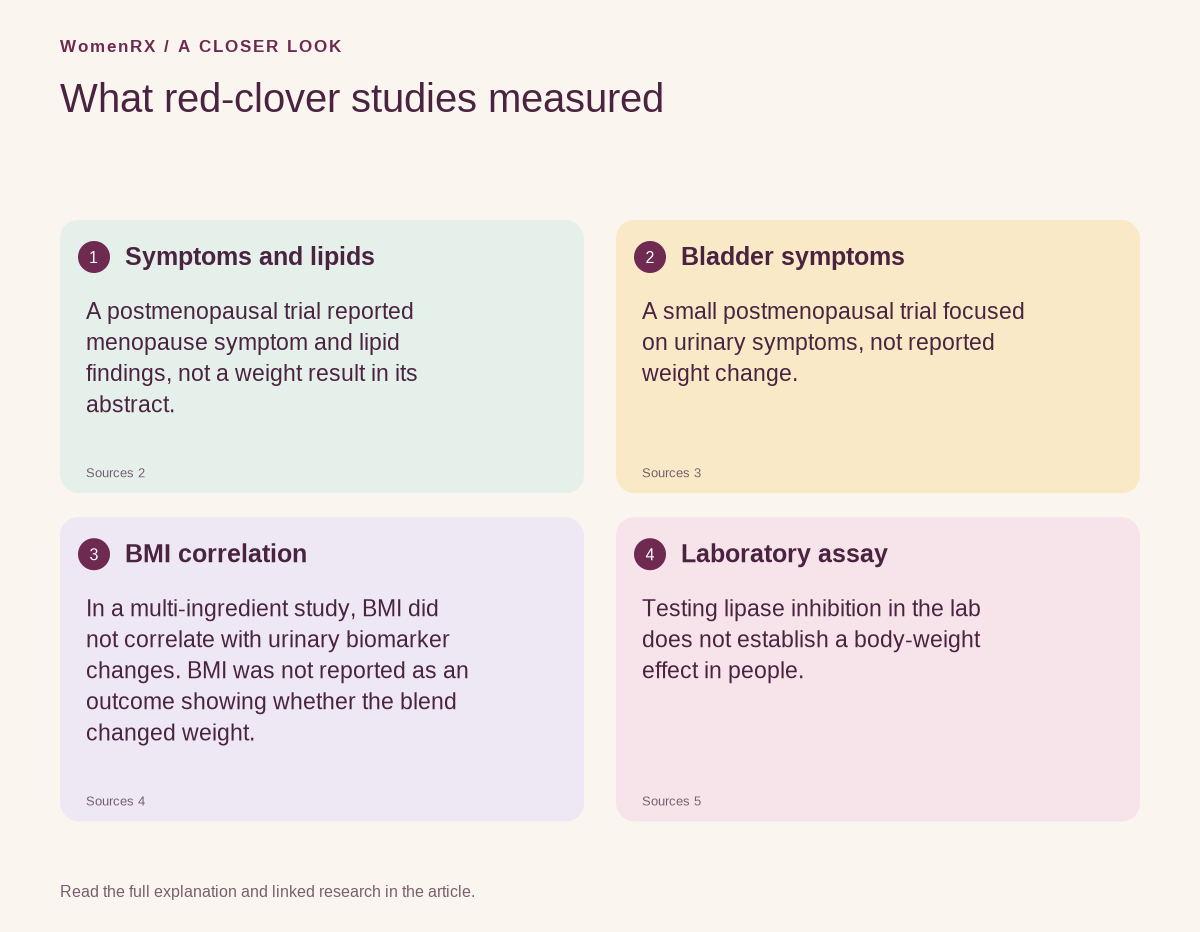
What red-clover studies measured
Symptoms and lipids: A postmenopausal trial reported menopause symptom and lipid findings, not a weight result in its abstract.2
Bladder symptoms: A small postmenopausal trial focused on urinary symptoms, not reported weight change.3
BMI correlation: In a multi-ingredient study, BMI did not correlate with urinary biomarker changes. BMI was not reported as an outcome showing whether the blend changed weight.4
Laboratory assay: Testing lipase inhibition in the lab does not establish a body-weight effect in people.5
Read the figure as text
Separate direct weight outcomes from other menopause-trial endpoints, biomarker comparisons, and laboratory mechanisms.- Symptoms and lipids: A postmenopausal trial reported menopause symptom and lipid findings, not a weight result in its abstract.2
- Bladder symptoms: A small postmenopausal trial focused on urinary symptoms, not reported weight change.3
- BMI correlation: In a multi-ingredient study, BMI did not correlate with urinary biomarker changes. BMI was not reported as an outcome showing whether the blend changed weight.4
- Laboratory assay: Testing lipase inhibition in the lab does not establish a body-weight effect in people.5
More questions, answered
Does a study mentioning BMI show that red clover changed weight?
No. In the crossover study, BMI was examined for correlations with changes in urinary biomarkers. That does not show that the intervention changed weight, and the intervention included several ingredients, not red clover alone. 4
Sources you can check
- Body Weight: MedlinePlusAccessed 2026-09-25Return to first citation
- Isoflavones obtained from red clover improve both dyslipidemia and menopausal symptoms in menopausal women: a prospective randomized placebo-controlled trial.Yigit E, Unsal S. · Climacteric : the journal of the International Menopause Society · 2024Return to first citation
- Use of Fermented Red Clover Isoflavones in the Treatment of Overactive Bladder in Postmenopausal Women: A Randomized, Double-Blinded, Placebo-Controlled Trial.Villadsen AB, Holm-Jacobsen JN, Prabhala BK, Bundgaard-Nielsen C, Huntjens P, Kornum JB, Glavind K, Leutscher PDC, Christensen LP, Jeppesen PB, Sørensen S, Arenholt LTS. · Nutrients · 2023Return to first citation
- Precision health targeting TMAO in postmenopausal women: polyphenol effects modulated by urolithin A and equol metabotypes in a randomised, placebo-controlled crossover trial.Jarrín-Orozco MP, García-Nicolás M, Romo-Vaquero M, Carrascosa C, Berná J, Puigcerver J, Saura-Sanmartín A, Ávila-Gálvez MÁ, Espín JC. · Food & function · 2026Return to first citation
- Multidirectional Effects of Red Clover (Trifolium pratense L.) in Support of Menopause Therapy.Gościniak A, Szulc P, Zielewicz W, Walkowiak J, Cielecka-Piontek J. · Molecules (Basel, Switzerland) · 2023Return to first citation