Red Clover Supplements: Read the Label, Weigh the Evidence
Red clover extract weight and isoflavone content aren’t interchangeable, and neither tells you whether a product will help with menopause symptoms.
When comparing red clover supplements, look for the extract amount per serving, the total isoflavones per serving, and any named isoflavones such as formononetin or biochanin A. Those figures describe different things, and products or study preparations may vary. No universal dose is established; a review focused on women with or at risk of breast cancer doesn’t establish reliable menopause relief for women generally. 1 2
Red clover is sold for menopause-related concerns, but a supplement label can’t tell you on its own whether it’s a good fit. The useful first step is to separate what the product contains from what research has actually shown.
Read the extract and isoflavone amounts separately
Check how much red clover extract is listed per serving, then look for a separate amount for total isoflavones. If the label lists individual compounds, note those too. Red clover contains isoflavones including formononetin, biochanin A, daidzein, and genistein. A 2013 systematic review described commercial extracts with differing amounts and proportions of these compounds, illustrating why the weight of an extract alone doesn’t tell you its isoflavone content. 1
Also check how many capsules or tablets make up a serving. A number on the front of a bottle may refer to extract, not to total isoflavones per serving. If the label doesn’t make the distinction clear, you can ask a pharmacist or the manufacturer to clarify what the stated amount represents. Don’t assume a product with more extract has more of a particular isoflavone, or that two products with the same extract weight are equivalent.
Research preparations aren’t automatically interchangeable with products on a store shelf, either. A review of plant-derived isoflavones describes variation in sources, active ingredients, doses, and study protocols, alongside limited safety information. 2 A label that names an amount is useful for comparison; it doesn’t establish that the product matches a studied preparation or will have the same effect.
Match the evidence to your reason for considering it
For menopause symptoms, red clover is often marketed as an option, but marketing isn’t proof of relief. A 2013 systematic review focused on women with or at risk of breast cancer described the red clover evidence as limited; that review doesn’t establish a reliable benefit for menopause symptoms in women generally. 1 The evidence it reviewed is also older, so it shouldn’t be treated as a current product-by-product assessment.
Before buying, write down the goal you have in mind, such as easing hot flashes, and ask whether evidence relates to that goal, to red clover specifically, and to a comparable preparation. Don’t use an extract amount or total-isoflavone number as a target dose: the research summarized here doesn’t establish a universal red clover dose for women.
Put personal circumstances into the decision
Human safety evidence for red clover is limited; the 2013 review concluded that better evidence was needed before high-dose isoflavones could be recommended for people with breast cancer. 1 That finding doesn’t show that a particular product will cause harm, but it does leave important questions open.
If you’re pregnant or breastfeeding, have a hormone-sensitive condition, or take medicines, a clinician or pharmacist can help you assess the exact product in light of your circumstances. Treat this as a precautionary, individualized check, not evidence that red clover has a proven risk or interaction in each situation. Don’t treat evidence about soy as proof that red clover has the same effects: the review assessed the two separately and found much less red clover evidence. 1
A practical comparison is three questions: What amount is extract, and what amount is isoflavones? Is the product’s stated content clear enough to compare? Does the evidence address your intended use and your personal circumstances? If those answers are unclear, the label alone can’t settle the decision.
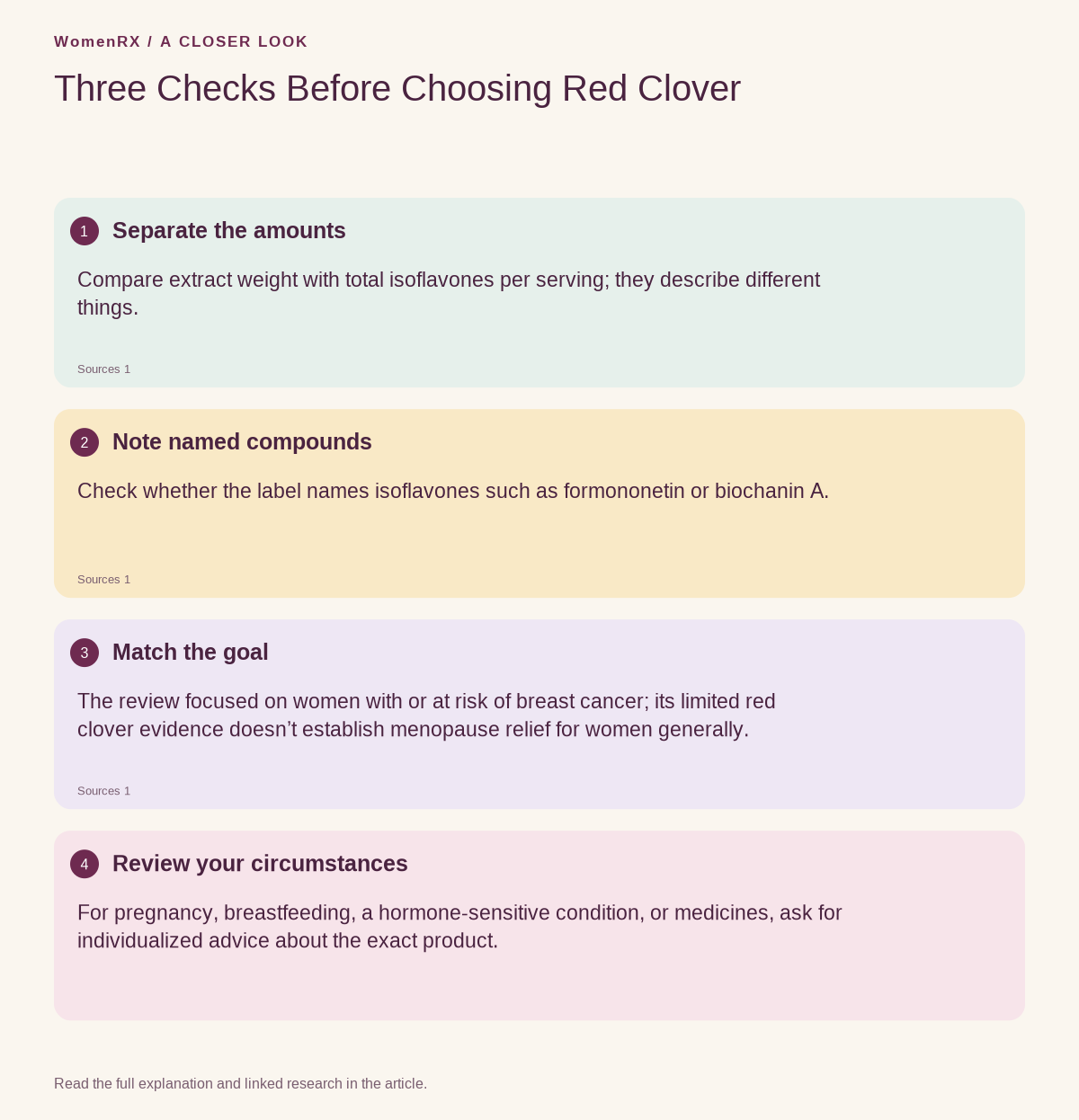
Three Checks Before Choosing Red Clover
Separate the amounts: Compare extract weight with total isoflavones per serving; they describe different things.1
Note named compounds: Check whether the label names isoflavones such as formononetin or biochanin A.1
Match the goal: The review focused on women with or at risk of breast cancer; its limited red clover evidence doesn’t establish menopause relief for women generally.1
Review your circumstances: For pregnancy, breastfeeding, a hormone-sensitive condition, or medicines, ask for individualized advice about the exact product.
Read the figure as text
Separate what the label says from what the evidence and your circumstances can support.- Separate the amounts: Compare extract weight with total isoflavones per serving; they describe different things.1
- Note named compounds: Check whether the label names isoflavones such as formononetin or biochanin A.1
- Match the goal: The review focused on women with or at risk of breast cancer; its limited red clover evidence doesn’t establish menopause relief for women generally.1
- Review your circumstances: For pregnancy, breastfeeding, a hormone-sensitive condition, or medicines, ask for individualized advice about the exact product.
More questions, answered
Is there a standard red clover dose for menopause?
The evidence cited here doesn’t establish a universal dose. Extract weight and isoflavone content can differ, so don’t treat a number on one product label as a general target. 1 2
Does a higher isoflavone amount mean a product works better?
Not necessarily. An amount describes product content, not clinical effectiveness. Research preparations and products can differ in their ingredients and regimens, and the evidence doesn’t show that a higher label amount means greater menopause relief. 1 2
Sources you can check
- Soy, red clover, and isoflavones and breast cancer: a systematic review.Fritz H, Seely D, Flower G, Skidmore B, Fernandes R, Vadeboncoeur S, Kennedy D, Cooley K, Wong R, Sagar S, Sabri E, Fergusson D. · PloS one · 2013Return to first citation
- Isoflavones derived from plant raw materials: bioavailability, anti-cancer, anti-aging potentials, and microbiome modulation.Aboushanab SA, Khedr SM, Gette IF, Danilova IG, Kolberg NA, Ravishankar GA, Ambati RR, Kovaleva EG. · Critical reviews in food science and nutrition · 2023Return to first citation