When to Take Red Clover: Follow the Label, Not the Clock
A red clover study tested once-daily use, not morning against night, so your product’s directions and medicine list are the more useful checks.
A small study of red clover isoflavones examined once-daily use but didn’t compare morning with night, so it can’t tell you which time is preferable. 4 Check your bottle’s directions rather than adopting the study’s schedule. Before settling into a routine, compare its ingredients with your other supplements and review the product alongside your medicines. Herbal products can interact with medicines. 2
The clock matters less than the directions
Red clover supplements contain isoflavones. In a small pharmacokinetic study, 14 people took about 80 mg of red clover isoflavones once daily for two weeks. The researchers concluded that the compounds’ levels in blood were consistent with once-daily use. They did not compare morning with evening, or test whether food changes the effect. The study therefore can’t tell you which time of day is preferable. 4
That study also wasn’t a guide to every red clover product. If your bottle gives instructions about timing, food, or how often to take it, use those directions rather than borrowing a schedule from another product or study. If it doesn’t specify a time, choosing a time you can remember is a practical way to keep to the label. A regular routine is a convenience, not proof that the supplement works better at that hour.
Make a quick label-and-medicine check
Before adding red clover to your routine, look at the serving directions and the full ingredient list. Compare that list with your other supplements so you know what you’re taking together. MedlinePlus notes that herbal products can interact with prescription and over-the-counter medicines, and recommends telling your healthcare provider about herbal medicines you take. 2
Make the medicine review specific. Include prescriptions, nonprescription medicines, and other supplements, and mention menopause treatments and other hormone-related medicines. Red clover isoflavones include compounds described as estrogenic or proestrogenic, but that fact alone doesn’t establish that a particular product interacts with a particular hormone treatment. 5 A small study in 15 peri- and postmenopausal women found no meaningful change in the blood levels of four test medicines after two weeks of one standardized red clover supplement. It did not test all medicines, other red clover products, or menopause hormone treatments, so it can’t rule out interactions with those. 5
Have the exact product and medication list checked rather than assuming there’s an interaction or that changing the time of day would prevent one.
Pregnancy and breastfeeding call for a different check
Timing isn’t a workaround for uncertainty about use during pregnancy. MedlinePlus advises checking with a healthcare provider before taking herbs or supplements while pregnant. 3 For breastfeeding, MedlinePlus notes that some medicines can pass into breast milk and recommends checking with a provider if you have concerns about breastfeeding and medicines; herbal products can also interact with medicines. Discuss the specific red clover product with your provider rather than relying on a morning-or-night schedule. 12
A useful way to decide
Read the label first, then compare its directions with the routine you’re considering. Next, check the entire ingredient list against your other supplements. Finally, review the exact product alongside your medicines, including menopause treatments and hormone-related medicines.
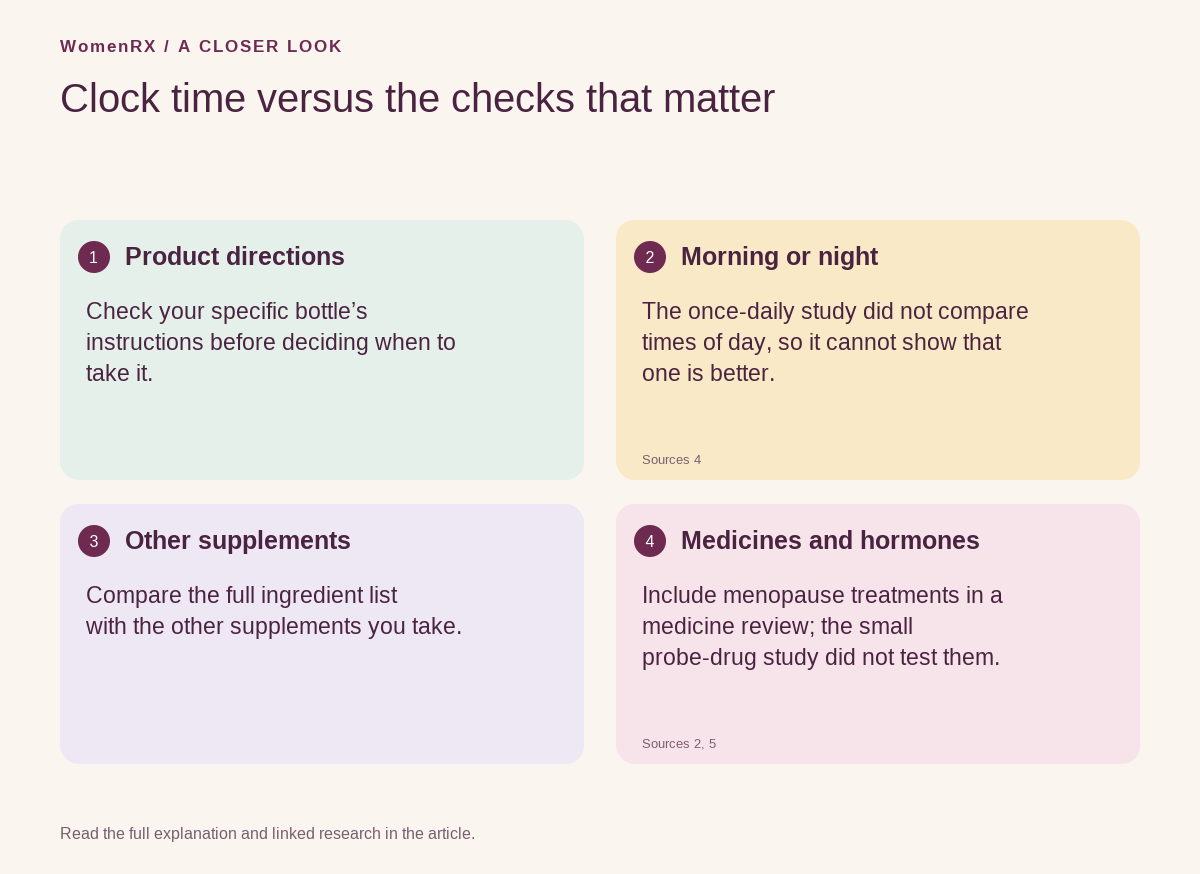
Clock time versus the checks that matter
Product directions: Check your specific bottle’s instructions before deciding when to take it.
Morning or night: The once-daily study did not compare times of day, so it cannot show that one is better.4
Other supplements: Compare the full ingredient list with the other supplements you take.
Medicines and hormones: Include menopause treatments in a medicine review; the small probe-drug study did not test them.25
Read the figure as text
The once-daily study did not compare morning with night. These comparisons separate product directions and medicine review from assumptions about the clock.- Product directions: Check your specific bottle’s instructions before deciding when to take it.
- Morning or night: The once-daily study did not compare times of day, so it cannot show that one is better.4
- Other supplements: Compare the full ingredient list with the other supplements you take.
- Medicines and hormones: Include menopause treatments in a medicine review; the small probe-drug study did not test them.25
More questions, answered
Does taking red clover at night avoid medicine interactions?
Changing the time of day doesn’t establish whether red clover fits with a medicine. A small study tested one standardized red clover product with four medicines used as test drugs, but it didn’t assess every medicine or menopause hormone treatments. 5
Sources you can check
- Breastfeeding | Benefits of Breastfeeding | MedlinePlusAccessed 2026-09-25Return to first citation
- Herbal Medicine: MedlinePlusAccessed 2026-09-25Return to first citation
- Pregnancy and Medicines | MedlinePlusAccessed 2026-09-25Return to first citation
- Long-term pharmacokinetics of an extract of isoflavones from red clover (Trifolium pratense).Howes J, Waring M, Huang L, Howes LG. · Journal of alternative and complementary medicine (New York, N.Y.) · 2002Return to first citation
- No Clinically Relevant Pharmacokinetic Interactions of a Red Clover Dietary Supplement with Cytochrome P450 Enzymes in Women.Chen L, Choi J, Leonard SW, Banuvar S, Barengolts E, Viana M, Chen SN, Pauli GF, Bolton JL, van Breemen RB. · Journal of agricultural and food chemistry · 2020Return to first citation