Which Supplements Help With Perimenopause Symptoms?
For hot flashes, supplement evidence is mixed, and the ingredient that looks promising on a label may bring safety questions of its own.
If hot flashes are your main concern, no herbal supplement has strong enough evidence to be routinely recommended as a treatment. Soy isoflavones may offer a small benefit, but results are inconsistent; red clover and black cohosh are less convincing. St. John’s wort has an especially long list of medicine interactions. Match the ingredient to your symptom, then check its safety before buying. 378910
Start with the symptom, not the “menopause blend”
A supplement marketed for perimenopause might promise help with hot flashes, sleep and mood in one bottle. Those are different questions. The strongest guidance here addresses vasomotor symptoms, meaning hot flashes and night sweats. In its 2023 review, The Menopause Society did not recommend supplements or herbal remedies for these symptoms; it also did not recommend soy foods, soy extracts or equol as treatments. That’s a judgment about whether the evidence supports recommending them, not a claim that no one ever notices a difference. 3
Some research reviews sound more positive. A 2024 meta-analysis pooled trials of many different plant-derived products and found improvements over placebo in hot-flash frequency and symptom questionnaires. But the participants included both peri- and postmenopausal women, and the products and study quality varied. The pooled result cannot tell you that a particular bottle will help you during perimenopause. 6
How the commonly sold ingredients compare
Soy isoflavones: These are often sold for hot flashes. The National Center for Complementary and Integrative Health (NCCIH) says soy isoflavone supplements or soy protein may reduce hot-flash frequency and severity, but any effect may be small and findings are inconsistent. That more tentative finding can coexist with The Menopause Society’s decision not to recommend soy as a hot-flash treatment. Soy food, soy protein and concentrated isoflavone extract are not interchangeable products. 83
Red clover: It also contains isoflavones. Studies of red clover for menopausal hot flashes have produced inconsistent results, and some had a high risk of bias. Its estrogen-like chemical structure does not establish that it will “balance hormones” or reliably relieve symptoms. 9
Black cohosh: It has been studied extensively for menopause symptoms, yet the evidence has not made herbal supplements a recommended hot-flash treatment. A review of non-soy herbal trials found that the interventions, doses, study lengths and ways of measuring symptoms differed too much for a confident overall conclusion. Don’t treat a claim about one black cohosh product as proof for every extract or blend. 734
St. John’s wort: Its better-known research concerns mild or moderate depression. NCCIH says evidence is insufficient for definite conclusions about its usefulness for other conditions, including menopause symptoms. It is a particularly poor ingredient to choose casually for a broad “mood and menopause” promise because it interacts with many medicines. 10
Does the evidence actually include perimenopause?
Often, only partly. Reviews of herbal supplements have included women in perimenopause and postmenopause together, so an overall improvement does not necessarily show a separate benefit for women who are still having periods. 46
One placebo-controlled trial did focus on perimenopause: 106 women aged up to 50 with mild to moderate symptoms were enrolled to test a combination of a succinate-based supplement and a vitamin B complex. The researchers reported improvements on several symptom scales. Because the products were given together, the trial cannot show whether either component works alone, or whether another product with similar-sounding ingredients would perform the same way. Its abstract does not provide a practical basis for recommending an ingredient or dose. 5
That distinction matters if you’re comparing a studied product with what’s on a store shelf. Check the exact ingredients rather than assuming that “contains soy” or “contains black cohosh” means a product matches a trial. In a content analysis of menopause supplement promotions on Instagram, nearly half of the 20 most frequently advertised products contained proprietary blends, which limited ingredient transparency. That finding describes advertised products, not every supplement for sale, but it gives you a useful reason to pass on a label that hides what’s in the blend. 1
Make the safety check ingredient-specific
A label can look gentle and still deserve a closer look alongside your medicines or health history:
- Black cohosh: Rare cases of sometimes serious liver damage have been reported in people taking products labeled as black cohosh, although it’s uncertain whether the herb caused them. Its safety after a hormone-sensitive condition, such as breast or uterine cancer, is also uncertain. If you’re taking it and develop dark urine and fatigue, seek medical advice rather than waiting to finish the bottle. Some products labeled black cohosh have contained the wrong herb or unlisted herbs. 7
- Soy: Check for a soy allergy. If you take a monoamine oxidase inhibitor (MAOI), ask specifically about soy foods high in tyramine, such as tofu or soy sauce: interactions causing dangerously high blood pressure have been reported. That warning concerns certain foods and should not be casually transferred to every isoflavone capsule. 8
- Red clover: Its hot-flash benefit remains uncertain, and NCCIH says supplements may be unsafe during pregnancy or breastfeeding. That matters during perimenopause if pregnancy is still possible. 9
- St. John’s wort: It can weaken the effects of birth control pills, warfarin and certain medicines for seizures, heart conditions, cancer and other serious conditions. Combining it with certain antidepressants or other medicines that affect serotonin may cause serious serotonin-related side effects. If you take prescription medicine, this is an ingredient to review with a pharmacist or prescriber before trying it. 10
If a product combines herbs, check every ingredient against your medication list. A promise to help several symptoms does not erase an interaction hidden lower down the label. 110
If hot flashes are disrupting your days or nights
You don’t have to settle for a supplement with uncertain benefit. Hormone therapy remains the most effective treatment for vasomotor symptoms, though whether it suits you depends on your health history and preferences. Evidence-supported nonhormone options include menopause-specific cognitive behavioral therapy, clinical hypnosis and several prescription treatments. The useful comparison is not simply “natural versus medical”; it’s what has been shown to help your particular symptom, and what is safe for you to use. 23
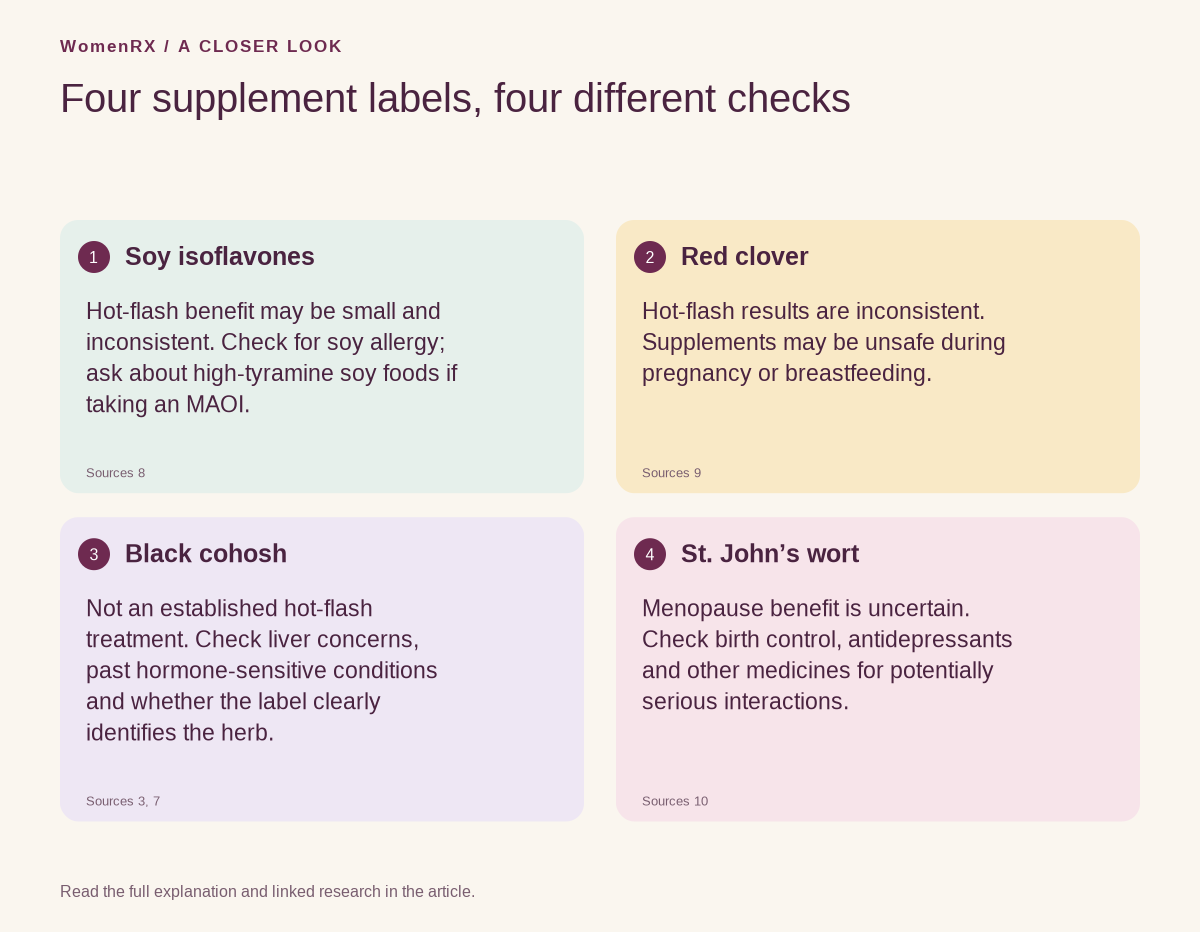
Four supplement labels, four different checks
Soy isoflavones: Hot-flash benefit may be small and inconsistent. Check for soy allergy; ask about high-tyramine soy foods if taking an MAOI.8
Red clover: Hot-flash results are inconsistent. Supplements may be unsafe during pregnancy or breastfeeding.9
Black cohosh: Not an established hot-flash treatment. Check liver concerns, past hormone-sensitive conditions and whether the label clearly identifies the herb.37
St. John’s wort: Menopause benefit is uncertain. Check birth control, antidepressants and other medicines for potentially serious interactions.10
Read the figure as text
Use the ingredient and the symptom being studied together; the safety question changes with the ingredient.- Soy isoflavones: Hot-flash benefit may be small and inconsistent. Check for soy allergy; ask about high-tyramine soy foods if taking an MAOI.8
- Red clover: Hot-flash results are inconsistent. Supplements may be unsafe during pregnancy or breastfeeding.9
- Black cohosh: Not an established hot-flash treatment. Check liver concerns, past hormone-sensitive conditions and whether the label clearly identifies the herb.37
- St. John’s wort: Menopause benefit is uncertain. Check birth control, antidepressants and other medicines for potentially serious interactions.10
Sources you can check
- Social Media and Supplements for Menopausal Symptoms: A Content Analysis.Eubanks AA, Shvartsman K. · BJOG : an international journal of obstetrics and gynaecology · 2026Return to first citation
- The 2022 hormone therapy position statement of The North American Menopause Society.“The 2022 Hormone Therapy Position Statement of The North American Menopause Society” Advisory Panel. · Menopause (New York, N.Y.) · 2022Return to first citation
- The 2023 nonhormone therapy position statement of The North American Menopause Society.Menopause (New York, N.Y.) · 2023Return to first citation
- The Effectiveness of Non-Soy Oral Herbal Supplements for Menopausal Symptoms: A Systematic Review.Jing G, Keane CM, Reynolds CM. · Nutrients · 2026Return to first citation
- Clinical Evaluation of Effectiveness and Safety of Combined Use of Dietary Supplements Amberen® and Smart B® in Women with Climacteric Syndrome in Perimenopause.Kachko VA, Shulman LP, Kuznetsova IV, Uspenskaya YB, Burchakov DI. · Advances in therapy · 2024Return to first citation
- Efficacy of plant-derived dietary supplements in improving overall menopausal symptoms in women: An updated systematic review and meta-analysis.Oh MR, Park JH, Park SK, Park SH. · Phytotherapy research : PTR · 2024Return to first citation
- Black Cohosh: Usefulness and Safety | NCCIHAccessed 2026-09-25Return to first citation
- Soy: Usefulness and Safety | NCCIHAccessed 2026-09-25Return to first citation
- Red Clover: Usefulness and Safety | NCCIHAccessed 2026-09-25Return to first citation
- St. Johnâs Wort: Usefulness and Safety | NCCIHAccessed 2026-09-25Return to first citation