What Menopause Supplement Blend Trials Actually Show
For hot flashes, an encouraging study result doesn’t necessarily support the ingredient, blend, or symptom named on a bottle.
If you’re considering a supplement for hot flashes or night sweats, start with the exact symptom and formula. A review found improvements across varied plant products, but the Menopause Society does not recommend supplements or herbal remedies as treatments for those symptoms. Check what was studied, whether it was compared with placebo or another treatment, and whether the full formula raises safety questions for you. 356
A bottle labeled “menopause support” might promise help with hot flashes, sleep, mood, and vaginal dryness all at once. Those aren’t interchangeable claims. Hot flashes and night sweats are called vasomotor symptoms, and most of the supplement research discussed below focuses on them. If vaginal dryness is your main concern, a hot-flash study won’t tell you whether a product will help.
Why a positive review isn’t a winning bottle
A 2024 systematic review pooled randomized, placebo-controlled studies of plant-derived supplements. It found improvements in symptom scores and hot-flash frequency compared with placebo. The participants were peri- or postmenopausal women, but the products ranged from soy-derived supplements to red clover and other plants. The authors described the research as varied and generally suboptimal, and called for more rigorous studies. A pooled result across different products can’t tell you what to expect from one formula on a shelf. 5
The Menopause Society’s 2023 position statement reached a different practical conclusion: it does not recommend supplements or herbal remedies for treating vasomotor symptoms. It also does not recommend soy foods or soy extracts for that purpose. That doesn’t mean every study found no change. It means the research isn’t strong or consistent enough to recommend these approaches as treatments for hot flashes and night sweats. 35
What changes when you look at the ingredient
Black cohosh: An NIH Office of Dietary Supplements fact sheet summarizes a meta-analysis that found no significant reduction in hot-flash frequency or improvement on self-reported menopause symptom scales with black cohosh. Preparations also differ in chemical composition, and the plant’s active ingredients remain unknown. A study of one preparation may not describe another bottle with “black cohosh” on its label. 1
Clinical trials of black cohosh preparations have reported a low incidence of adverse effects, most commonly temporary stomach upset and rash. That’s useful safety information, but it doesn’t establish the safety of every formula, particularly a blend with other ingredients. 1
Soy isoflavones and other plant products: Soy-derived supplements were well represented in the positive pooled review. Still, the 2023 Menopause Society statement does not recommend soy foods, soy extracts, or the soy metabolite equol for treating vasomotor symptoms. If a label says “clinically proven,” look for a study of the specific preparation and symptom rather than treating a finding about plant products as a whole as proof for that bottle. 35
A combination tested in perimenopause: One randomized, double-blind, placebo-controlled trial enrolled 106 women up to age 50 who were in perimenopause and had mild to moderate symptoms. It tested a succinate-based supplement together with a vitamin B complex and reported improvements on several symptom and wellbeing measures, with few reported adverse effects that were mild and temporary. The result can’t be assigned to vitamin B alone or extended to different blends. 4
Stage matters when you read these claims. That combination trial enrolled women in perimenopause, while the plant-product review included peri- and postmenopausal participants. Its pooled findings don’t establish whether a given supplement works differently before and after the final menstrual period. 45
Placebo is not the same comparison as treatment
A supplement can outperform placebo in a trial without being shown to work as well as other care. The 2023 Menopause Society statement recommends several nonhormonal options for vasomotor symptoms, including cognitive behavioral therapy, clinical hypnosis, and certain prescription treatments; it does not put supplements in that group. Hormone therapy remains the most effective treatment for vasomotor symptoms, though its benefits and risks depend on factors such as health history, age, and timing. 23
For example, if night sweats are repeatedly disrupting your sleep, the choice isn’t limited to buying a supplement or doing nothing. You can discuss treatments with stronger evidence for night sweats. If vaginal dryness is the bigger problem, ask about care directed at that symptom instead: menopause guidance describes over-the-counter approaches and, when those aren’t enough, vaginal treatment options for appropriate patients. 23
Read the whole label, not just the headline ingredient
Before choosing a product, identify every ingredient in the formula and the symptom the seller claims it helps. Then ask whether the research tested that same ingredient or combination, in people at a comparable menopause stage, against placebo or against another treatment. A trial of a blend cannot tell you which component produced a reported change; a placebo-controlled trial cannot establish equivalence to established care. 45
The full label matters for safety, too. Menopause guidance identifies potential medication interactions as a consideration when weighing nonhormonal options. If you take medicines, show a pharmacist or your clinician the exact supplement label rather than asking about its headline ingredient alone. Black cohosh trial reports of mostly mild side effects, for instance, cannot answer questions about every combination product. 16
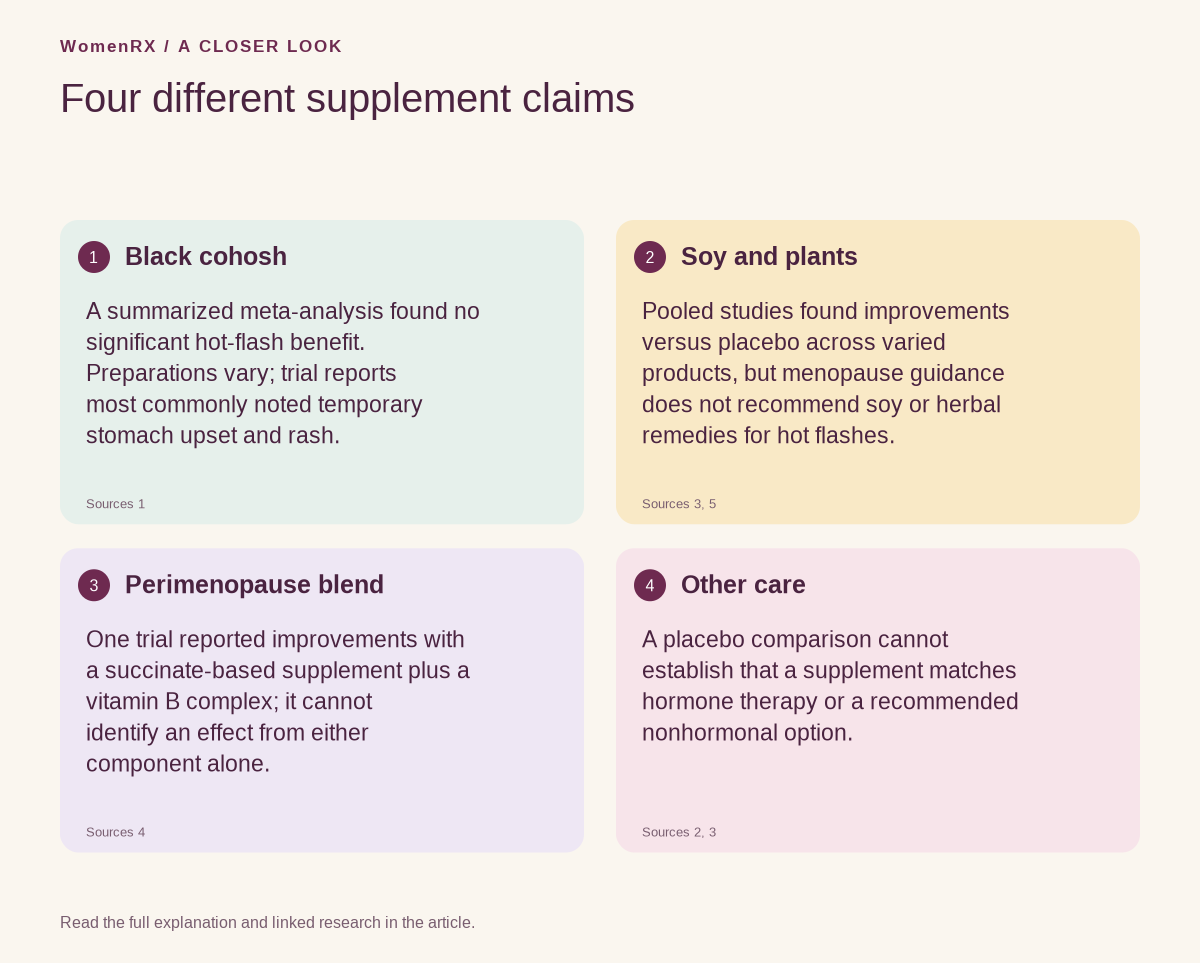
Four different supplement claims
Black cohosh: A summarized meta-analysis found no significant hot-flash benefit. Preparations vary; trial reports most commonly noted temporary stomach upset and rash.1
Soy and plants: Pooled studies found improvements versus placebo across varied products, but menopause guidance does not recommend soy or herbal remedies for hot flashes.35
Perimenopause blend: One trial reported improvements with a succinate-based supplement plus a vitamin B complex; it cannot identify an effect from either component alone.4
Other care: A placebo comparison cannot establish that a supplement matches hormone therapy or a recommended nonhormonal option.23
Read the figure as text
The question to ask changes with the ingredient, study population, and comparison.- Black cohosh: A summarized meta-analysis found no significant hot-flash benefit. Preparations vary; trial reports most commonly noted temporary stomach upset and rash.1
- Soy and plants: Pooled studies found improvements versus placebo across varied products, but menopause guidance does not recommend soy or herbal remedies for hot flashes.35
- Perimenopause blend: One trial reported improvements with a succinate-based supplement plus a vitamin B complex; it cannot identify an effect from either component alone.4
- Other care: A placebo comparison cannot establish that a supplement matches hormone therapy or a recommended nonhormonal option.23
More questions, answered
Does a supplement study for hot flashes also support a claim about vaginal dryness?
No. A hot-flash result measures a different problem. For bothersome vaginal and urinary symptoms, menopause guidance describes symptom-specific options, including vaginal treatments in appropriate circumstances when over-the-counter approaches haven’t helped. 2
Sources you can check
- Black Cohosh - Health Professional Fact SheetAccessed 2026-09-25Return to first citation
- The 2022 hormone therapy position statement of The North American Menopause Society.“The 2022 Hormone Therapy Position Statement of The North American Menopause Society” Advisory Panel. · Menopause (New York, N.Y.) · 2022Return to first citation
- The 2023 nonhormone therapy position statement of The North American Menopause Society.Menopause (New York, N.Y.) · 2023Return to first citation
- Clinical Evaluation of Effectiveness and Safety of Combined Use of Dietary Supplements Amberen® and Smart B® in Women with Climacteric Syndrome in Perimenopause.Kachko VA, Shulman LP, Kuznetsova IV, Uspenskaya YB, Burchakov DI. · Advances in therapy · 2024Return to first citation
- Efficacy of plant-derived dietary supplements in improving overall menopausal symptoms in women: An updated systematic review and meta-analysis.Oh MR, Park JH, Park SK, Park SH. · Phytotherapy research : PTR · 2024Return to first citation
- Nonhormonal management of menopause-associated vasomotor symptoms: 2015 position statement of The North American Menopause Society.Menopause (New York, N.Y.) · 2015Return to first citation