Do Supplements Help With Urinary Leakage Around Menopause?
A small vitamin D trial offers a narrow finding for urgency-related leakage, while the care worth considering depends on how you leak.
Supplements aren’t a reliable substitute for care tailored to urinary leakage. One small trial reported improvement with vitamin D in postmenopausal women who had low vitamin D levels and urgency-related symptoms, but it doesn’t establish a treatment for everyone. Leaking with a cough and leaking after a sudden urge are different patterns, and that distinction helps point toward more relevant care. 6 2 3
First, notice what sets off the leak
If you leak when you cough, laugh, or exercise, that fits stress incontinence. “Stress” here means pressure on the bladder, not emotional stress. If a sudden, intense need to urinate comes just before the leak, that fits urgency incontinence. You can have both. 2 3
That difference matters more than whether leakage began around menopause. Stress incontinence is often linked to weakness or damage in the pelvic-floor muscles or the muscle that helps keep the urethra closed. Pregnancy, vaginal birth, and increasing age can also affect the picture, but leakage isn’t an inevitable part of aging. Menopausal status alone doesn’t tell you which type of incontinence you have or what’s causing it. 2
What supplements can tell you, and what they can’t
A randomized trial enrolled 90 postmenopausal women with low vitamin D levels who had urgency incontinence or nighttime urination. Half received vitamin D and half received placebo for eight weeks. The researchers reported reduced leakage severity and nighttime urination in the vitamin D group. The abstract does not give enough between-group detail to judge the size of the benefit over placebo. More importantly for a treatment decision, this trial doesn’t establish that vitamin D helps stress leaks or women without low vitamin D levels. 6
Soy isoflavones and black cohosh appear in discussions of menopause supplements, but research or guidance about hot flashes doesn’t establish that either treats urinary leakage. Black cohosh preparations also vary considerably in composition, making a general product claim especially hard to assess. 5 4
More vitamins aren’t automatically better for the bladder, either. In a survey of 2,060 women ages 30 to 79, higher vitamin C and calcium intakes were associated with some urinary storage symptoms, including frequency and urgency. Because the study measured intake and symptoms at the same time, it cannot show that the nutrients caused those symptoms or that changing intake would treat them. 7
Compare the claim with care that fits the pattern
For cough- or exercise-triggered leaks: A pelvic-floor-focused discussion is more closely connected to the usual mechanism than a menopause supplement claim. Pelvic-floor exercises are among the measures described in incontinence guidance, particularly for prevention during pregnancy. That guidance does not, by itself, establish how much exercises will improve existing leakage after menopause. An assessment can help clarify whether the pattern really is stress incontinence and what care fits. 2
For leaks after a sudden urge: The useful distinction is whether urgency comes with frequent trips to the bathroom or nighttime urination, which can occur together. An assessment may include a record of fluid intake and bathroom trips. If symptoms remain difficult to manage, medication may be considered; guidance also describes procedures specifically for urgency incontinence. Those are options to discuss based on the assessment, not reasons to assume a supplement will treat an overactive bladder. 2 3
If both happen: Describe both patterns rather than choosing the one that bothers you most. Mixed incontinence is recognized, and an assessment can keep a pressure-related leak from being mistaken for an urgency-related one, or vice versa. 3 2
A different clue deserves attention: frequent little trickles together with a feeling that your bladder hasn’t emptied can fit overflow incontinence. That calls for assessment rather than assuming it’s a pelvic-floor problem or trying a menopause supplement. 3
While you’re working out a longer-term plan, absorbent pads or underwear can make leaks easier to manage. They’re a practical aid while you wait for diagnosis or treatment, not a treatment for the cause. 1
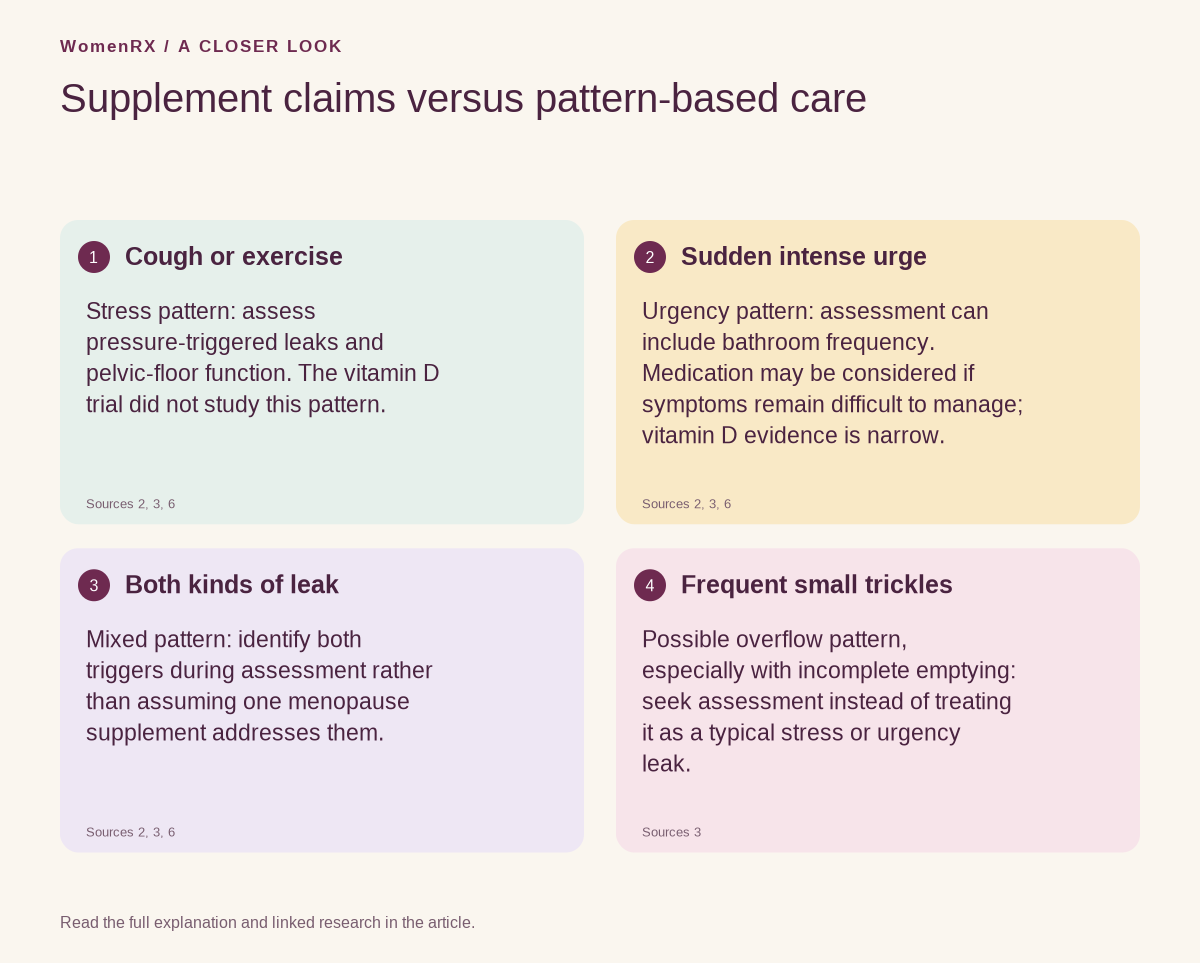
Supplement claims versus pattern-based care
Cough or exercise: Stress pattern: assess pressure-triggered leaks and pelvic-floor function. The vitamin D trial did not study this pattern.236
Sudden intense urge: Urgency pattern: assessment can include bathroom frequency. Medication may be considered if symptoms remain difficult to manage; vitamin D evidence is narrow.236
Both kinds of leak: Mixed pattern: identify both triggers during assessment rather than assuming one menopause supplement addresses them.236
Frequent small trickles: Possible overflow pattern, especially with incomplete emptying: seek assessment instead of treating it as a typical stress or urgency leak.3
Read the figure as text
The same supplement claim may sound relevant to every leak, but the more useful comparison starts with when leakage happens.- Cough or exercise: Stress pattern: assess pressure-triggered leaks and pelvic-floor function. The vitamin D trial did not study this pattern.236
- Sudden intense urge: Urgency pattern: assessment can include bathroom frequency. Medication may be considered if symptoms remain difficult to manage; vitamin D evidence is narrow.236
- Both kinds of leak: Mixed pattern: identify both triggers during assessment rather than assuming one menopause supplement addresses them.236
- Frequent small trickles: Possible overflow pattern, especially with incomplete emptying: seek assessment instead of treating it as a typical stress or urgency leak.3
More questions, answered
Should I assume leakage after menopause is caused by low estrogen?
No. The timing is worth mentioning, but leakage also has distinct patterns, and factors such as pelvic-floor function, childbirth history, and age may matter. An assessment starts with what happens when you leak rather than assigning one cause from menopausal status alone. 2 3
Sources you can check
- Products to help with urinary incontinence - NHSAccessed 2026-09-25Return to first citation
- Urinary incontinence - NHSAccessed 2026-09-25Return to first citation
- Urinary incontinence - Symptoms - NHSAccessed 2026-09-25Return to first citation
- Black Cohosh - Health Professional Fact SheetAccessed 2026-09-25Return to first citation
- The 2023 nonhormone therapy position statement of The North American Menopause Society.Menopause (New York, N.Y.) · 2023Return to first citation
- The effect of vitamin D on urgent urinary incontinence in postmenopausal women.Arjmand M, Abbasi H, Behforouz A. · International urogynecology journal · 2023Return to first citation
- Intakes of vitamins and minerals in relation to urinary incontinence, voiding, and storage symptoms in women: a cross-sectional analysis from the Boston Area Community Health survey.Maserejian NN, Giovannucci EL, McVary KT, McKinlay JB. · European urology · 2011Return to first citation