Menopause Supplements for Vaginal Dryness: What Helps?
Supplements haven’t shown dependable relief for vaginal dryness, while moisturizers, lubricants, and targeted vaginal treatments are designed for the symptom itself.
There isn’t strong, consistent evidence that oral supplements relieve vaginal dryness during or after menopause. One review mentioned modest improvement with soy products, but that doesn’t establish that soy isoflavone supplements work. Black cohosh studies also don’t provide reliable support. Vaginal moisturizers and lubricants act locally, and vaginal estrogen is a targeted option when symptoms persist and it’s suitable for you. 2 3 6
The short answer: a supplement is not a local treatment
If dryness is making sex uncomfortable or causing irritation in daily life, it’s understandable to look for something you can take by mouth. But the evidence for supplements is uncertain, and it doesn’t show that an oral product reliably treats vaginal dryness. By contrast, moisturizers, lubricants, and vaginal treatments are used in or around the vagina for symptoms there. They have different purposes and shouldn’t be treated as interchangeable. 1 3 5
Dryness can happen around menopause as changing hormone levels affect vaginal moisture. It can also have other causes, including breastfeeding, some cancer treatments, not being aroused during sex, or certain health conditions. So the right next step may depend on when dryness happens and whether you have other symptoms. 1
What the supplement research can, and can’t, tell you
Soy: A review summarized in a 2016 article suggested modest improvement in hot flashes and vaginal dryness with soy products. That finding doesn’t establish that soy isoflavone supplements relieve dryness: the summary doesn’t say whether the result came from food, supplements, or both, or provide enough detail to judge the effect. It’s a limited signal, not a dependable treatment recommendation. 6
Black cohosh: Studies have varied in their preparations and results. In a review of 16 randomized trials involving 2,027 women, the evidence was judged insufficient to support or oppose black cohosh for menopausal symptoms. Vaginal dryness was among the symptoms assessed, and a high-quality trial that included sexual dysfunction outcomes found no significant differences for most secondary outcomes between treatment groups. The research therefore doesn’t show reliable relief of vaginal dryness from black cohosh. 2
This is a specific evidence gap: findings about hot flashes or general menopause symptoms don’t automatically show that a supplement helps vaginal dryness. And evidence about soy products as a group isn’t proof that an individual supplement works. The available summaries also don’t establish a supplement benefit specifically for perimenopausal women compared with postmenopausal women. 2 6
Compare options by where they work
Lubricants are for sexual activity. Water-based lubricant can reduce friction during sex. It’s used at the time you need it, rather than as a treatment intended to keep the vagina moist between sexual activity. 1
Vaginal moisturizers are for ongoing dryness. These are used inside the vagina to help keep it moist. A pharmacist or clinician can help you compare products if you’re unsure what’s suitable. 1 4
Vaginal estrogen is a targeted medical option. It delivers a low dose locally and is used for menopause-related dryness and irritation. The North American Menopause Society recommends considering low-dose vaginal estrogen or other therapies for bothersome genitourinary symptoms that aren’t relieved by over-the-counter treatments, for women without an indication for systemic hormone therapy. Whether it suits you depends on your situation and preferences. 3 4 5
Oral supplements are not equivalent to any of these. They’re taken by mouth, and the evidence above doesn’t establish a reliable effect on vaginal dryness. If you’re weighing a supplement, ask what symptom the research actually measured and whether it studied the same product type you’re considering. 2 6
A practical way to choose your next step
If discomfort mainly happens during sex, trying a lubricant may address friction directly. If dryness or irritation bothers you at other times too, a vaginal moisturizer is a different option. If those measures aren’t enough, ask about targeted treatments such as vaginal estrogen and whether your personal medical history affects the choice. This is a comparison of purposes, not a requirement to try every option in sequence. 1 4 5
Mention any supplement you use or are considering when discussing treatment. And don’t assume that dryness explains every vaginal symptom: seek medical advice if it persists despite self-care, affects daily life, or comes with unusual discharge or bleeding. Bleeding after menopause, in particular, should be checked rather than treated as dryness alone. 1
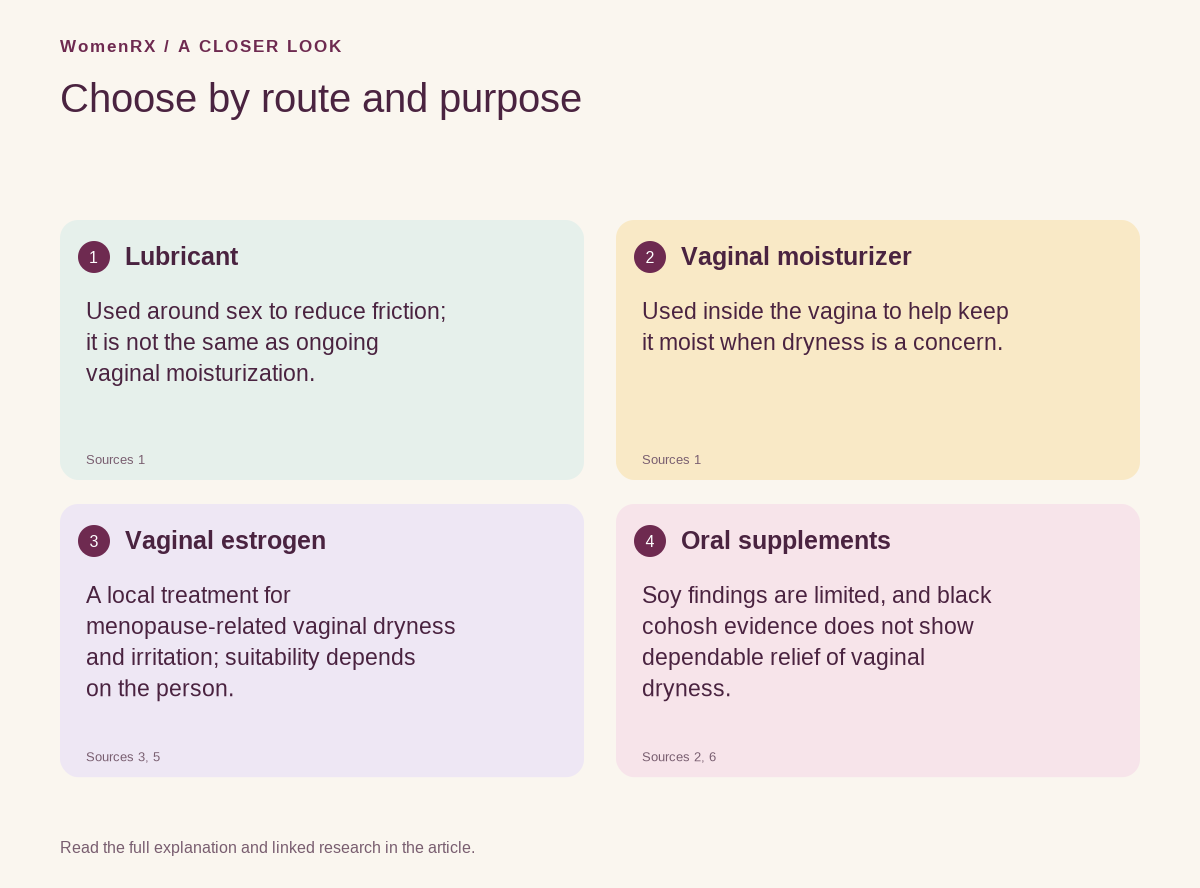
Choose by route and purpose
Lubricant: Used around sex to reduce friction; it is not the same as ongoing vaginal moisturization.1
Vaginal moisturizer: Used inside the vagina to help keep it moist when dryness is a concern.1
Vaginal estrogen: A local treatment for menopause-related vaginal dryness and irritation; suitability depends on the person.35
Oral supplements: Soy findings are limited, and black cohosh evidence does not show dependable relief of vaginal dryness.26
Read the figure as text
These options differ in where they act and what symptom they’re intended to address; an oral supplement is not the same as a local treatment.- Lubricant: Used around sex to reduce friction; it is not the same as ongoing vaginal moisturization.1
- Vaginal moisturizer: Used inside the vagina to help keep it moist when dryness is a concern.1
- Vaginal estrogen: A local treatment for menopause-related vaginal dryness and irritation; suitability depends on the person.35
- Oral supplements: Soy findings are limited, and black cohosh evidence does not show dependable relief of vaginal dryness.26
More questions, answered
Does evidence about soy foods apply to soy isoflavone supplements?
Not automatically. A review summary mentions modest improvement with soy products but doesn’t establish whether that finding came from foods, supplements, or both. It isn’t enough to conclude that soy isoflavone supplements reliably relieve vaginal dryness. 6
When should vaginal dryness be checked?
Get medical advice if dryness lasts for a few weeks and self-care isn’t helping, affects your daily life, or comes with unusual discharge or bleeding. Bleeding after menopause should be evaluated rather than assumed to be caused by dryness. 1
Sources you can check
- Vaginal dryness - NHSAccessed 2026-09-25Return to first citation
- Black Cohosh - Health Professional Fact SheetAccessed 2026-09-25Return to first citation
- About vaginal oestrogen - NHSAccessed 2026-09-25Return to first citation
- Common questions about vaginal oestrogen - NHSAccessed 2026-09-25Return to first citation
- The 2022 hormone therapy position statement of The North American Menopause Society.“The 2022 Hormone Therapy Position Statement of The North American Menopause Society” Advisory Panel. · Menopause (New York, N.Y.) · 2022Return to first citation
- Hormone Therapy and Other Treatments for Symptoms of Menopause.Hill DA, Crider M, Hill SR. · American family physician · 2016Return to first citation