What Helps Menopause Hot Flashes Without a Prescription?
Cognitive behavioral therapy and clinical hypnosis have stronger support for hot flashes than supplements, while everyday comfort measures can still have a place.
If you want a nonprescription approach to menopause hot flashes, structured cognitive behavioral therapy (CBT) and clinical hypnosis are the best-supported places to start. Menopause guidance recommends both, but does not recommend supplements or herbal remedies as hot-flash treatments. Soy extracts and black cohosh aren’t proven substitutes for fezolinetant or other prescription options. 2
Start with approaches that have evidence for hot flashes
The North American Menopause Society’s 2023 review recommends CBT and clinical hypnosis for menopause-related hot flashes. Both are structured approaches rather than products you buy off a shelf. The review supports them as options, but doesn’t establish that one works better than the other or that either will make every hot flash disappear. 2
There’s a useful distinction between feeling more comfortable and treating hot flashes reliably. For example, you might prefer a cooler bedroom or notice that a particular drink makes you feel overheated. You can make those changes for your own comfort. But the 2023 review does not recommend cooling techniques or avoiding triggers as established hot-flash treatments. It also does not recommend paced breathing, exercise, yoga, mindfulness, or relaxation for this specific purpose. That finding isn’t a reason to give up an activity you otherwise enjoy. 2
Weight loss appears among the review’s recommended options, but with lower-level evidence than CBT and clinical hypnosis. That makes it a different conversation from choosing a structured treatment for hot flashes, not a universal instruction to change your weight. 2
Why supplement claims deserve a closer look
The same 2023 review does not recommend supplements or herbal remedies to treat hot flashes. It separately lists soy foods, soy extracts, and equol among approaches not recommended for that purpose. This is a judgment about hot-flash relief, not a warning to avoid soy as a food. 2
A placebo-controlled trial shows why a promising ingredient name isn’t enough. Researchers assigned 252 recently postmenopausal women with frequent hot flashes to one of two red-clover isoflavone supplements or placebo. After 12 weeks, average daily hot-flash counts had fallen by 5.1 and 5.4 in the supplement groups, compared with 5.0 in the placebo group. The researchers concluded that neither product had a clinically important effect. That result applies to the products studied, not to every supplement on the shelf. 3
Black cohosh has a more complicated history. An older review found that many trials suggested symptom improvement, but also identified shortcomings in their methods. The newer menopause position statement does not recommend herbal remedies for hot flashes. When deciding whether to spend money on black cohosh, the more recent evidence-based recommendation is a better guide than a claim based on selected older trials. 4 2
Check the product, not just the plant name
Safety deserves its own question. The older black-cohosh review described four case reports of possible liver injury. Case reports cannot prove that black cohosh caused those injuries, but they do challenge the assumption that a botanical product is automatically harmless. The same review found that soy-isoflavone supplements varied substantially in composition and that the long-term safety of higher-dose extracts was uncertain. 4
If you’re considering a supplement, the practical question is: What exactly is in this product, and how does it fit with my health conditions and medicines? Bring the full ingredient label to a pharmacist or clinician, especially for a blend containing several herbs. Evidence for one extract cannot establish the benefits or risks of a different mixture. Don’t assume a menopause label answers the interaction question. 4
If fezolinetant isn’t right for you
Fezolinetant is a prescription, nonhormonal medicine for moderate to severe menopause-related hot flashes, not a supplement. Its US prescribing information says it must not be used by people with cirrhosis, severe kidney problems or kidney failure, or those taking certain medicines called CYP1A2 inhibitors. It also requires liver blood tests because of the risk of liver problems. Those restrictions are reasons to discuss a different option, not evidence that a supplement will work in its place. 1
There are other evidence-supported prescription nonhormonal choices, including certain SSRIs or SNRIs and gabapentin. If your hot flashes are disrupting sleep or daily life and CBT or clinical hypnosis doesn’t feel like enough, you don’t have to choose between fezolinetant and an unproven bottle of supplements. 2
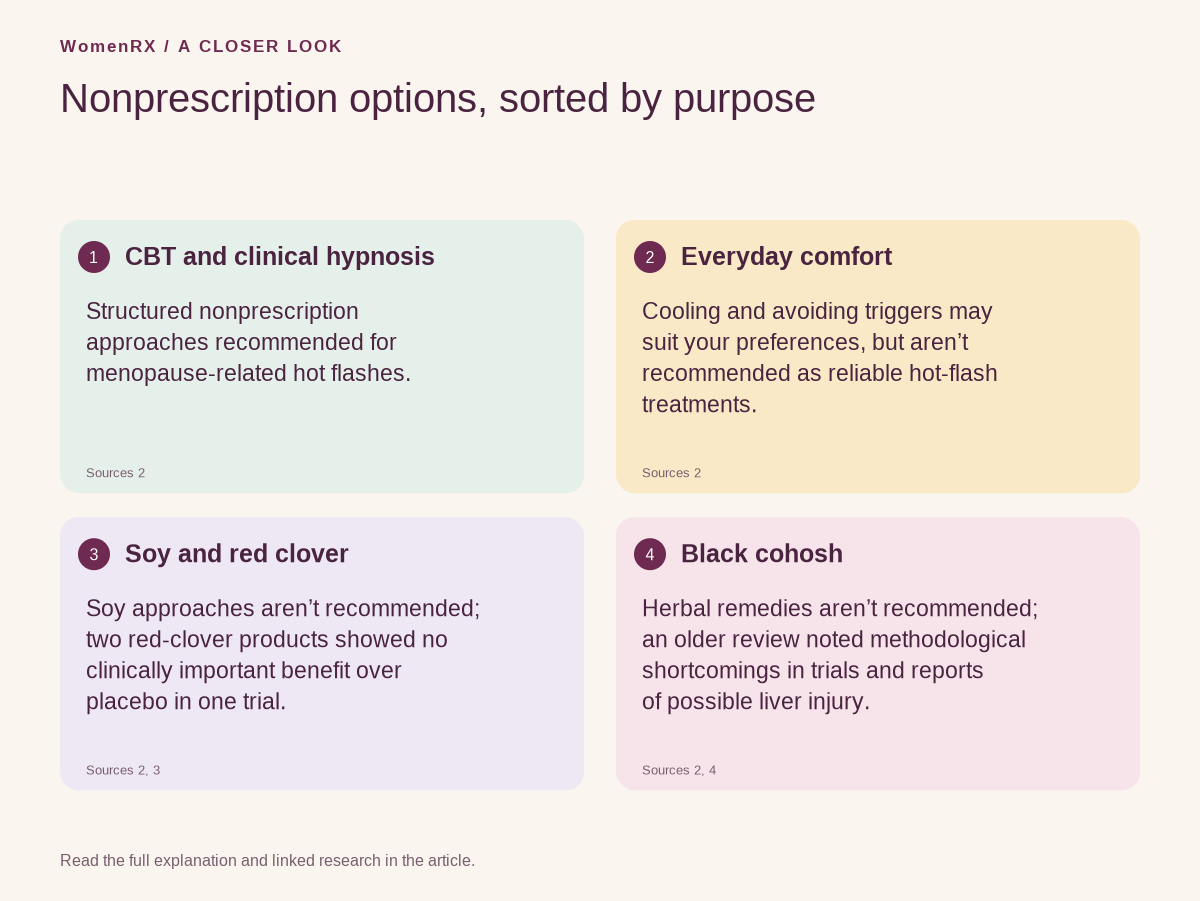
Nonprescription options, sorted by purpose
CBT and clinical hypnosis: Structured nonprescription approaches recommended for menopause-related hot flashes.2
Everyday comfort: Cooling and avoiding triggers may suit your preferences, but aren’t recommended as reliable hot-flash treatments.2
Soy and red clover: Soy approaches aren’t recommended; two red-clover products showed no clinically important benefit over placebo in one trial.23
Black cohosh: Herbal remedies aren’t recommended; an older review noted methodological shortcomings in trials and reports of possible liver injury.24
Read the figure as text
This comparison separates approaches supported for hot-flash treatment from comfort measures and products with uncertain benefit.- CBT and clinical hypnosis: Structured nonprescription approaches recommended for menopause-related hot flashes.2
- Everyday comfort: Cooling and avoiding triggers may suit your preferences, but aren’t recommended as reliable hot-flash treatments.2
- Soy and red clover: Soy approaches aren’t recommended; two red-clover products showed no clinically important benefit over placebo in one trial.23
- Black cohosh: Herbal remedies aren’t recommended; an older review noted methodological shortcomings in trials and reports of possible liver injury.24
More questions, answered
Does the guidance mean I should stop eating soy foods?
No. Soy foods were not recommended as a treatment for hot flashes. That is different from a recommendation to avoid eating them. 2
Sources you can check
- VEOZAH (FEZOLINETANT) TABLET, FILM COATED [ASTELLAS PHARMA US, INC.] | US prescribing information and patient instructionsAccessed 2026-09-25Return to first citation
- The 2023 nonhormone therapy position statement of The North American Menopause Society.Menopause (New York, N.Y.) · 2023Return to first citation
- Phytoestrogen supplements for the treatment of hot flashes: the Isoflavone Clover Extract (ICE) Study: a randomized controlled trial.Tice JA, Ettinger B, Ensrud K, Wallace R, Blackwell T, Cummings SR. · JAMA · 2003Return to first citation
- Menopause: a review of botanical dietary supplements.Low Dog T. · The American journal of medicine · 2005Return to first citation