Menopause Supplements for Hot Flashes and Bone Health
Hot-flash supplements have uncertain benefits, while calcium and vitamin D serve a separate bone-health purpose.
Start with what you want to change. For hot flashes and night sweats, current menopause guidance does not recommend supplements or herbal remedies, despite positive findings in a review that pooled many different plant products. Black cohosh and soy are not dependable substitutes for treatments with stronger evidence. Calcium and vitamin D belong in a different conversation: meeting bone-health needs, not relieving hot flashes. 5 6 2 3
A “menopause” label isn’t a symptom match
A bottle promising menopause support may contain an herb studied for hot flashes alongside nutrients that help maintain bones. Those are different goals. Before comparing products, name the outcome you care about: fewer hot flashes, enough calcium in your diet, or relief from vaginal dryness, for example. Evidence for one doesn’t establish benefit for the others.
Life stage matters, too. Perimenopause and postmenopause are both represented in supplement research, but results aren’t always reported separately. In one year-long hot-flash trial, 52% of participants were in the menopausal transition and 48% were postmenopausal; the reported results describe the group overall. You can’t tell from them whether a supplement worked differently at each stage. 7
For hot flashes, a pooled benefit isn’t a reliable product recommendation
The 2023 North American Menopause Society position statement does not recommend supplements or herbal remedies for vasomotor symptoms, meaning hot flashes and night sweats. It also does not recommend soy foods, soy extracts, or equol for that purpose. The statement identifies evidence-supported nonhormonal options, including cognitive behavioral therapy, clinical hypnosis, and certain prescription medicines. Hormone therapy remains the most effective treatment for vasomotor symptoms, though its benefits and risks need an individual assessment. 5 4
Why, then, do some headlines say plant supplements help? A 2024 systematic review and meta-analysis found improvements in hot-flash frequency and symptom-questionnaire scores compared with placebo across studies of plant-derived supplements. Its participants were peri- or postmenopausal women, but the products included many different soy-derived and other plant preparations. The authors also noted uneven study quality and substantial differences among studies. That pooled finding is worth knowing about; it does not identify a dependable ingredient, formulation, or store-bought blend. 6
Black cohosh shows the problem clearly. A review of 16 randomized trials involving 2,027 women found the evidence insufficient to support or oppose its use for menopause symptoms; preparations and trial methods varied considerably. In a separate year-long randomized trial of 351 women ages 45 to 55 who had at least two vasomotor symptoms a day, black cohosh and the tested herbal combinations did not improve the reported hot-flash measures more than placebo. The soy component of one trial group was dietary counseling, not a test of every soy-isoflavone supplement. 1 7
Calcium and vitamin D answer a bone-health question
After menopause, falling estrogen contributes to bone loss. Calcium helps build and maintain bone, and vitamin D helps the gut absorb calcium. Neither role makes a calcium or vitamin D pill a treatment for hot flashes. 2 3 5
For women older than 50, the recommended calcium intake is 1,200 mg a day from food and supplements combined. That’s an age-based total, not an instruction to take a 1,200 mg pill or a target that automatically changes on the date of your final period. Foods that can contribute calcium include dairy products, canned fish with edible bones, some vegetables, and fortified foods. If you’re considering a supplement, first look at what you routinely eat and check the label’s serving size to see how much calcium the product would add. 2
Vitamin D supports calcium absorption, but a low dietary vitamin D intake does not, by itself, prove low vitamin D status: sunlight also affects it. Whether you need a vitamin D supplement is a different question from whether you need more calcium. 3
It’s also worth separating maintaining adequate nutrient intake from proving that a supplement prevents fractures. Reviews of calcium alone or calcium with vitamin D in older adults have reached mixed conclusions about fracture prevention. A supplement may help fill an intake gap without being a guaranteed way to prevent a fracture. 2
Check the exact bottle, not just the front-label promise
Multi-ingredient products make it especially easy to mistake evidence for one component as evidence for the whole blend. Read the ingredient amounts per serving and the serving size, then compare the actual ingredients with the outcome studied. Supplements do not have to undergo the same testing as drugs. 1 8
Safety deserves the same specificity. Black cohosh trials most commonly reported mild stomach upset or rash, but most studies lasted six months or less, leaving long-term safety unclear. Liver injuries have been reported in people using black cohosh, although a causal link has not been established. If you have a liver disorder, avoid black cohosh; if you develop dark urine, jaundice, or abdominal pain while taking it, stop using it and seek medical advice. 1 If a blend contains vitamin E and you take a blood thinner, that ingredient merits a check with your pharmacist or clinician because vitamin E supplements may be harmful with blood thinners and some other medicines. 9
If your main concern is vaginal dryness or other bothersome vaginal or urinary symptoms, don’t borrow the evidence from hot-flash products. Menopause guidance addresses those symptoms separately and describes options including over-the-counter therapies and, when those don’t provide relief, treatments such as low-dose vaginal estrogen for women without a reason to use systemic hormone therapy. 4
The useful question to bring to a product or treatment discussion is specific: “I want help with this symptom. Was this ingredient studied for it, and does this exact blend make sense alongside my medicines and health history?” That keeps a bone-health nutrient, an uncertain hot-flash herb, and an unrelated ingredient from being treated as one all-purpose menopause remedy. 1 5 8
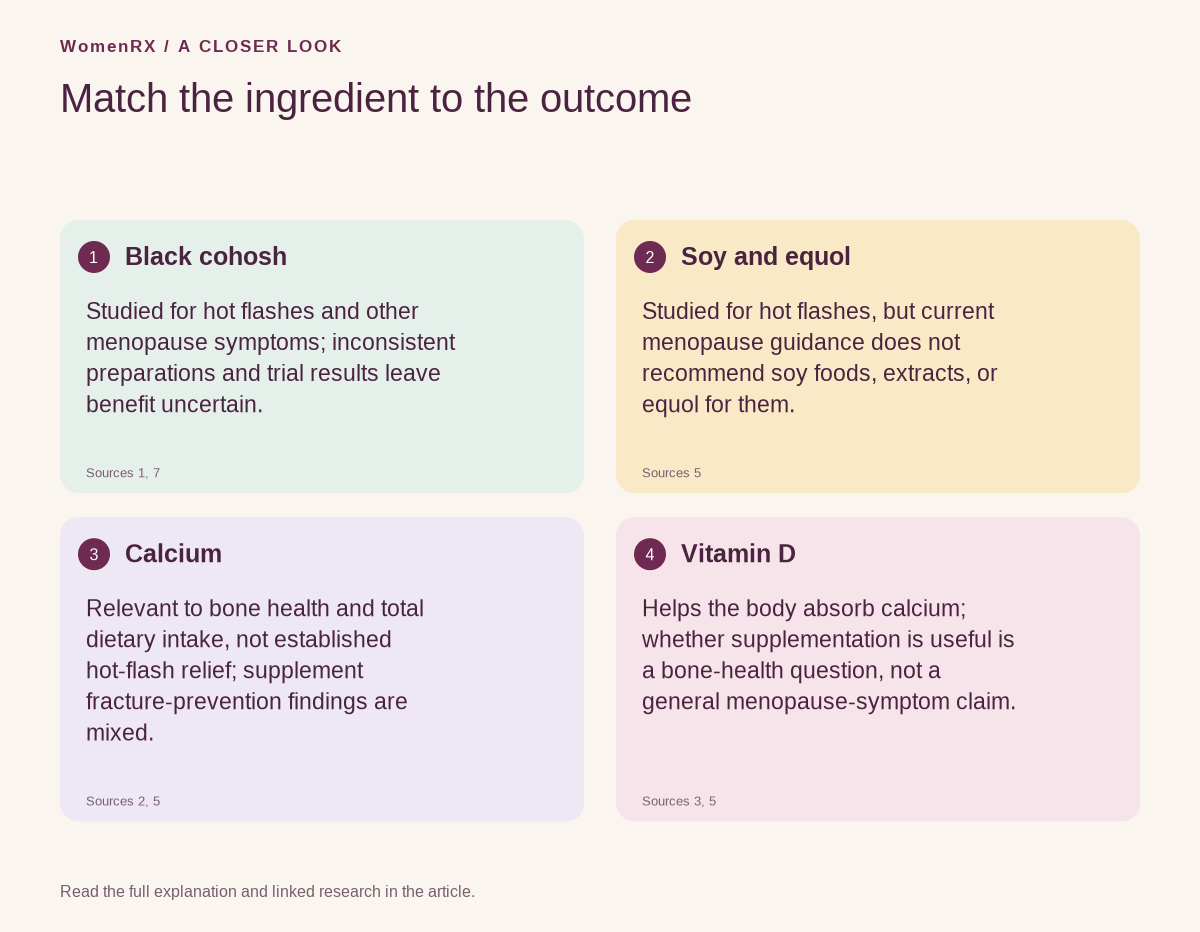
Match the ingredient to the outcome
Black cohosh: Studied for hot flashes and other menopause symptoms; inconsistent preparations and trial results leave benefit uncertain.17
Soy and equol: Studied for hot flashes, but current menopause guidance does not recommend soy foods, extracts, or equol for them.5
Calcium: Relevant to bone health and total dietary intake, not established hot-flash relief; supplement fracture-prevention findings are mixed.25
Vitamin D: Helps the body absorb calcium; whether supplementation is useful is a bone-health question, not a general menopause-symptom claim.35
Read the figure as text
These ingredients are discussed for different goals; a menopause label does not make their evidence interchangeable.- Black cohosh: Studied for hot flashes and other menopause symptoms; inconsistent preparations and trial results leave benefit uncertain.17
- Soy and equol: Studied for hot flashes, but current menopause guidance does not recommend soy foods, extracts, or equol for them.5
- Calcium: Relevant to bone health and total dietary intake, not established hot-flash relief; supplement fracture-prevention findings are mixed.25
- Vitamin D: Helps the body absorb calcium; whether supplementation is useful is a bone-health question, not a general menopause-symptom claim.35
More questions, answered
Does calcium need to come from a supplement after menopause?
Not automatically. The 1,200 mg daily recommendation applies to women older than 50 and counts calcium from food and supplements together. Consider what your usual diet supplies before deciding whether a supplement would fill a gap. 2
Sources you can check
- Black Cohosh - Health Professional Fact SheetAccessed 2026-09-25Return to first citation
- Calcium - Health Professional Fact SheetAccessed 2026-09-25Return to first citation
- Vitamin D - Health Professional Fact SheetAccessed 2026-09-25Return to first citation
- The 2022 hormone therapy position statement of The North American Menopause Society.“The 2022 Hormone Therapy Position Statement of The North American Menopause Society” Advisory Panel. · Menopause (New York, N.Y.) · 2022Return to first citation
- The 2023 nonhormone therapy position statement of The North American Menopause Society.Menopause (New York, N.Y.) · 2023Return to first citation
- Efficacy of plant-derived dietary supplements in improving overall menopausal symptoms in women: An updated systematic review and meta-analysis.Oh MR, Park JH, Park SK, Park SH. · Phytotherapy research : PTR · 2024Return to first citation
- Treatment of vasomotor symptoms of menopause with black cohosh, multibotanicals, soy, hormone therapy, or placebo: a randomized trial.Newton KM, Reed SD, LaCroix AZ, Grothaus LC, Ehrlich K, Guiltinan J. · Annals of internal medicine · 2006Return to first citation
- Dietary Supplements: MedlinePlusAccessed 2026-09-25Return to first citation
- Vitamin E: MedlinePlusAccessed 2026-09-25Return to first citation