What Helps Hot Flashes Without a Prescription?
CBT and clinical hypnosis have the strongest support among non-drug approaches, while exercise offers benefits that don’t necessarily include fewer hot flashes.
If you want a nonprescription approach aimed at hot flashes, cognitive behavioral therapy (CBT) and clinical hypnosis have the strongest support. Exercise is valuable for health but hasn’t reliably reduced flashes in trials. Soy products and herbal supplements aren’t recommended as hot-flash treatments in current menopause guidance. Choose based on the outcome you want, not whether an option sounds natural. 4 8
Start with the outcome you want
There’s a difference between having fewer hot flashes, finding them less disruptive, and sleeping better despite them. That distinction makes nonprescription options easier to compare.
For menopause-associated hot flashes and night sweats, the North American Menopause Society’s 2023 position statement recommends CBT and clinical hypnosis, both supported by its highest evidence category. Its abstract lists both as recommended at Level I without ranking them against each other. Both require more of your time and attention than buying a supplement, but they have stronger evidence for this purpose. 4
CBT is a structured behavioral approach, not simply advice to relax. In a randomized trial of 422 people with breast cancer experiencing treatment-induced menopause, groups assigned to CBT, either alone or with exercise, reported less perceived burden from hot flashes and night sweats than a waiting-list group. That finding matters if the flashes themselves feel hard to live with. It does not mean the trial showed that CBT stopped flashes or reduced their frequency. 5
Clinical hypnosis is also recommended for vasomotor symptoms in the 2023 guidance. The abstract lists CBT and hypnosis as recommended without ranking them, so there’s no sound basis here to rank one above the other. 4
Exercise helps, but don’t give it the wrong job
You don’t need to exercise harder to prove you’re doing something about hot flashes. The 2023 position statement does not recommend exercise as a treatment for vasomotor symptoms, and a review of the MsFLASH trials found no hot-flash benefit from exercise compared with usual activity. A breast-cancer treatment trial found improvements in some broader symptoms and physical functioning in its exercise groups; the reduction in perceived hot-flash burden was reported in groups that included CBT. 4 8 5
Exercise can still be worth your effort. Regular physical activity supports heart health, muscles and bones, mood, and sleep. Those benefits stand on their own, even if your hot flashes don’t change. 2
The same outcome distinction applies to small comfort measures. For example, you might prefer lighter bedding when you wake up hot. That’s a reasonable choice about comfort, not evidence that changing bedding prevents night sweats. Menopause guidance does not recommend cooling techniques or avoiding triggers as treatments for reducing vasomotor symptoms. It lists weight loss as a recommended option, but at a lower evidence level than CBT or clinical hypnosis. That is not a reason to treat weight change as a prerequisite for relief. 4
Why supplements rank lower
Soy foods, soy extracts, and equol, a soy-related compound, are not recommended as hot-flash treatments in the 2023 position statement. A later review highlighted a promising study in which a diet changed several things at once, including soy intake and body weight. That result cannot tell you what a soy supplement alone would do. It also does not overturn the broader guidance’s assessment of soy for hot flashes. 4 7
Black cohosh has been studied more extensively than many herbal products, but its benefit remains uncertain. A review of 16 randomized trials involving 2,027 women found insufficient evidence to support or oppose its use for menopausal symptoms. A later analysis found no significant association with fewer vasomotor symptoms. Black-cohosh preparations also vary considerably in composition, making it harder to apply a study of one preparation to another product on a shelf. 1
The practical tradeoff is clear: a supplement may be easier to buy than a course of behavioral therapy is to arrange, but convenience is not evidence that it works. Nor does “natural” establish that a product is suitable alongside your medications. If you’re receiving cancer treatment or taking other medicines, bring the exact product label into a discussion with your pharmacist or treating team rather than relying on a general claim about soy or herbs.
If sleep is the bigger problem
CBT for insomnia, often called CBT-I, has a different target from CBT aimed at coping with hot flashes. In a pooled analysis of 546 peri- and postmenopausal women who had insomnia symptoms and bothersome hot flashes, CBT-I improved insomnia symptoms compared with control over 8 to 12 weeks. That supports it as a sleep approach; the analysis does not establish that it reduces hot flashes themselves. 6
The evidence won’t apply identically to everyone. The CBT trial in people with breast cancer addresses treatment-induced symptoms, while the sleep analysis includes women in both perimenopause and postmenopause. The abstract of the 2023 guidance gives no stage-specific ranking of non-drug options. If flashes continue to disrupt your days or nights, you can also discuss treatments beyond nonprescription approaches. Hormone therapy remains the most effective treatment for vasomotor symptoms, although whether it fits depends on your health history and preferences. 5 6 4 3
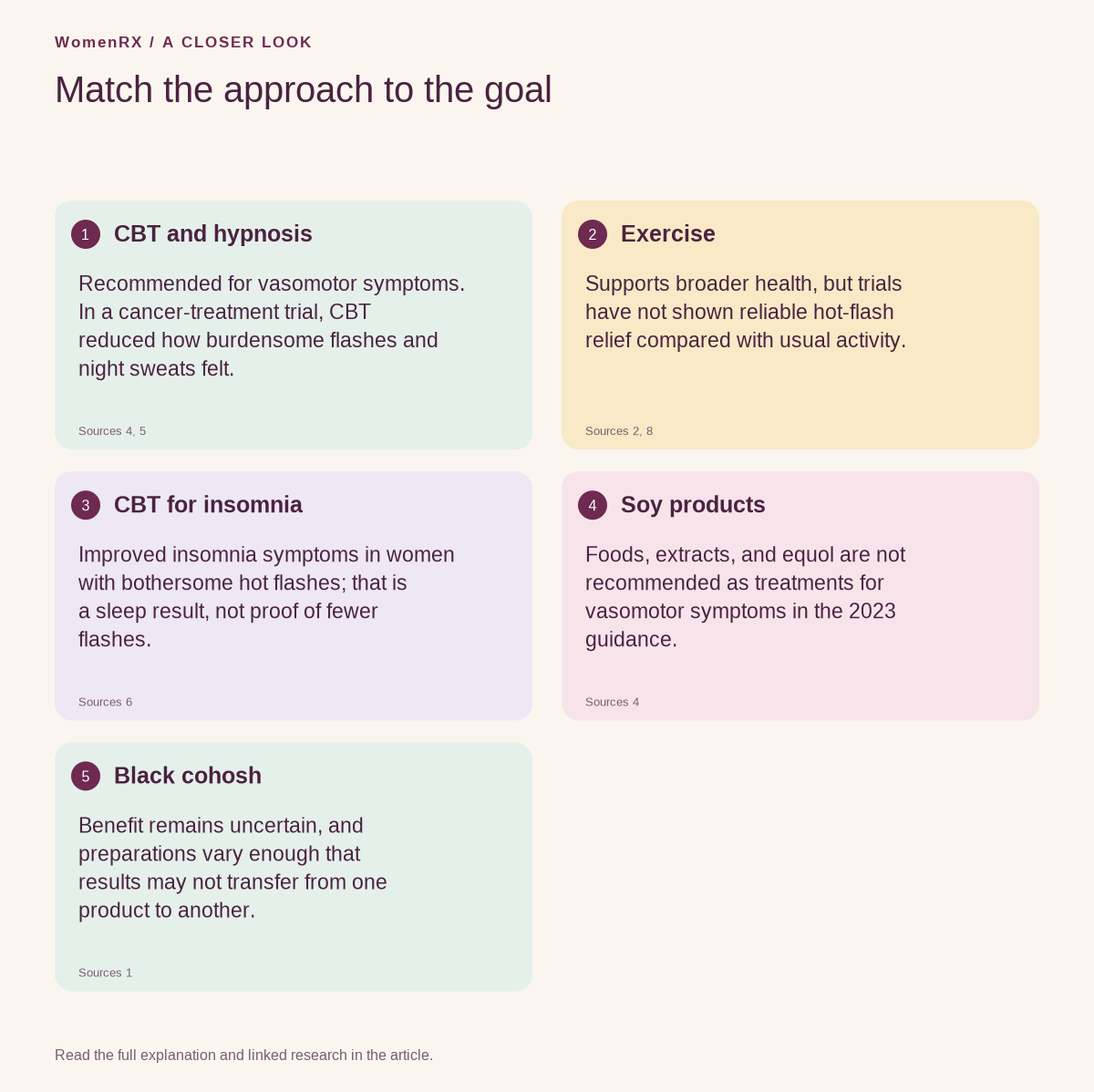
Match the approach to the goal
CBT and hypnosis: Recommended for vasomotor symptoms. In a cancer-treatment trial, CBT reduced how burdensome flashes and night sweats felt.45
Exercise: Supports broader health, but trials have not shown reliable hot-flash relief compared with usual activity.28
CBT for insomnia: Improved insomnia symptoms in women with bothersome hot flashes; that is a sleep result, not proof of fewer flashes.6
Soy products: Foods, extracts, and equol are not recommended as treatments for vasomotor symptoms in the 2023 guidance.4
Black cohosh: Benefit remains uncertain, and preparations vary enough that results may not transfer from one product to another.1
Read the figure as text
These options differ in what they have been shown to help, not just in whether they require a prescription.- CBT and hypnosis: Recommended for vasomotor symptoms. In a cancer-treatment trial, CBT reduced how burdensome flashes and night sweats felt.45
- Exercise: Supports broader health, but trials have not shown reliable hot-flash relief compared with usual activity.28
- CBT for insomnia: Improved insomnia symptoms in women with bothersome hot flashes; that is a sleep result, not proof of fewer flashes.6
- Soy products: Foods, extracts, and equol are not recommended as treatments for vasomotor symptoms in the 2023 guidance.4
- Black cohosh: Benefit remains uncertain, and preparations vary enough that results may not transfer from one product to another.1
Sources you can check
- Black Cohosh - Health Professional Fact SheetAccessed 2026-09-25Return to first citation
- Benefits of Exercise: MedlinePlusAccessed 2026-09-25Return to first citation
- The 2022 hormone therapy position statement of The North American Menopause Society.“The 2022 Hormone Therapy Position Statement of The North American Menopause Society” Advisory Panel. · Menopause (New York, N.Y.) · 2022Return to first citation
- The 2023 nonhormone therapy position statement of The North American Menopause Society.Menopause (New York, N.Y.) · 2023Return to first citation
- Efficacy of cognitive behavioral therapy and physical exercise in alleviating treatment-induced menopausal symptoms in patients with breast cancer: results of a randomized, controlled, multicenter trial.Duijts SF, van Beurden M, Oldenburg HS, Hunter MS, Kieffer JM, Stuiver MM, Gerritsma MA, Menke-Pluymers MB, Plaisier PW, Rijna H, Lopes Cardozo AM, Timmers G, van der Meij S, van d... · Journal of clinical oncology : official journal of the American Society of Clinical Oncology · 2012Return to first citation
- Effects of Pharmacologic and Nonpharmacologic Interventions on Insomnia Symptoms and Self-reported Sleep Quality in Women With Hot Flashes: A Pooled Analysis of Individual Participant Data From Four MsFLASH Trials.Guthrie KA, Larson JC, Ensrud KE, Anderson GL, Carpenter JS, Freeman EW, Joffe H, LaCroix AZ, Manson JE, Morin CM, Newton KM, Otte J, Reed SD, McCurry SM. · Sleep · 2018Return to first citation
- Natural strategies to optimize estrogen levels in aging women: mini review.Bolgova O, Shypilova I, Mavrych V. · Frontiers in aging · 2025Return to first citation
- Lights on MsFLASH: a review of contributions.Reed SD, LaCroix AZ, Anderson GL, Ensrud KE, Caan B, Carpenter JS, Cohen L, Diem SJ, Freeman EW, Joffe H, Larson JC, McCurry SM, Mitchell CM, Newton KM, Sternfeld B, Guthrie KA. · Menopause (New York, N.Y.) · 2020Return to first citation