Alternatives to Paroxetine for Menopause Hot Flashes
Behavioral treatments and several prescription medicines have evidence for hot-flash relief, while supplements aren’t recommended for that purpose.
If you’d rather not take paroxetine, cognitive behavioral therapy, clinical hypnosis, other prescription medicines, and fezolinetant are evidence-supported nonhormonal options for menopause-related hot flashes. The 2023 North American Menopause Society statement does not recommend supplements or herbal remedies for this symptom. Your choice depends in part on whether you want a behavioral treatment or medicine and which safety considerations apply to you. 4
Paroxetine isn’t your only nonhormonal option for hot flashes. A useful first distinction is between treatments studied for vasomotor symptoms, meaning hot flashes and night sweats, and products marketed for “menopause support” without established hot-flash benefits. The 2023 North American Menopause Society statement recommends several behavioral and prescription approaches, but not supplements or herbal remedies for this symptom. 4
If you’d prefer not to take another medicine
Cognitive behavioral therapy (CBT) and clinical hypnosis are both recommended nonhormonal treatments for vasomotor symptoms. They offer a different starting point from replacing paroxetine with another prescription drug. The society recommends both, but its statement doesn’t establish that one is the better choice for every woman. 4
Some everyday measures may still make a hot flash more comfortable. For example, you might prefer a cooler bedroom if night sweats interrupt your sleep. That’s different from claiming that cooling techniques treat vasomotor symptoms: the society does not recommend them as a hot-flash treatment. It also does not recommend exercise or yoga specifically for hot-flash relief. Those judgments are about this symptom, not about whether you can enjoy those activities for other reasons. 4
If you’re open to a different prescription
The recommended medicine categories include certain SSRIs and SNRIs, gabapentin, and fezolinetant. Oxybutynin is also recommended, though the society assigns it a different evidence rating. These aren’t interchangeable simply because they’re all nonhormonal. A 2025 review describes most nonhormonal prescription options as offering mild-to-moderate symptom improvement and calls for more direct comparisons between treatments. 4 5
Fezolinetant is distinct from paroxetine: it blocks a receptor in a brain pathway involved in temperature regulation rather than acting as an SSRI. In two placebo-controlled trials, a total of 1,022 postmenopausal women who averaged at least seven moderate-to-severe vasomotor symptoms per day were assigned to fezolinetant or placebo. The studied 45 mg strength reduced hot-flash frequency more than placebo at weeks 4 and 12. Its prescribing information also warns about serious liver problems, making liver safety a specific part of deciding whether it fits you. 2
Those fezolinetant trials involved postmenopausal women with frequent symptoms. They don’t, by themselves, tell someone in perimenopause which option will work best for her. Nor do separate placebo-controlled studies provide a reliable ranking of fezolinetant against paroxetine or the other medicines. 2 5
If you take paroxetine, its prescribing information describes metabolism involving CYP2D6 and notes potential drug interactions. That makes reviewing your medicines relevant when considering another treatment; it doesn’t establish a particular interaction with any one alternative. 1
Where supplements fit
The 2023 menopause statement does not recommend supplements or herbal remedies for hot flashes. It also does not recommend soy foods, soy extracts, or the soy metabolite equol as vasomotor-symptom treatments. This is a judgment about treating hot flashes, not a claim that every supplement is identical or that soy foods have no place in a diet. 4
If a supplement still interests you, check the exact product rather than relying on a front-label claim such as “natural menopause relief.” Show its full ingredient list to a pharmacist or prescriber along with your medicines, especially if you’re taking paroxetine or considering a prescription alternative. The menopause statement’s recommendation is about hot-flash treatment; it is not a product-by-product interaction or safety assessment. 4
Hormone therapy is another conversation if you’re open to it, though it isn’t a nonhormonal alternative. The menopause society describes it as the most effective treatment for vasomotor symptoms and says its benefits and risks vary with factors including age, timing since menopause, and the type of therapy. 3
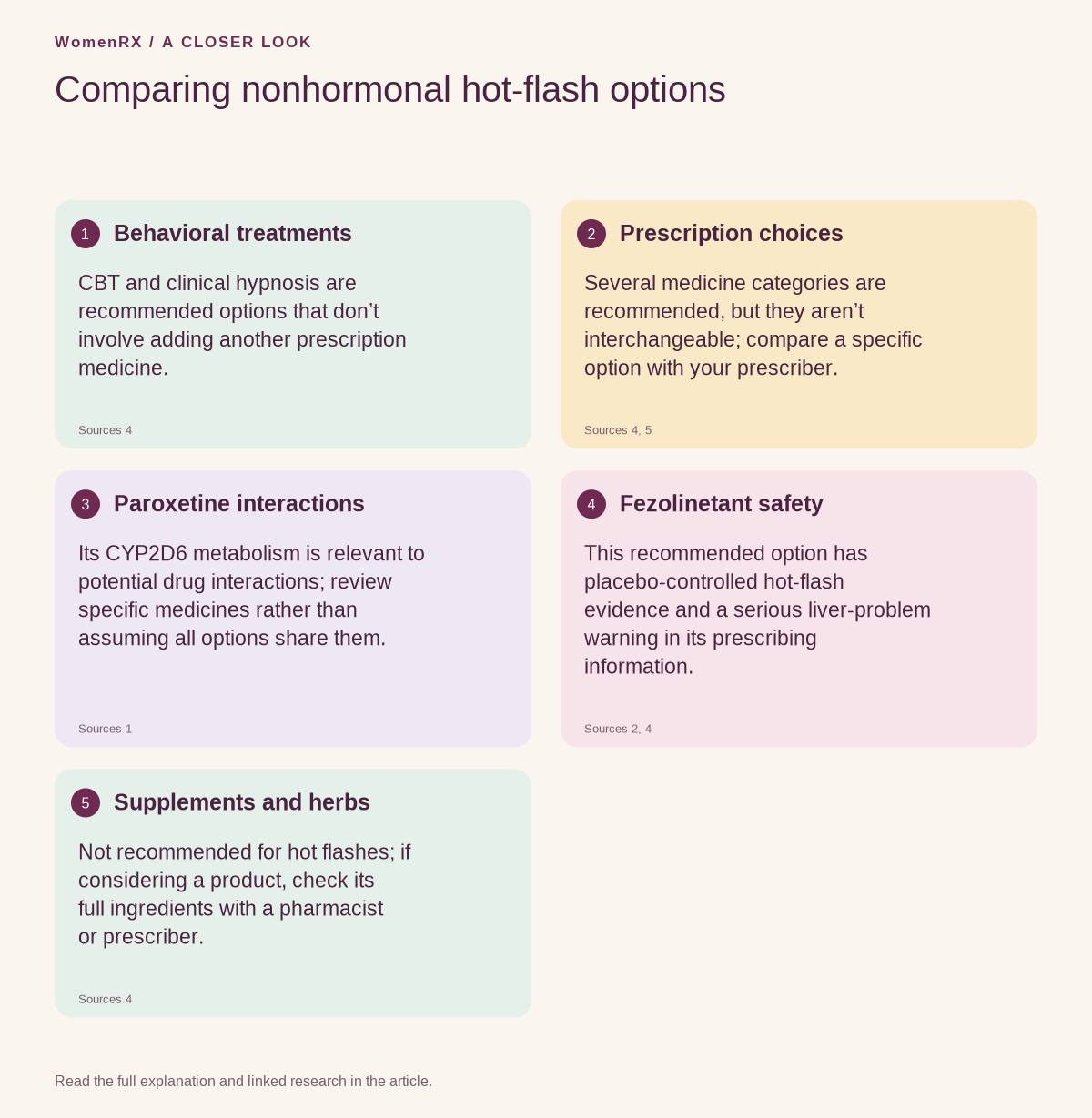
Comparing nonhormonal hot-flash options
Behavioral treatments: CBT and clinical hypnosis are recommended options that don’t involve adding another prescription medicine.4
Prescription choices: Several medicine categories are recommended, but they aren’t interchangeable; compare a specific option with your prescriber.45
Paroxetine interactions: Its CYP2D6 metabolism is relevant to potential drug interactions; review specific medicines rather than assuming all options share them.1
Fezolinetant safety: This recommended option has placebo-controlled hot-flash evidence and a serious liver-problem warning in its prescribing information.24
Supplements and herbs: Not recommended for hot flashes; if considering a product, check its full ingredients with a pharmacist or prescriber.4
Read the figure as text
These options differ in evidence, treatment type, and what to review before choosing.- Behavioral treatments: CBT and clinical hypnosis are recommended options that don’t involve adding another prescription medicine.4
- Prescription choices: Several medicine categories are recommended, but they aren’t interchangeable; compare a specific option with your prescriber.45
- Paroxetine interactions: Its CYP2D6 metabolism is relevant to potential drug interactions; review specific medicines rather than assuming all options share them.1
- Fezolinetant safety: This recommended option has placebo-controlled hot-flash evidence and a serious liver-problem warning in its prescribing information.24
- Supplements and herbs: Not recommended for hot flashes; if considering a product, check its full ingredients with a pharmacist or prescriber.4
More questions, answered
Does a supplement’s claim to support menopause mean it helps hot flashes?
No. A general menopause or wellness claim doesn’t establish hot-flash relief. The 2023 North American Menopause Society statement does not recommend supplements or herbal remedies as treatments for vasomotor symptoms. 4
Sources you can check
- BRISDELLE (PAROXETINE) CAPSULE [LEGACY PHARMA USA, INC.] | US prescribing information and patient instructionsAccessed 2026-09-25Return to first citation
- VEOZAH (FEZOLINETANT) TABLET, FILM COATED [ASTELLAS PHARMA US, INC.] | US prescribing information and patient instructionsAccessed 2026-09-25Return to first citation
- The 2022 hormone therapy position statement of The North American Menopause Society.“The 2022 Hormone Therapy Position Statement of The North American Menopause Society” Advisory Panel. · Menopause (New York, N.Y.) · 2022Return to first citation
- The 2023 nonhormone therapy position statement of The North American Menopause Society.Menopause (New York, N.Y.) · 2023Return to first citation
- Cooling the flames: Navigating menopausal vasomotor symptoms with nonhormone medications.Carson E, Vernon V, Cunningham L, Mathew S. · American journal of health-system pharmacy : AJHP : official journal of the American Society of Health-System Pharmacists · 2025Return to first citation