Alternatives to Fezolinetant for Menopause Hot Flashes
Hormone therapy, several nonhormonal medicines, and specific behavioral treatments are options to weigh according to your health history and preferences.
If fezolinetant isn’t available, affordable, suitable, or helping, alternatives to discuss include menopausal hormone therapy, SSRIs or SNRIs, gabapentin, oxybutynin, cognitive behavioral therapy, and clinical hypnosis. Hormone therapy is the most effective option overall, but its risks and suitability vary. Nonhormonal choices have different evidence and practical tradeoffs, so there isn’t one universal substitute. 4 5
Begin with what you need the alternative to solve
Fezolinetant is a nonhormonal prescription treatment for moderate to severe menopause-related hot flashes. Its US prescribing information calls for liver blood tests before treatment, monthly during the first three months, and again at months six and nine. If testing, another medical consideration, cost, access, or lack of relief is behind your search, naming that reason can help focus the comparison. 1
The main choice is not simply “hormones or no hormones.” There are several nonhormonal approaches, too, and they differ in how they’re used and in the strength of evidence supporting them. Current menopause guidance identifies hormone therapy as the most effective treatment overall, while also recommending several nonhormonal options. 4 5
If you’re open to hormone therapy
Menopausal hormone therapy may be worth discussing if you want the treatment with the strongest overall effect on hot flashes and are a suitable candidate. For women younger than 60 or within 10 years of menopause onset who have no contraindications, the benefit-risk balance is generally favorable for bothersome vasomotor symptoms. It appears less favorable when treatment begins after age 60 or more than 10 years after menopause onset, in part because some health risks increase. The balance also depends on treatment details, including type, route, duration, and whether a progestogen is used. 4
Your health history and preferences matter. The nonhormone position statement gives estrogen-dependent cancers and cardiovascular disease as examples of circumstances that can make hormone therapy unsuitable. If either is relevant to you, the question is how to find symptom relief within your circumstances, not whether you have to accept hot flashes without options. 4 5
If you prefer a nonhormonal prescription
SSRIs and SNRIs are recommended nonhormonal medicine classes for vasomotor symptoms. A review of treatments for menopause symptoms names venlafaxine as an example of an SNRI used for hot-flash relief. The best fit depends on your health history and treatment priorities; the guidance supports these classes, not a single medicine as the right choice for everyone. 5 6
Gabapentin is another recommended option. It’s used for other conditions as well, and general medication information lists sleepiness, tiredness, and dizziness among possible effects. If staying alert during the day is a priority, that tradeoff may be worth raising when considering it. 5 2 3
Oxybutynin is also a recommended option in the menopause guidance, though its evidence is rated differently from SSRIs/SNRIs and gabapentin. The guidance assigns it Levels I-II, compared with Level I for those other options. These evidence categories describe the strength of the supporting research; they don’t rank treatments by what will work best for you. 5
If cost or availability is the main barrier, ask which of the evidence-supported approaches are accessible through your coverage and which are appropriate for your health history. The available treatment recommendations don’t establish a lowest-cost option or compare prices.
If you’d rather try a non-drug approach
Cognitive behavioral therapy and clinical hypnosis are recommended nonhormonal treatments for vasomotor symptoms, each with Level I evidence in the menopause position statement. They may be worth considering if you prefer a non-drug option or want to compare approaches beyond prescription medicines. Weight loss is also listed as an option, but at a lower evidence level, Levels II-III. 5
This doesn’t mean every commonly suggested self-care practice has similar evidence. The same statement does not recommend supplements or herbal remedies, paced respiration, or acupuncture for vasomotor symptoms. They shouldn’t be assumed to be proven substitutes for fezolinetant or other evidence-supported treatments. 5
Match the option to the tradeoff
A useful way to narrow the discussion is to lead with your main constraint: “I’d like to avoid hormones,” “I’m concerned about side effects,” “I want to understand the liver testing involved,” or “Cost is the barrier.” Then ask which supported options fit that concern and your medical history. If hormone therapy is an option, its effectiveness and timing-related risks may be central; if it isn’t, you can compare nonhormonal medicines with behavioral approaches instead. 1 4 5
There isn’t a head-to-head ranking here that identifies one best replacement for every woman. The practical goal is to choose among options with different evidence and tradeoffs, rather than treating them as interchangeable.
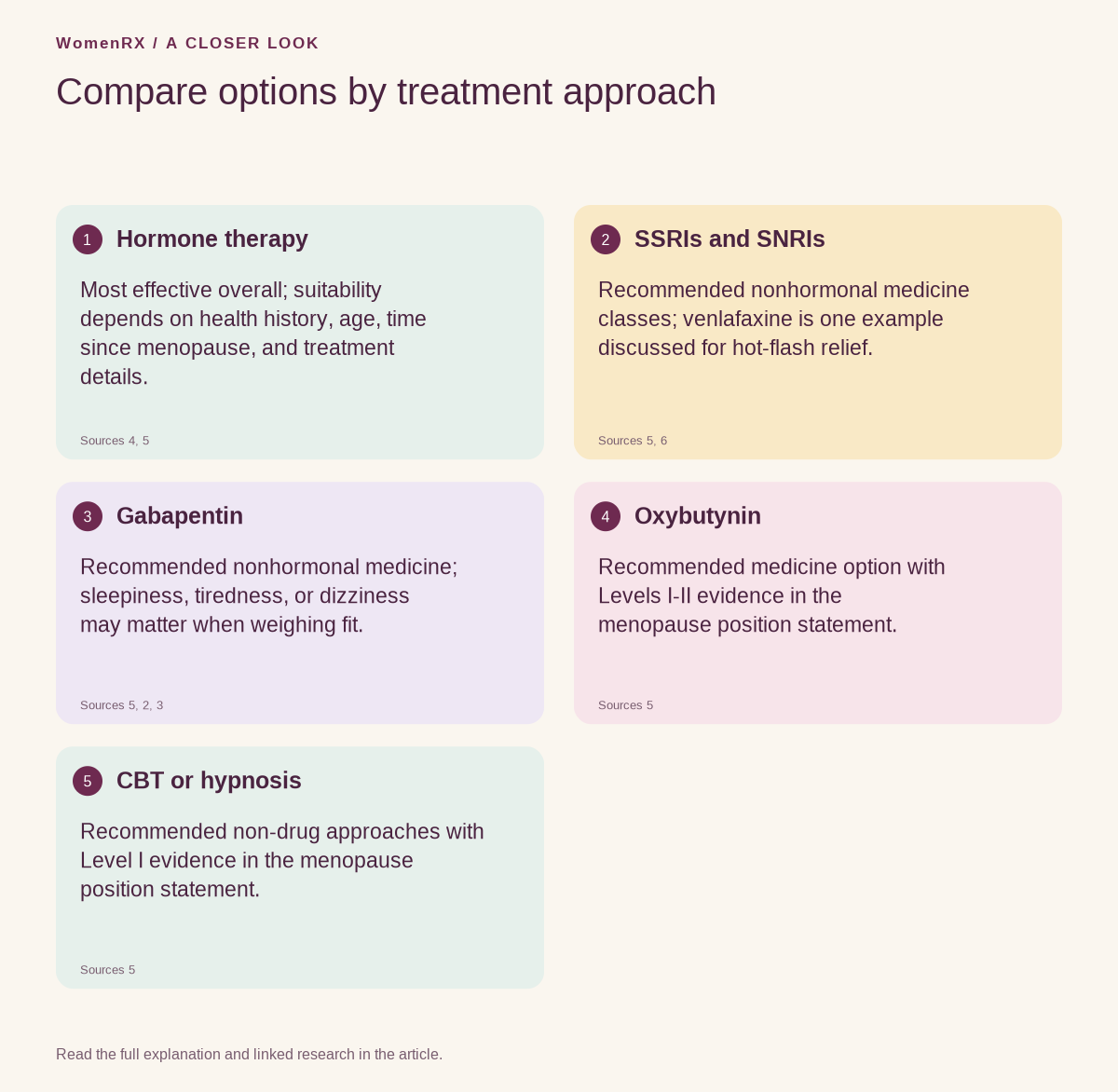
Compare options by treatment approach
Hormone therapy: Most effective overall; suitability depends on health history, age, time since menopause, and treatment details.45
SSRIs and SNRIs: Recommended nonhormonal medicine classes; venlafaxine is one example discussed for hot-flash relief.56
Gabapentin: Recommended nonhormonal medicine; sleepiness, tiredness, or dizziness may matter when weighing fit.523
Oxybutynin: Recommended medicine option with Levels I-II evidence in the menopause position statement.5
CBT or hypnosis: Recommended non-drug approaches with Level I evidence in the menopause position statement.5
Read the figure as text
These categories highlight differences in hormone preference, treatment format, and evidence. They are not a universal ranking.- Hormone therapy: Most effective overall; suitability depends on health history, age, time since menopause, and treatment details.45
- SSRIs and SNRIs: Recommended nonhormonal medicine classes; venlafaxine is one example discussed for hot-flash relief.56
- Gabapentin: Recommended nonhormonal medicine; sleepiness, tiredness, or dizziness may matter when weighing fit.523
- Oxybutynin: Recommended medicine option with Levels I-II evidence in the menopause position statement.5
- CBT or hypnosis: Recommended non-drug approaches with Level I evidence in the menopause position statement.5
More questions, answered
Are supplements a proven substitute for fezolinetant?
No. Menopause guidance does not recommend supplements or herbal remedies for vasomotor symptoms, so they shouldn’t be treated as proven equivalents to evidence-supported options. 5
Is hormone therapy always the right alternative?
No. It’s the most effective treatment overall for vasomotor symptoms, but its benefit-risk balance depends on factors such as age, time since menopause, treatment details, medical history, and preference. 4 5
Sources you can check
- VEOZAH (FEZOLINETANT) TABLET, FILM COATED [ASTELLAS PHARMA US, INC.] | US prescribing information and patient instructionsAccessed 2026-09-25Return to first citation
- About gabapentin - NHSAccessed 2026-09-25Return to first citation
- Side effects of gabapentin - NHSAccessed 2026-09-25Return to first citation
- The 2022 hormone therapy position statement of The North American Menopause Society.“The 2022 Hormone Therapy Position Statement of The North American Menopause Society” Advisory Panel. · Menopause (New York, N.Y.) · 2022Return to first citation
- The 2023 nonhormone therapy position statement of The North American Menopause Society.Menopause (New York, N.Y.) · 2023Return to first citation
- Nonhormonal Treatment of Vasomotor Symptoms of Menopause.Goyal A, Ekelmans A, Cerjak J, Frishman WH. · Cardiology in review · 2025Return to first citation