Fezolinetant vs hormone therapy for menopausal hot flashes
Both can reduce hot flashes, but the better fit depends on your other symptoms, health history, and the safety checks each option requires.
Menopausal hormone therapy (MHT) is considered the most effective treatment for hot flashes and may address other menopause concerns. Fezolinetant, sold as Veozah, is a nonhormonal oral medicine for moderate to severe hot flashes and night sweats. They haven’t been directly compared in the trial described below, so the choice depends on more than a ranking of hot-flash relief. 1 2 4
First, decide what needs relief
If hot flashes interrupt meetings, or night sweats keep waking you, relief is a reasonable treatment goal. Menopausal hormone therapy (MHT) and fezolinetant approach that goal differently. MHT is considered the most effective treatment for menopause-related hot flashes. Fezolinetant, sold as Veozah, is a nonhormonal prescription option for moderate to severe hot flashes and night sweats. 1 2 3
The first distinction is whether hot flashes are the whole problem. Hormone therapy can also treat genitourinary symptoms of menopause and has been shown to prevent bone loss and fractures. Fezolinetant’s indication is specifically for vasomotor symptoms, meaning hot flashes and night sweats. If vaginal or urinary symptoms are bothering you too, don’t assume a hot-flash treatment will cover them. 1 2
What a hot-flash trial can, and can’t, compare
Fezolinetant blocks the NK3 receptor rather than supplying hormones. In SKYLIGHT 1, a randomized trial, women ages 40 to 65 who averaged at least seven moderate to severe hot flashes a day received fezolinetant or placebo. After 12 weeks, the two fezolinetant groups had reductions in daily hot-flash frequency that were, on average, 2.39 and 2.55 greater than the reduction in the placebo group. Those are differences between trial groups, not a prediction of your individual result. 1 4
SKYLIGHT 1 did not compare fezolinetant with MHT. So its results show that fezolinetant can reduce hot flashes compared with placebo, but they cannot tell you how the two treatments would perform against each other for the same woman. The guidance describing MHT as the most effective option draws on the broader hormone-therapy evidence, not that fezolinetant trial. 2 3 4
The safety discussions are different
MHT isn’t one fixed treatment. Its risks differ by treatment type, dose, duration, route, when it’s started, and whether a progestogen is used. Menopause guidance describes the benefit-risk balance as favorable for women younger than 60 or within 10 years of menopause onset who have no contraindications. Starting after age 60 or more than 10 years after menopause onset appears less favorable, partly because the absolute risks of coronary heart disease, stroke, blood clots, and dementia are greater. That guidance informs a conversation; it doesn’t calculate your personal risk. 2
Medical history can change that conversation. The nonhormone therapy position statement identifies estrogen-dependent cancers and cardiovascular disease as examples of reasons a woman may not be a good candidate for hormone therapy. A preference not to use hormones is also a valid reason to discuss nonhormonal options; it doesn’t, by itself, mean MHT would be unsafe for you. 3
Fezolinetant has a different set of checks. It is a once-daily oral tablet, and its US prescribing information calls for liver blood tests before treatment, monthly for the first three months, and again at months six and nine. It says not to use the medicine if you have cirrhosis, severe kidney problems or kidney failure, or take certain medicines called CYP1A2 inhibitors. A prescriber or pharmacist can check whether a medicine you already take falls into that category. 1
The liver warning also matters after treatment starts. If you develop symptoms such as unusual tiredness, reduced appetite, nausea or vomiting, itching, yellow skin or eyes, pale stools, dark urine, or abdominal pain, the prescribing information says to stop fezolinetant right away and call your healthcare provider. 1
Compare the actual plans, not just the names
One practical question is what treatment is being proposed. For MHT, ask which formulation and route are under consideration and how your age, menopause timing, and medical history affect that choice. For fezolinetant, ask whether your medicines and health history fit its restrictions and whether the liver-test schedule is workable. 1 2
Then return to your goals. If hot flashes are your main concern and you want to avoid hormones, fezolinetant is an evidence-supported option. If you’re also seeking help with other menopause symptoms, MHT may offer benefits fezolinetant isn’t indicated to provide. Neither description settles the choice without the specifics of your health and the treatment being considered. 1 2 3
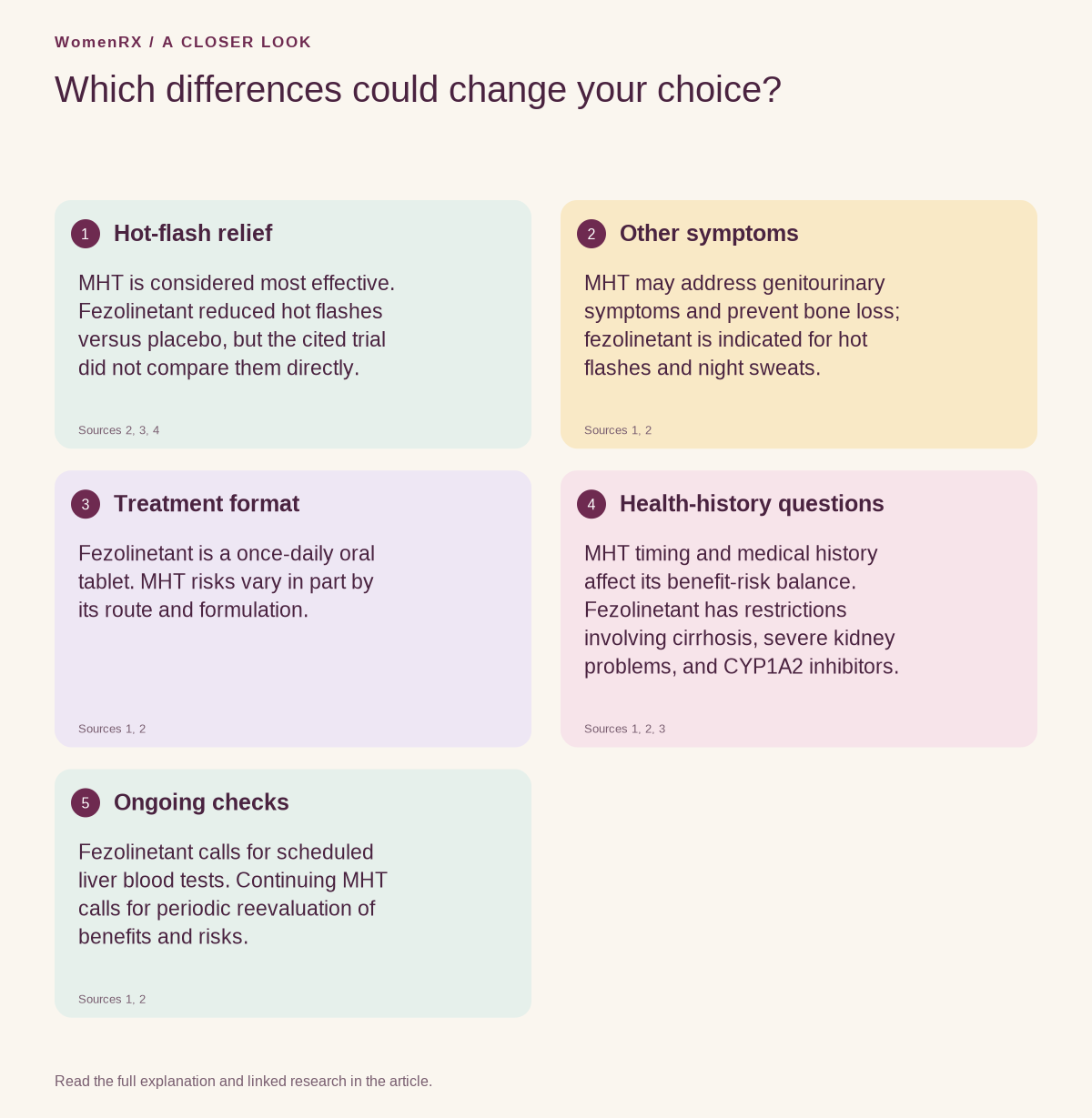
Which differences could change your choice?
Hot-flash relief: MHT is considered most effective. Fezolinetant reduced hot flashes versus placebo, but the cited trial did not compare them directly.234
Other symptoms: MHT may address genitourinary symptoms and prevent bone loss; fezolinetant is indicated for hot flashes and night sweats.12
Treatment format: Fezolinetant is a once-daily oral tablet. MHT risks vary in part by its route and formulation.12
Health-history questions: MHT timing and medical history affect its benefit-risk balance. Fezolinetant has restrictions involving cirrhosis, severe kidney problems, and CYP1A2 inhibitors.123
Ongoing checks: Fezolinetant calls for scheduled liver blood tests. Continuing MHT calls for periodic reevaluation of benefits and risks.12
Read the figure as text
This comparison separates symptom coverage, treatment format, and safety considerations rather than ranking the options for every woman.- Hot-flash relief: MHT is considered most effective. Fezolinetant reduced hot flashes versus placebo, but the cited trial did not compare them directly.234
- Other symptoms: MHT may address genitourinary symptoms and prevent bone loss; fezolinetant is indicated for hot flashes and night sweats.12
- Treatment format: Fezolinetant is a once-daily oral tablet. MHT risks vary in part by its route and formulation.12
- Health-history questions: MHT timing and medical history affect its benefit-risk balance. Fezolinetant has restrictions involving cirrhosis, severe kidney problems, and CYP1A2 inhibitors.123
- Ongoing checks: Fezolinetant calls for scheduled liver blood tests. Continuing MHT calls for periodic reevaluation of benefits and risks.12
More questions, answered
What if vaginal symptoms bother me, but systemic hormone therapy isn’t a fit?
Menopause guidance describes treatments aimed specifically at bothersome genitourinary symptoms, including low-dose vaginal estrogen and other options, when over-the-counter measures haven’t helped and systemic hormone therapy isn’t indicated. That’s a separate treatment discussion from choosing a medicine for hot flashes. 2
Sources you can check
- VEOZAH (FEZOLINETANT) TABLET, FILM COATED [ASTELLAS PHARMA US, INC.] | US prescribing information and patient instructionsAccessed 2026-09-25Return to first citation
- The 2022 hormone therapy position statement of The North American Menopause Society.“The 2022 Hormone Therapy Position Statement of The North American Menopause Society” Advisory Panel. · Menopause (New York, N.Y.) · 2022Return to first citation
- The 2023 nonhormone therapy position statement of The North American Menopause Society.Menopause (New York, N.Y.) · 2023Return to first citation
- Fezolinetant for treatment of moderate-to-severe vasomotor symptoms associated with menopause (SKYLIGHT 1): a phase 3 randomised controlled study.Lederman S, Ottery FD, Cano A, Santoro N, Shapiro M, Stute P, Thurston RC, English M, Franklin C, Lee M, Neal-Perry G. · Lancet (London, England) · 2023Return to first citation