Hot Flashes: How to Compare Treatment Options
Hormone therapy usually offers the strongest relief, but several nonhormonal treatments have evidence behind them too.
Menopausal hormone therapy is the most effective treatment for hot flashes and night sweats, but whether it fits you depends on your health history and when you start it relative to menopause. Evidence-supported alternatives include menopause-focused cognitive behavioral therapy and several prescription medicines. The useful choice is the one that addresses what’s disrupting your life while fitting your risks and preferences. 12
Hot flashes can be brief and still take up a lot of space in your day. A night sweat that wakes you repeatedly, or a flash that makes you stop what you’re doing, is a reasonable reason to consider treatment. Hot flashes and night sweats are called vasomotor symptoms. They can begin during perimenopause, when periods are changing, and continue after menopause. 45
Start with the kind of relief you need
Start by identifying what you most want to change: the frequency of hot flashes, their interruption of daily activities, or the sleep disruption that comes with night sweats. An option’s evidence for one outcome should not be taken as evidence for all three. For example, if the flashes are frequent during work, you may put a high priority on reducing episodes. If you’re mainly distressed by the cycle of waking, worrying about sleep, and struggling the next day, a treatment that addresses that experience may also appeal to you.
A short record can make that distinction clearer. Note roughly how often flashes or night sweats happen, whether they wake you or interrupt an activity, and which change would matter most to you. Hot-flash trials have used diaries to assess frequency and severity, while clinical reviews recognize effects on quality of life and work ability. This isn’t a test you have to pass to deserve help. 64
Hormone therapy offers the strongest symptom relief
Menopausal hormone therapy remains the most effective treatment for vasomotor symptoms. Its risks aren’t one fixed number: they vary with the type of therapy, how it’s given, how long it’s used, when it’s started, and whether a progestogen is used. Those details belong in the treatment decision, rather than in a blanket verdict that hormones are right or wrong for everyone. 1
Timing is one important part of that decision. The Menopause Society’s 2022 position statement finds a generally favorable benefit-risk balance for bothersome hot flashes in women younger than 60 or within 10 years of menopause onset who have no contraindications. Starting after age 60 or more than 10 years after menopause onset appears less favorable because the absolute risks of coronary heart disease, stroke, blood clots, and dementia are greater. These are broad guidance categories, not a prediction of your individual risk. 1
If hormone therapy interests you, the practical discussion is about your menopausal stage, medical history, preferred form of treatment, and how its benefits and risks would be reassessed over time. If you don’t want hormones, or they aren’t suitable for you, there are other supported choices. 12
Nonhormonal care isn’t one single alternative
Menopause-focused cognitive behavioral therapy (CBT) offers a therapy-based route if you prefer not to take hormone therapy. Both The Menopause Society and NICE support it for vasomotor symptoms; The Menopause Society also recommends clinical hypnosis as a nonhormonal option. A recommendation for CBT does not tell you how many fewer flashes to expect from a particular program. If you try it, judge its value by the changes that matter to you, such as how often symptoms interrupt your day or sleep. 25
Several prescription medicines have evidence for hot-flash relief, but the recommendations distinguish them. The Menopause Society gives SSRIs or SNRIs and gabapentin its highest evidence rating, while oxybutynin has a rating that includes limited or inconsistent evidence. NICE, however, advises against routinely offering SSRIs or SNRIs first-line for hot flashes alone. These ratings and treatment-order recommendations do not establish which medicine would work best or be safest for you. Expected relief, side effects, interactions with other medicines, and your health history still matter when choosing among them. 25
Fezolinetant has a more specific mechanism: it blocks a neurokinin-3 receptor involved in the brain’s temperature regulation. In a 12-week randomized trial involving 87 generally healthy menopausal women aged 40 to 65 with moderate or severe symptoms, it reduced the mean frequency of moderate or severe flashes by five episodes per day more than placebo at week 12. The most common fezolinetant-related adverse event reported in that small trial was a gastrointestinal disorder, in six participants. NICE recommends fezolinetant as an option for moderate to severe symptoms when hormone therapy is unsuitable. That makes it a distinct option if hormone therapy does not fit, although its side effects and suitability still need consideration. 65
Elinzanetant blocks two neurokinin receptors rather than the one targeted by fezolinetant. Trials reported fewer hot flashes versus placebo and improvements in measured sleep disturbance, with benefits maintained for up to 50 weeks. The trials included women with symptoms following natural or surgical menopause and women whose symptoms were caused by endocrine therapy for breast cancer. That range may matter if your circumstances resemble one of those groups. The review describes elinzanetant as generally well tolerated, but neither its trials nor the fezolinetant trial directly compares these medicines with each other or establishes which has fewer risks. 36
Put supplements and everyday comforts in perspective
You can still use simple comforts that make a hot flash easier to get through. The distinction is between feeling more comfortable and having good evidence that a strategy reliably treats vasomotor symptoms. The Menopause Society does not recommend cooling techniques or avoiding triggers as evidence-based hot-flash treatments. Its review also does not recommend supplements or herbal remedies for this purpose. 2
There is some disagreement in how guidance describes particular supplements: NICE notes some evidence that isoflavones or black cohosh may relieve symptoms, while warning that the safety, quality, and purity of unregulated preparations can be uncertain and that medicine interactions have been reported. That uncertainty matters if you’re considering a supplement instead of an established treatment or alongside another medicine. 52
The choice doesn’t have to begin with a commitment to one treatment forever. Begin with the problem you most want to change, then compare options on relief, personal risks, and what you’re willing to take or try. For hormone therapy in particular, continuing benefits and risks should be revisited periodically. 1
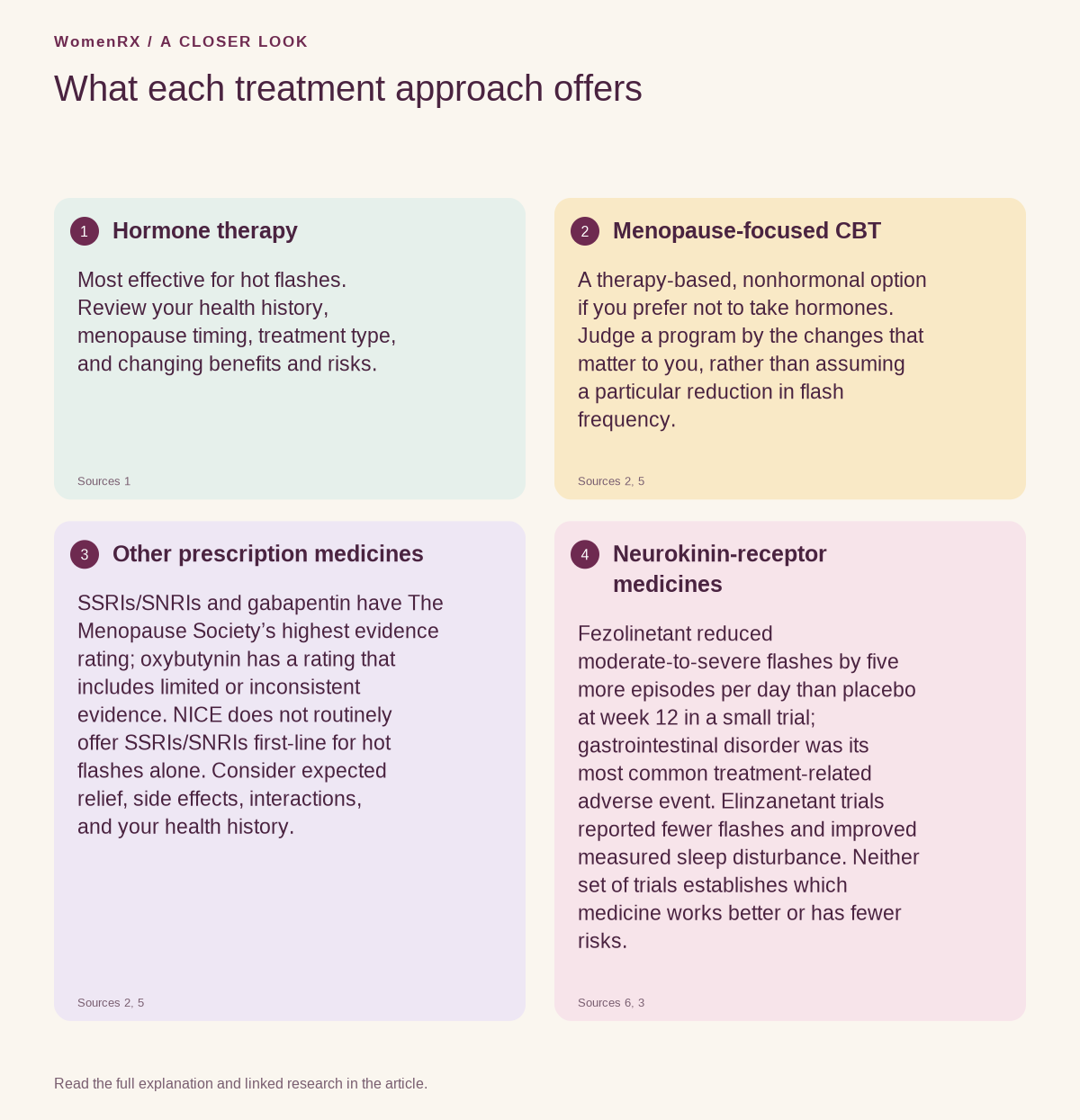
What each treatment approach offers
Hormone therapy: Most effective for hot flashes. Review your health history, menopause timing, treatment type, and changing benefits and risks.1
Menopause-focused CBT: A therapy-based, nonhormonal option if you prefer not to take hormones. Judge a program by the changes that matter to you, rather than assuming a particular reduction in flash frequency.25
Other prescription medicines: SSRIs/SNRIs and gabapentin have The Menopause Society’s highest evidence rating; oxybutynin has a rating that includes limited or inconsistent evidence. NICE does not routinely offer SSRIs/SNRIs first-line for hot flashes alone. Consider expected relief, side effects, interactions, and your health history.25
Neurokinin-receptor medicines: Fezolinetant reduced moderate-to-severe flashes by five more episodes per day than placebo at week 12 in a small trial; gastrointestinal disorder was its most common treatment-related adverse event. Elinzanetant trials reported fewer flashes and improved measured sleep disturbance. Neither set of trials establishes which medicine works better or has fewer risks.63
Read the figure as text
Compare the main approaches by the benefit they’re used for and the question that helps narrow your choice.- Hormone therapy: Most effective for hot flashes. Review your health history, menopause timing, treatment type, and changing benefits and risks.1
- Menopause-focused CBT: A therapy-based, nonhormonal option if you prefer not to take hormones. Judge a program by the changes that matter to you, rather than assuming a particular reduction in flash frequency.25
- Other prescription medicines: SSRIs/SNRIs and gabapentin have The Menopause Society’s highest evidence rating; oxybutynin has a rating that includes limited or inconsistent evidence. NICE does not routinely offer SSRIs/SNRIs first-line for hot flashes alone. Consider expected relief, side effects, interactions, and your health history.25
- Neurokinin-receptor medicines: Fezolinetant reduced moderate-to-severe flashes by five more episodes per day than placebo at week 12 in a small trial; gastrointestinal disorder was its most common treatment-related adverse event. Elinzanetant trials reported fewer flashes and improved measured sleep disturbance. Neither set of trials establishes which medicine works better or has fewer risks.63
More questions, answered
Do I have to wait until my periods stop to seek help?
No. Hot flashes can start during perimenopause, when your menstrual cycle is changing. Tell your clinician about both the symptoms and any period changes so the discussion reflects your stage of menopause. 5
Is hormone therapy the only option with good evidence?
No. It remains the most effective treatment overall, but an evidence review also recommends menopause-focused CBT and several nonhormonal prescription options for vasomotor symptoms. The strongest choice for you depends on suitability and what you want treatment to change. 12
Sources you can check
- The 2022 hormone therapy position statement of The North American Menopause Society.“The 2022 Hormone Therapy Position Statement of The North American Menopause Society” Advisory Panel. · Menopause (New York, N.Y.) · 2022Return to first citation
- The 2023 nonhormone therapy position statement of The North American Menopause Society.Menopause (New York, N.Y.) · 2023Return to first citation
- Consistency of efficacy and safety of elinzanetant for vasomotor symptoms and sleep disturbance associated with menopause across different populations: a review of the OASIS clinical trial program.Pinkerton JV, Simon JA, Panay N, Nappi RE, Brennan DJ, Donders G, Soares CN, Maki P, Caetano C, Haberland C, Laapas K, Zuurman L, Cardoso F. · Maturitas · 2026Return to first citation
- Risk factors, management and consequences of severe menopausal vasomotor symptoms.Hickey M, Huguenin A, Chung HF, Mishra GD. · Nature reviews. Endocrinology · 2026Return to first citation
- Recommendations | Menopause: identification and management | Guidance | NICEAccessed 2026-09-25Return to first citation
- Treatment of Menopausal Vasomotor Symptoms With Fezolinetant, a Neurokinin 3 Receptor Antagonist: A Phase 2a Trial.Depypere H, Timmerman D, Donders G, Sieprath P, Ramael S, Combalbert J, Hoveyda HR, Fraser GL. · The Journal of clinical endocrinology and metabolism · 2019Return to first citation