Hot Flashes in Your 40s: Could It Be Perimenopause?
A hot flash can be a clue, but your menstrual history gives it much more context.
Yes, hot flashes in your 40s could be related to perimenopause, especially if your periods are also becoming irregular. But age and hot flashes don’t settle the question on their own. A review of diagnostic studies found that menstrual history and age are more useful than relying on any single symptom or hormone test.3 Hot flashes were also reported in a premenopausal group, mainly among anovulatory women.7
Start with what’s happening to your periods
If a sudden wave of heat has you wondering about perimenopause, look beyond the episode itself. Have your periods begun arriving less predictably than they used to? Have you missed some? Changes in menstrual history, considered alongside age, are central to assessing perimenopause. Hot flashes add a clue, but no single symptom or laboratory test can confirm or rule out the transition by itself.3
That distinction matters in your 40s. Perimenopause is possible, but being in this age group doesn’t mean every new symptom comes from changing reproductive hormones. In a cross-sectional study of women at different reproductive stages, hot flashes were reported in the premenopausal group, mainly among anovulatory women, as well as after menopause. The study describes how often symptoms appeared in those groups; it cannot diagnose the cause of an individual episode.7
You don’t need to decide whether a sensation “counts” as a hot flash before bringing it up. Describe what happens in your own words: whether the heat comes on suddenly, whether you sweat, when it occurs, and whether it wakes you. That description, paired with your menstrual history, is more useful than a label alone.32
Notice what happens around the heat
Nighttime symptoms can be especially disruptive. In a small study of 30 women ages 40 to 60 who associated their symptoms with menopause, hot flashes, night sweats, waking during the night, and early-morning waking were among the most commonly reported symptoms. The women often described connections between their symptoms, particularly between hot flashes and disturbed sleep. The study captures their experiences; it doesn’t show that every nighttime awakening is caused by a hot flash.2
For example, there’s a useful difference between “I wake up hot and sweaty, then have trouble falling back asleep” and “I wake up for another reason and notice I feel warm.” You don’t have to work out the cause yourself. The order of events helps explain what you’re experiencing and how much it’s affecting you.
Leave room for another explanation
Perimenopause isn’t the only possible explanation for a new symptom. If you take hormone therapy, side effects can resemble menopause symptoms, so a change that occurs while taking it deserves a closer look rather than an automatic assumption that perimenopause is progressing.1 Make a note of when the heat episodes began and whether that coincided with a change in a medicine you take. That timing is a question to discuss, not proof that the medicine caused them.
Bleeding and pelvic pain also deserve attention in their own right. A clinical review of conditions across the menopausal transition says abnormal uterine bleeding and pelvic pain should be evaluated rather than automatically attributed to the transition.4 If those changes are happening alongside episodes of heat, mention both.
What’s worth bringing to a conversation about it?
A few details can make the pattern clearer without turning symptom tracking into a daily chore:
- Your recent menstrual pattern: What was usual for you, and what has changed? Menstrual history and age carry more diagnostic weight than a hot flash alone.3
- The episodes themselves: When do they happen, and do they interrupt sleep or daily life? Women in one small symptom study often described the sequence and connections among their symptoms.2
- Changes in treatment or medicines: Mention any recent changes, particularly if you use hormone therapy, whose side effects may overlap with menopause symptoms.1
- Bleeding or pelvic pain: Bring these up separately instead of folding them into a general description of “hormonal symptoms.”4
If the episodes are bothering you, you can also ask about relief while sorting out the cause. Treatment isn’t limited to enduring hot flashes or choosing hormone therapy. The North American Menopause Society identifies hormone therapy as the most effective treatment for menopause-related vasomotor symptoms and recommends several nonhormone options, including cognitive behavioral therapy and certain prescription medicines. Which approach fits depends on your symptoms and health history.56
The useful next move is to put the heat episodes beside your cycle history, not to make either one deliver a verdict alone. That gives you a clearer starting point for understanding what’s changing and what needs a separate look.3
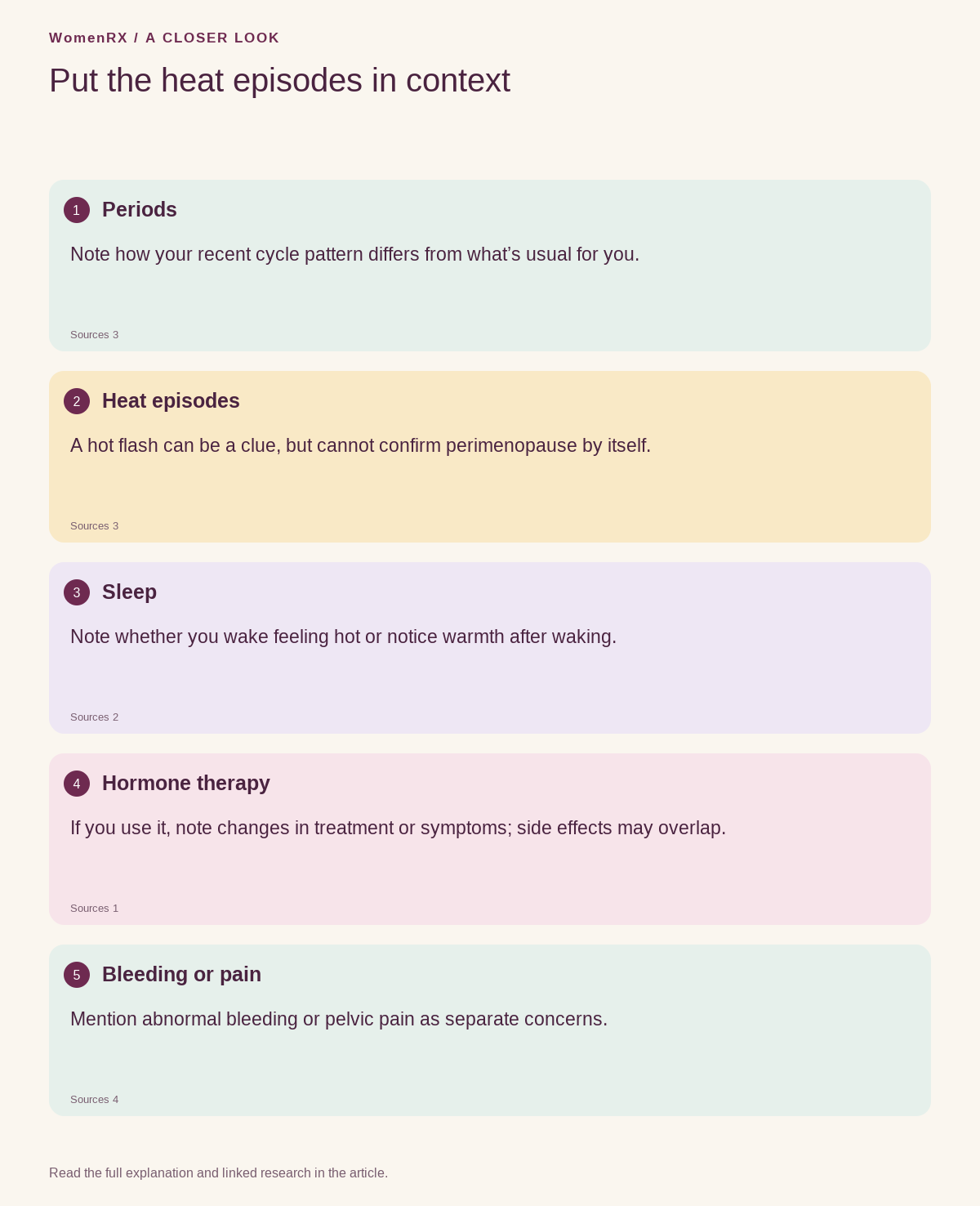
Put the heat episodes in context
Periods: Note how your recent cycle pattern differs from what’s usual for you.3
Heat episodes: A hot flash can be a clue, but cannot confirm perimenopause by itself.3
Sleep: Note whether you wake feeling hot or notice warmth after waking.2
Hormone therapy: If you use it, note changes in treatment or symptoms; side effects may overlap.1
Bleeding or pain: Mention abnormal bleeding or pelvic pain as separate concerns.4
Read the figure as text
These details help separate a symptom description from an assumption about its cause.- Periods: Note how your recent cycle pattern differs from what’s usual for you.3
- Heat episodes: A hot flash can be a clue, but cannot confirm perimenopause by itself.3
- Sleep: Note whether you wake feeling hot or notice warmth after waking.2
- Hormone therapy: If you use it, note changes in treatment or symptoms; side effects may overlap.1
- Bleeding or pain: Mention abnormal bleeding or pelvic pain as separate concerns.4
More questions, answered
Would a hormone blood test tell me for sure?
No single test is accurate enough by itself to confirm or rule out perimenopause. A systematic review concluded that assessment should rely on menstrual history and age rather than a laboratory result alone.3
Can hot flashes happen before menopause?
Yes. A cross-sectional study reported hot flashes in its premenopausal group overall, mainly among women classified as anovulatory. A hot flash alone still doesn’t establish why it happened.73
Sources you can check
- Side effects of hormone replacement therapy (HRT) - NHSAccessed 2026-09-25Return to first citation
- Midlife women's symptom cluster heuristics: evaluation of an iPad application for data collection.Woods NF, Ismail R, Linder LA, Macpherson CF. · Menopause (New York, N.Y.) · 2015Return to first citation
- Is this woman perimenopausal?Bastian LA, Smith CM, Nanda K. · JAMA · 2003Return to first citation
- Uterine Leiomyomas Across the Menopausal Transition.Encalada-Soto D, Hochberg LS, Laughlin-Tommaso S. · Obstetrics and gynecology · 2026Return to first citation
- The 2022 hormone therapy position statement of The North American Menopause Society.“The 2022 Hormone Therapy Position Statement of The North American Menopause Society” Advisory Panel. · Menopause (New York, N.Y.) · 2022Return to first citation
- The 2023 nonhormone therapy position statement of The North American Menopause Society.Menopause (New York, N.Y.) · 2023Return to first citation
- Hot flashes, insomnia, and the reproductive stages: a cross-sectional observation of women from the EPISONO study.Hachul H, Castro LS, Bezerra AG, Pires GN, Poyares D, Andersen ML, Bittencourt LR, Tufik S. · Journal of clinical sleep medicine : JCSM : official publication of the American Academy of Sleep Medicine · 2021Return to first citation