What Causes Hot Flashes? Hormones and Temperature Control
Changing ovarian estrogen may affect the brain’s temperature-control system, helping explain why hot flashes can arrive suddenly during the menopause transition.
Hot flashes are linked to declining ovarian estrogen during the menopause transition, but estrogen loss alone doesn’t explain why they happen. A leading model is that changing estradiol affects brain pathways that regulate temperature and narrows the body’s thermoneutral zone, its comfortable operating range. That may make temperature-control responses easier to trigger, though the pathway isn’t fully understood and symptoms vary. 1 3 4
Estrogen is part of the story, not the whole story
As ovarian activity changes around menopause, estrogen levels can decline. Some women then experience hot flashes, also called vasomotor symptoms: sudden warmth, often in the face, neck, or chest, sometimes with sweating. The association with changing estrogen is well recognized, but a drop in estrogen by itself doesn’t explain every flash or predict the same experience for everyone. 1 3 4
A leading explanation centers on the brain’s temperature-control system. A review describes a possible narrowing of the thermoneutral zone as estradiol declines. Put simply, this is the range in which the body can maintain its temperature without needing to adjust actively. If that range becomes narrower, a change that once felt tolerable may be more likely to prompt a temperature-regulating response. This is a useful model for how a flash might begin, not a fully settled account of the process. 3
Where the brain fits in
Temperature regulation involves signals in the brain, including the hypothalamus. Research reviews point to altered signaling in hypothalamic KNDy neurons as one part of menopause-related changes in thermoregulation. These findings help explain why hot flashes are understood as more than a direct, simple reaction to an estrogen level: hormone changes may affect the systems that regulate temperature, while other brain signals also matter. 4
The proposed sequence is therefore: ovarian estrogen declines, brain temperature-control signaling changes, and the body may respond with the warmth and sweating that characterize a hot flash. Each link is plausible, but the complete cause-and-effect sequence hasn’t been established for every individual woman. 1 3 4
Why symptoms don’t follow one pattern
Some women have mild symptoms, while others find them more severe; not every woman experiences hot flashes. The menopause connection doesn’t mean everyone’s symptoms will start at the same point or feel alike. A biological model can describe a possible pathway, but it can’t explain an individual woman’s exact pattern on its own. 1 2
That variation is a reason to think of hot flashes as a response involving both hormone changes and temperature-control pathways, rather than as a simple readout of estrogen. The proposed mechanism helps make sense of the sudden wave of heat. It doesn’t establish that every episode of flushing has the same cause.
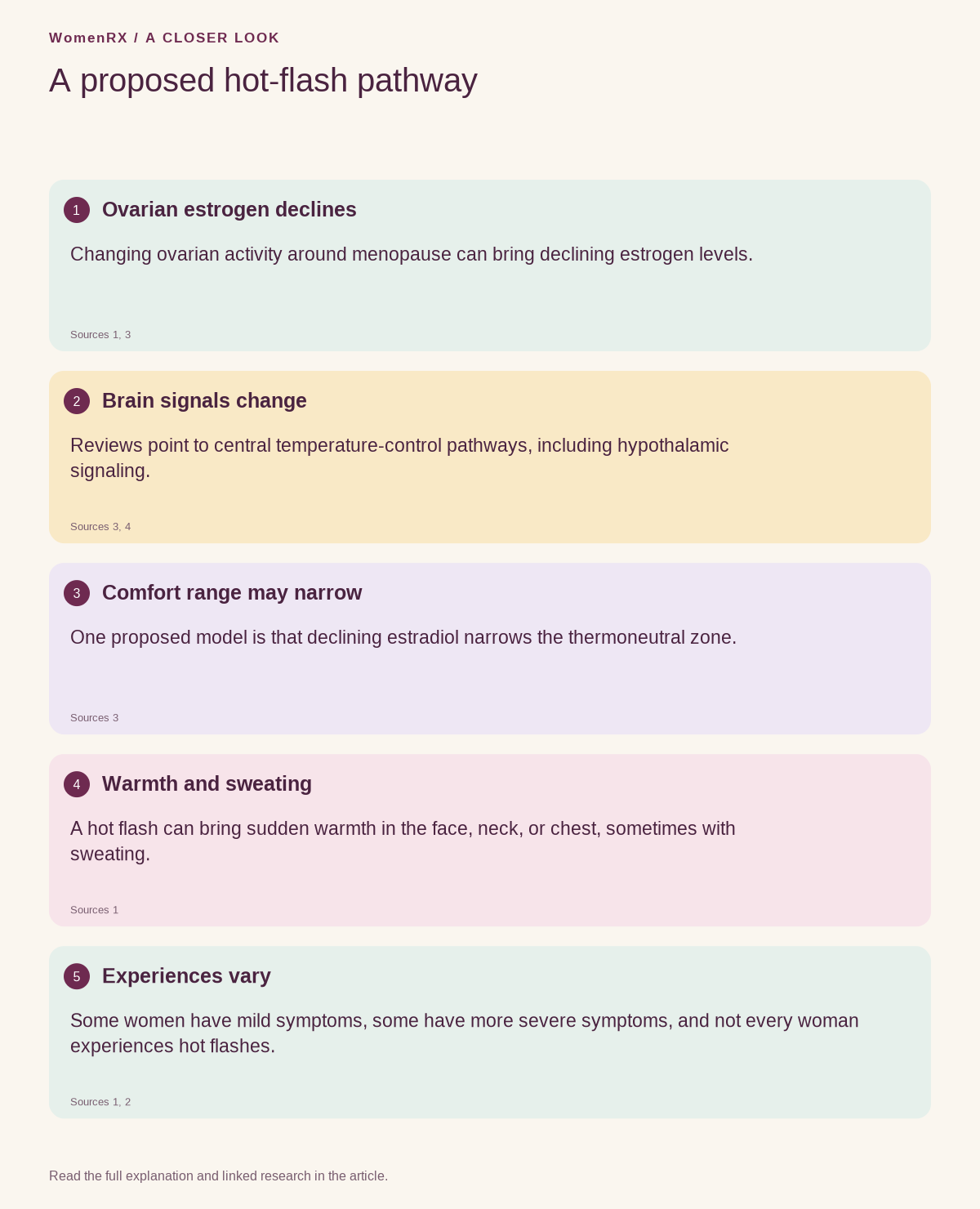
A proposed hot-flash pathway
Ovarian estrogen declines: Changing ovarian activity around menopause can bring declining estrogen levels.13
Brain signals change: Reviews point to central temperature-control pathways, including hypothalamic signaling.34
Comfort range may narrow: One proposed model is that declining estradiol narrows the thermoneutral zone.3
Warmth and sweating: A hot flash can bring sudden warmth in the face, neck, or chest, sometimes with sweating.1
Experiences vary: Some women have mild symptoms, some have more severe symptoms, and not every woman experiences hot flashes.12
Read the figure as text
This figure shows a leading model connecting menopause-related estrogen changes, brain temperature regulation, and hot-flash symptoms. It is a proposed explanation, not a definitive sequence for every woman.- Ovarian estrogen declines: Changing ovarian activity around menopause can bring declining estrogen levels.13
- Brain signals change: Reviews point to central temperature-control pathways, including hypothalamic signaling.34
- Comfort range may narrow: One proposed model is that declining estradiol narrows the thermoneutral zone.3
- Warmth and sweating: A hot flash can bring sudden warmth in the face, neck, or chest, sometimes with sweating.1
- Experiences vary: Some women have mild symptoms, some have more severe symptoms, and not every woman experiences hot flashes.12
Sources you can check
- CLIMARA PRO (ESTRADIOL AND LEVONORGESTREL) PATCH [BAYER HEALTHCARE PHARMACEUTICALS INC.] | US prescribing information and patient instructionsAccessed 2026-09-25Return to first citation
- CLIMARA (ESTRADIOL) PATCH [BAYER HEALTHCARE PHARMACEUTICALS INC.] | US prescribing information and patient instructionsAccessed 2026-09-25Return to first citation
- [Understanding menopause. Pathophysiology of hot flashes].Trémollières F. · Medecine sciences : M/S · 2025Return to first citation
- Non-hormonal pharmacological interventions for managing vasomotor symptoms-how can we help: 2024 landscape.Pertynska-Marczewska M, Pertynski T. · European journal of obstetrics, gynecology, and reproductive biology · 2024Return to first citation