Night Sweats and Hormones: What the Link Can Tell You
Changing estradiol may contribute to menopause-related night sweats, but sweating alone can’t show what caused it or reveal your hormone level.
Night sweats are a recognized menopause symptom. A review describes how falling estradiol may affect brain systems involved in temperature regulation, offering a plausible explanation for episodes during the menopause transition or after menopause. But anxiety, alcohol or drug use, excessive sweating, and medicines can also be involved, so the symptom alone can’t identify its cause or your estradiol level. 1 2 4
How estradiol may be part of the picture
Night sweats can occur along with other menopause-related symptoms. As ovarian estrogen levels fall, some women experience sudden heat and sweating. A review of menopause research describes a possible pathway: lower estradiol affects the brain’s temperature-regulating center and related neurotransmitter activity. That gives a biological explanation for menopause-related episodes, but it doesn’t mean every night sweat is caused by hormones. 1 2 4
The distinction matters in perimenopause as well as after menopause. A symptom can fit with reproductive hormone changes without proving that those changes caused it. Night sweats don’t tell you your estradiol level, and by themselves they can’t establish your menopause stage.
Individual variation is part of the picture, too. In a study of 102 recently postmenopausal White women, researchers reported associations between some genetic variations and night-sweat frequency or estrogen measures. Those findings describe associations in that study group; they don’t provide a way to identify the cause of one person’s sweating. 3
Other explanations deserve a place in the picture
Menopause is one possible cause, not the only one. Anxiety, alcohol or drug use, and hyperhidrosis, a condition involving excessive sweating, are among other causes listed for night sweats. A medicine may also be a factor. A warm room or heavy bedding can cause ordinary nighttime sweating, which isn’t the same as repeatedly waking with soaked clothes or sheets in a cool room. 1
So, timing can offer context, but it can’t settle the question on its own. For example, night sweats occurring alongside other menopause symptoms may fit a menopause-related explanation; they still don’t rule out another cause. The available genetic study also shows why a single symptom shouldn’t be treated as a direct readout of hormone levels: symptom frequency and estrogen measures varied in relation to genetic differences, without establishing an individual diagnostic test. 3
When to get recurring sweats checked
If night sweats regularly wake you, soak your clothes or bedding, or worry you, arrange a medical evaluation rather than assuming they’re hormonal. The same is true if they come with a very high temperature, feeling hot, cold, or shivery, a cough, diarrhea, or unexplained weight loss. These signs don’t identify a cause by themselves, but they make the full picture worth assessing. 1
The useful takeaway is that hormones offer a plausible explanation for some night sweats around menopause, not a conclusion you can draw from sweating alone. The pattern and any other symptoms help put that possibility in context.
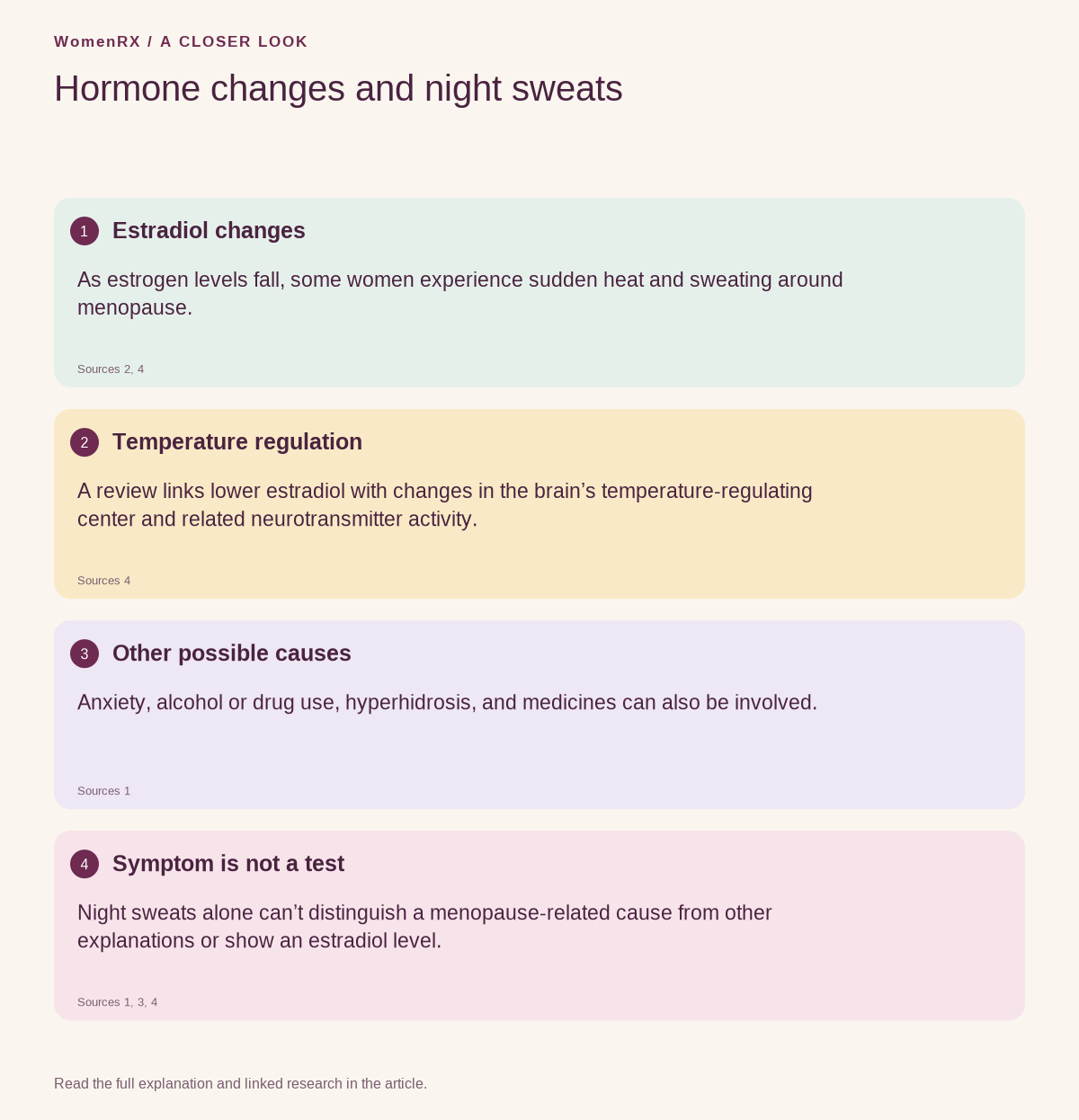
Hormone changes and night sweats
Estradiol changes: As estrogen levels fall, some women experience sudden heat and sweating around menopause.24
Temperature regulation: A review links lower estradiol with changes in the brain’s temperature-regulating center and related neurotransmitter activity.4
Other possible causes: Anxiety, alcohol or drug use, hyperhidrosis, and medicines can also be involved.1
Symptom is not a test: Night sweats alone can’t distinguish a menopause-related cause from other explanations or show an estradiol level.134
Read the figure as text
This proposed pathway can explain menopause-related night sweats, while showing why the symptom alone cannot identify a cause.- Estradiol changes: As estrogen levels fall, some women experience sudden heat and sweating around menopause.24
- Temperature regulation: A review links lower estradiol with changes in the brain’s temperature-regulating center and related neurotransmitter activity.4
- Other possible causes: Anxiety, alcohol or drug use, hyperhidrosis, and medicines can also be involved.1
- Symptom is not a test: Night sweats alone can’t distinguish a menopause-related cause from other explanations or show an estradiol level.134
More questions, answered
Does a night sweat mean my estradiol is low?
No. Falling estradiol is part of a proposed explanation for menopause-related night sweats, but the symptom can have other causes and doesn’t reveal an individual estradiol level. 1 4
Sources you can check
- Night sweats - NHSAccessed 2026-09-25Return to first citation
- CLIMARA PRO (ESTRADIOL AND LEVONORGESTREL) PATCH [BAYER HEALTHCARE PHARMACEUTICALS INC.] | US prescribing information and patient instructionsAccessed 2026-09-25Return to first citation
- Influence of SULT1A1 genetic variation on age at menopause, estrogen levels, and response to hormone therapy in recently postmenopausal white women.Moyer AM, de Andrade M, Weinshilboum RM, Miller VM. · Menopause (New York, N.Y.) · 2016Return to first citation
- What causes hot flushes? The neuroendocrine origin of vasomotor symptoms in the menopause.Rossmanith WG, Ruebberdt W. · Gynecological endocrinology : the official journal of the International Society of Gynecological Endocrinology · 2009Return to first citation