Hormones in Your 30s: What Age Can and Can’t Tell You
Your age doesn’t define a standard hormone profile, but persistent period changes before 40 can prompt a focused assessment.
There isn’t one hormone pattern every woman should expect in her 30s. Hormone levels change across the menstrual cycle, and cycle length and bleeding vary, so a test result needs to be understood in the context of the question it was meant to answer. Persistent irregular or absent periods before 40 raise a separate question: whether primary ovarian insufficiency (POI), among other possible causes, needs assessment. 1 2
Your age isn’t a hormone profile
Being in your 30s doesn’t tell you what your individual hormone levels should be. Hormone levels change during the menstrual cycle, and cycles vary from person to person. As a general reference, cycles lasting 21 to 35 days and periods lasting 2 to 7 days fall within ranges described as normal. 1
That variation is one reason a test result shouldn’t be treated as a stand-alone verdict about whether your hormones are “balanced.” The useful question is what the test was intended to assess and how the result fits your period pattern or other concern. A single number, without that context, doesn’t describe a universal hormone profile for people your age.
A persistent change is a different question
One early or late period doesn’t establish a hormone problem. If periods become persistently irregular or stop, it’s worth asking what might explain the change. Missed periods have several possible causes, and changing contraception can also disturb a usual cycle. 1
Before age 40, one specific possibility a clinician may assess is primary ovarian insufficiency, or POI. It involves loss of ovarian follicular activity before 40 and can be associated with irregular or absent periods. Ovarian insufficiency can be intermittent or permanent, so it doesn’t look exactly the same for everyone. 3 4
POI isn’t determined by age alone. The 2024 evidence-based guideline says that, when POI is suspected, one elevated follicle-stimulating hormone (FSH) result above 25 IU is required for diagnosis. If there’s diagnostic uncertainty, repeat FSH measurement and/or anti-Müllerian hormone (AMH) testing may be needed. This is a focused assessment for a particular concern, not a hormone profile to infer from being in your 30s. 2
Put the test beside the reason it was ordered
If a hormone test is being discussed, ask what it’s meant to find out and whether your cycle timing matters for interpreting that specific result. If the number doesn’t seem to fit your period pattern or symptoms, ask what would clarify the picture. These questions help keep a test connected to your situation rather than treating it as a stand-alone score.
If your main concern is a period change, noting when periods start, how long they last, and what has changed can help make the pattern clearer. Keeping a symptom diary across the cycle can also be useful when period problems are affecting your life. 1
The distinction is straightforward: cycle-related variation is not the same as a persistent change in periods. Age alone establishes neither an individual hormone profile nor a hormone problem. Persistent irregular or absent periods before 40 are a reason to consider a focused assessment, including whether POI is relevant. 1 2
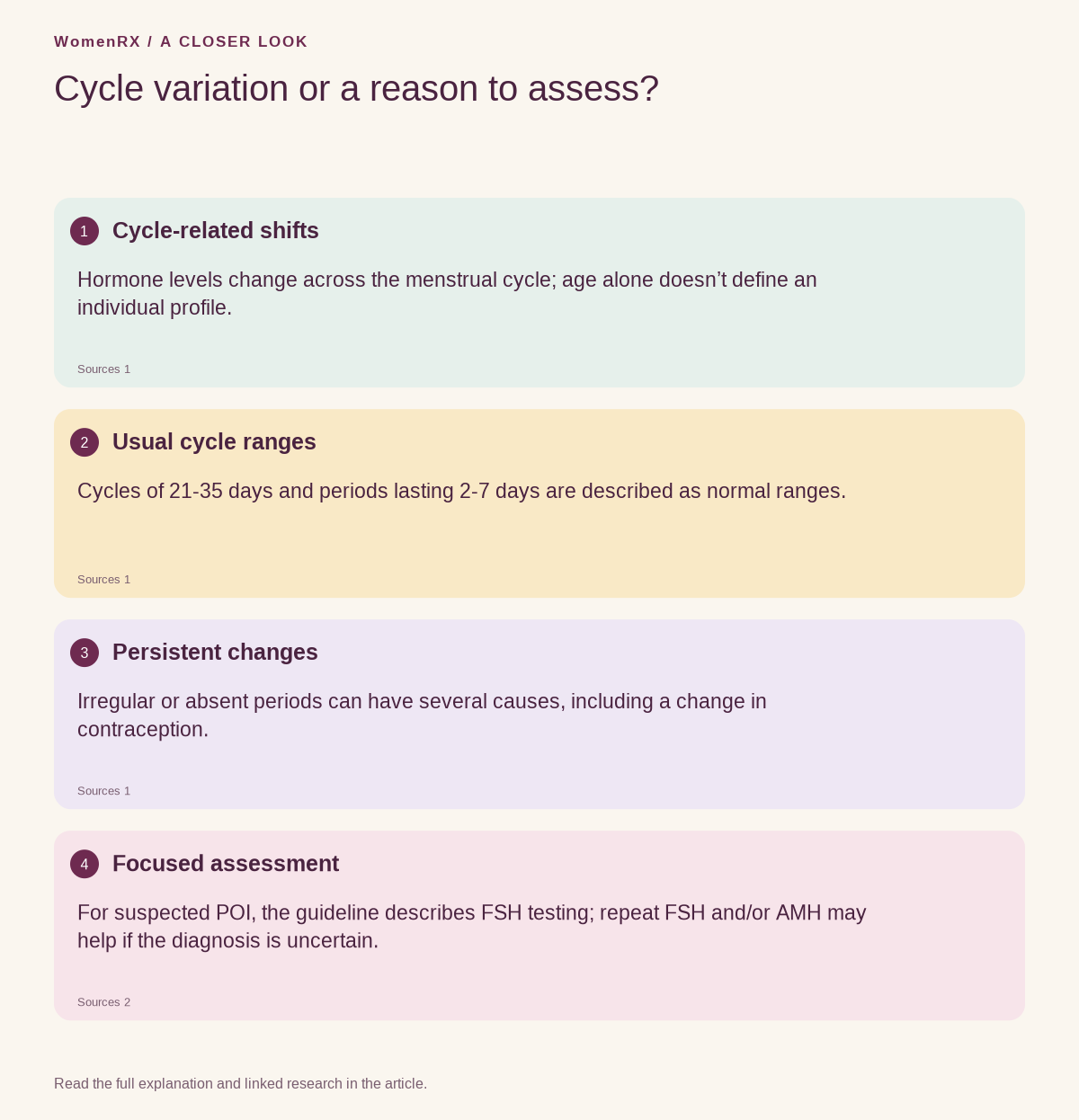
Cycle variation or a reason to assess?
Cycle-related shifts: Hormone levels change across the menstrual cycle; age alone doesn’t define an individual profile.1
Usual cycle ranges: Cycles of 21-35 days and periods lasting 2-7 days are described as normal ranges.1
Persistent changes: Irregular or absent periods can have several causes, including a change in contraception.1
Focused assessment: For suspected POI, the guideline describes FSH testing; repeat FSH and/or AMH may help if the diagnosis is uncertain.2
Read the figure as text
This flow separates ordinary cycle-related variation from persistent period changes that may prompt assessment before age 40.- Cycle-related shifts: Hormone levels change across the menstrual cycle; age alone doesn’t define an individual profile.1
- Usual cycle ranges: Cycles of 21-35 days and periods lasting 2-7 days are described as normal ranges.1
- Persistent changes: Irregular or absent periods can have several causes, including a change in contraception.1
- Focused assessment: For suspected POI, the guideline describes FSH testing; repeat FSH and/or AMH may help if the diagnosis is uncertain.2
More questions, answered
Does one elevated FSH result mean I have POI?
The 2024 guideline says one FSH result above 25 IU is required for diagnosis when POI is suspected. If there’s diagnostic uncertainty, repeat FSH and/or AMH testing may be needed. The result belongs in the context of the clinical concern, rather than being interpreted from age alone. 2
Do irregular periods always mean POI?
No. Missed or irregular periods can have different causes, and changing contraception can disturb a usual cycle. POI is one possibility to assess when period changes persist before 40, not the only explanation. 1 4
Sources you can check
- Period problems - NHSAccessed 2026-09-25Return to first citation
- Evidence-based guideline: premature ovarian insufficiency†‡.ESHRE, ASRM, CREWHIRL and IMS Guideline Group on POI, Panay N, Anderson RA, Bennie A, Cedars M, Davies M, Ee C, Gravholt CH, Kalantaridou S, Kallen A, Kim KQ, Misrahi M, Mousa A, N... · Climacteric : the journal of the International Menopause Society · 2024Return to first citation
- Primary ovarian insufficiency: a toolkit for the busy clinician.Kapoor E. · Menopause (New York, N.Y.) · 2024Return to first citation
- Primary ovarian insufficiency: different approaches in three cases and a review of literature.Moreira AM, Spritzer PM. · Endocrinology, diabetes & metabolism case reports · 2016Return to first citation