Weight in Your 30s: Is Age Really the Difference?
A change on the scale doesn’t, by itself, tell you whether your metabolism, body composition, routine, or health has changed.
Turning 30 doesn’t appear to trigger a sharp drop in average energy expenditure. In a large study of males and females, total daily energy expenditure adjusted for fat-free mass was broadly stable from ages 20 to 60. That doesn’t mean your weight or circumstances stay the same. Look at changes in your routine and health alongside the scale, especially if the change is unexpected. 53
What the age evidence actually says
If the habits that felt manageable at 25 feel harder to keep at 35, it’s tempting to blame a slower metabolism. But that explanation skips a useful question: what, exactly, has changed? A new commute, less time to cook, disrupted sleep, or more caregiving may change what your days look like. Those are possibilities to examine in your own life, not proof that any one of them caused a weight change.
A large study measured total daily energy expenditure, or the energy people used across an entire day, in males and females from infancy through older age. After accounting for fat-free mass, the researchers found that expenditure was broadly stable from ages 20 to 60. That finding pushes back on the idea of a sudden, inevitable metabolic slowdown in your 30s. It doesn’t say that everyone has the same energy needs, or that weight and body composition cannot change during those years. 5
The scale can’t identify what changed
Body weight includes muscle, bone, fat, and water. Two weigh-ins can differ without telling you which component changed. BMI has a similar limit: it compares weight with height but doesn’t distinguish fat from muscle or bone. Depending on the question, health history and waist circumference may add context that a scale reading alone cannot provide. 3
That distinction matters if you’re comparing your body now with your body several years ago. For example, if you’ve stopped doing an activity you used to enjoy, a change in strength may be worth noticing alongside a change in weight. But neither observation lets you calculate your muscle or fat from a bathroom scale. And if you’re actively trying to lose weight, the process itself can affect body composition: a systematic review of 16 dietary-intervention studies in adults with overweight or obesity found that lean body mass and resting metabolic rate tended to decrease during weight loss, though the changes varied across studies. That’s a finding about weight-loss interventions, not evidence of a sharp metabolic shift on your 30th birthday; a women-specific result wasn’t reported in the review abstract. 34
Compare your life now with the life behind the old routine
Rather than asking only, “Why doesn’t my old plan work?”, compare what the plan requires with what your week actually allows. If evening exercise used to be easy but you now spend that time commuting or caring for someone, the relevant change may be the opportunity to be active. If meals are more irregular, look at the pattern you can realistically maintain rather than assuming your body has become resistant to change. A healthy eating pattern and physical activity remain the foundation of long-term weight-loss approaches, but a workable version has to fit your circumstances. 2
Reproductive life can change those circumstances, too, though not every woman in her 30s is pregnant, postpartum, or pursuing fertility treatment. If one of those situations applies to you, avoid treating an earlier, unrelated period of life as the only fair comparison. Recovery, appointments, and changes to your routine are useful context when you discuss your goals. The lifespan energy-expenditure study found average fat-free mass-adjusted expenditure to be stable across ages 20 to 60, even during pregnancy; that population-level finding does not describe your personal needs during pregnancy or establish what happens during postpartum recovery or fertility treatment. 5
When a change deserves a closer look
A practical first question is whether the change was expected. Has your routine changed in a way that could help explain it, or are you gaining or losing weight without trying? MedlinePlus advises discussing an unexpected gain or loss with a clinician because it can signal a health problem. Ongoing weight loss without a change in eating or activity is particularly worth checking rather than attributing to a busy season; stress, health conditions, and medication effects are among the possible explanations. 13
You don’t need to arrive with a theory about your metabolism. A clearer account is often more useful: what changed, whether it was intentional, and what else was happening at the time. If you’re pregnant, postpartum, or receiving fertility treatment, include that context and the medications or supplements you’re taking. The aim isn’t to reduce your health to a number. It’s to find out whether the number reflects a change you understand, a goal that needs a different approach, or something that deserves care. 13
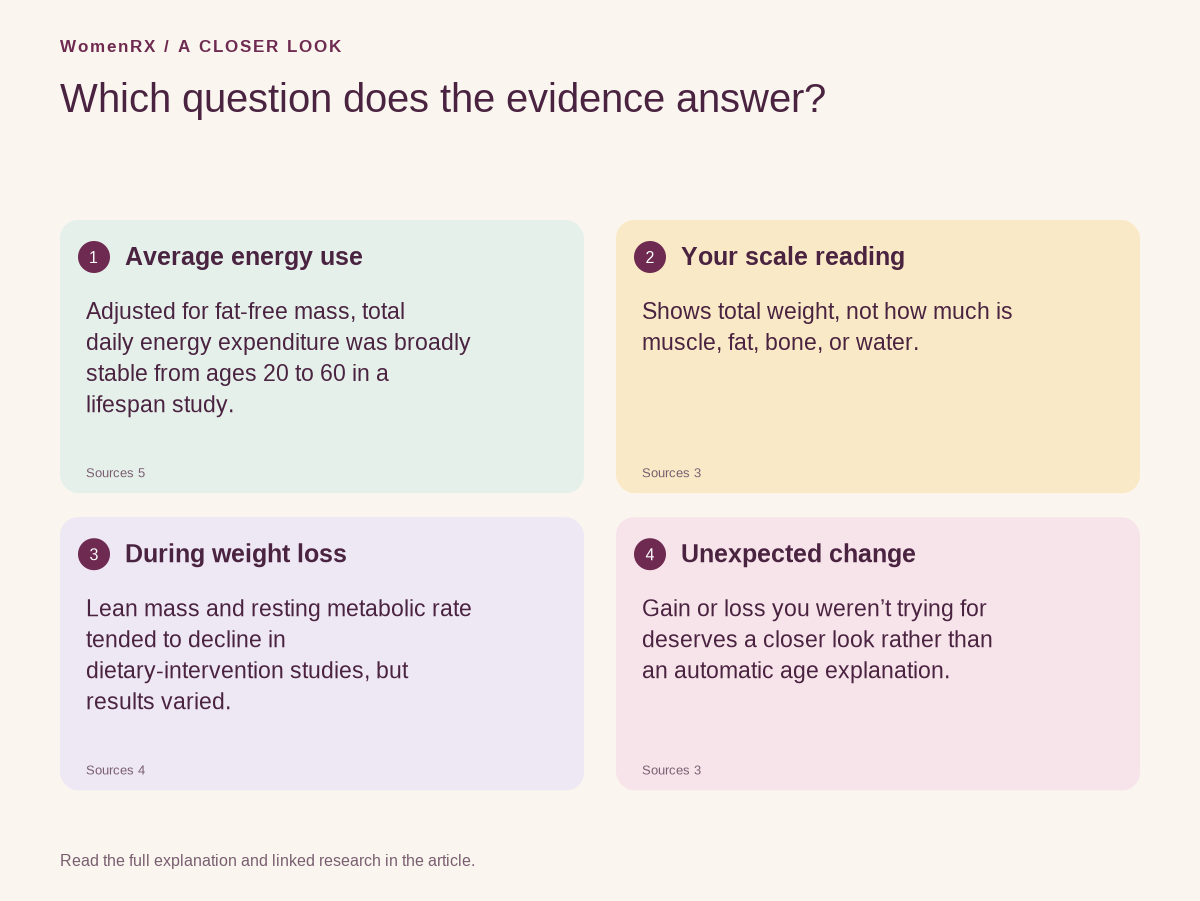
Which question does the evidence answer?
Average energy use: Adjusted for fat-free mass, total daily energy expenditure was broadly stable from ages 20 to 60 in a lifespan study.5
Your scale reading: Shows total weight, not how much is muscle, fat, bone, or water.3
During weight loss: Lean mass and resting metabolic rate tended to decline in dietary-intervention studies, but results varied.4
Unexpected change: Gain or loss you weren’t trying for deserves a closer look rather than an automatic age explanation.3
Read the figure as text
These findings are about different kinds of change. Keeping them separate makes an age explanation easier to assess.- Average energy use: Adjusted for fat-free mass, total daily energy expenditure was broadly stable from ages 20 to 60 in a lifespan study.5
- Your scale reading: Shows total weight, not how much is muscle, fat, bone, or water.3
- During weight loss: Lean mass and resting metabolic rate tended to decline in dietary-intervention studies, but results varied.4
- Unexpected change: Gain or loss you weren’t trying for deserves a closer look rather than an automatic age explanation.3
Sources you can check
- Unintentional weight loss - NHSAccessed 2026-09-25Return to first citation
- Dietary Supplements for Weight Loss - Health Professional Fact SheetAccessed 2026-09-25Return to first citation
- Body Weight: MedlinePlusAccessed 2026-09-25Return to first citation
- Impact of Diet Interventions for Weight Loss on Lean Body Mass and Resting Metabolic Rate: A Systematic Review.Lastovka N, Stanfar KL, Ghajar M, Bailey A, Byham-Gray LD, Radler DR. · Nutrition reviews · 2026Return to first citation
- Daily energy expenditure through the human life course.Pontzer H, Yamada Y, Sagayama H, Ainslie PN, Andersen LF, Anderson LJ, Arab L, Baddou I, Bedu-Addo K, Blaak EE, Blanc S, Bonomi AG, Bouten CVC, Bovet P, Buchowski MS, Butte NF, Cam... · Science (New York, N.Y.) · 2021Return to first citation