Does Metabolism Really Slow Down in Your 30s?
A change in weight or energy can be real without pointing to a sudden metabolic shift at 30.
There’s no reason to treat your 30th birthday as a metabolic turning point. In a cross-sectional study of adults, researchers found a gradual age-related pattern in resting energy expenditure, not a distinct shift identified in women in their 30s. The study couldn’t show how an individual woman’s metabolism changes over time, and resting energy use isn’t the same as total daily energy use. 4
If your clothes fit differently or you feel more tired than you used to, it makes sense to wonder whether your metabolism has changed. The useful distinction is between a change you’ve noticed and its cause. Neither a scale reading nor a low-energy afternoon measures how many calories your body uses.
What the age research actually measured
One study measured resting energy expenditure: the energy people use while at rest. Researchers measured it in 3,442 adults ages 18 to 81, including 2,465 women, and compared results across ages, sexes, and body-weight categories. They also considered body composition and factors such as physical activity. 4
In the study’s unadjusted analysis, resting energy expenditure tended to be lower at older ages. Among women in the normal-weight category, the estimated difference was 2.9 calories per day for each year of age. That’s a statistical slope across participants of different ages, not a measurement showing that any one woman loses that amount of daily energy use each year. 4
After accounting for body composition and other measured factors, the researchers described an age-related pattern they called adaptive change in women beginning around middle age, approximately 47, across body-weight categories. That estimate is not a biological switch that flips at 47. More importantly for this question, the study did not identify the 30s as a distinct onset for that pattern. Because it compared different people at one point in time, the authors said its findings need confirmation in studies that follow people as they age. 4
Resting metabolism isn’t your whole day
A resting measurement leaves out much of what you do between getting up and going to bed. Total energy expenditure is a different measure: the energy used over daily life. Researchers can measure it in free-living people with a method called doubly labeled water. Estimates of energy requirements also take physical activity into account. Neither measure can be read directly from a change on the scale. 3
That distinction matters if, for example, a new desk job replaced a commute on foot. Your daily movement may have changed even if your resting energy use hasn’t changed much. Conversely, the resting-energy study cannot tell you whether women’s total daily expenditure changes in a particular way during their 30s. It answers a narrower question about resting expenditure across adult ages. 43
A better way to read the clues
Start with what has changed, rather than assuming age explains everything. Weight includes muscle, bone, fat, and water; diet, activity, and stress can also affect it. A short-term change on the scale therefore doesn’t, by itself, demonstrate a change in body fat or metabolism. 2
If the bigger change is how you feel, look at that separately. Too little sleep, stress, and a change in exercise can contribute to fatigue. Pregnancy can be relevant for someone who is pregnant, but it isn’t an explanation to apply to everyone in their 30s. Fatigue can also have medical causes, including anemia and thyroid disease. If tiredness persists for weeks or doesn’t improve, it’s worth getting help to work out why rather than treating it as evidence that your metabolism has slowed. 1
The same goes for an unexpected weight change: if you’re gaining or losing weight without trying, have it checked instead of attributing it to a birthday. 2 The research gives you a reason to question a decade-specific slowdown, not a reason to dismiss a change you’re experiencing.
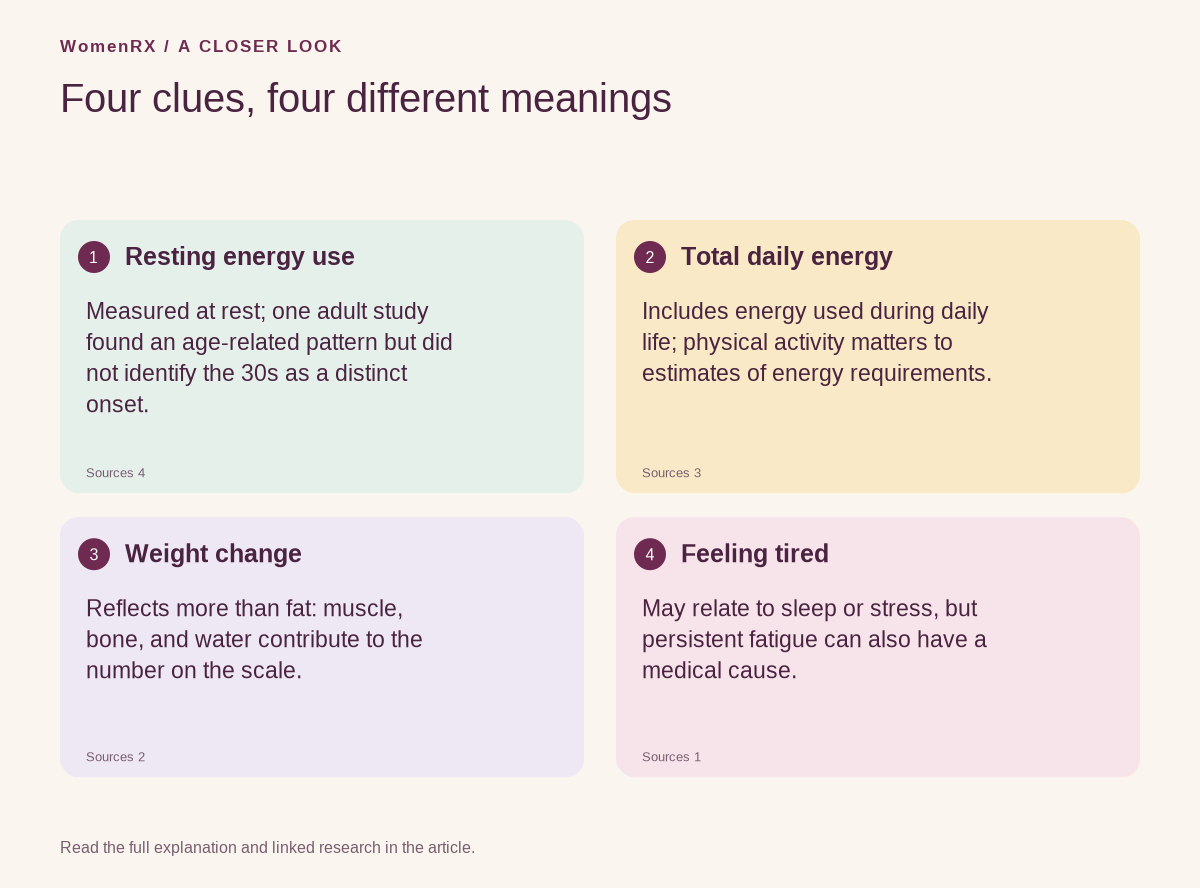
Four clues, four different meanings
Resting energy use: Measured at rest; one adult study found an age-related pattern but did not identify the 30s as a distinct onset.4
Total daily energy: Includes energy used during daily life; physical activity matters to estimates of energy requirements.3
Weight change: Reflects more than fat: muscle, bone, and water contribute to the number on the scale.2
Feeling tired: May relate to sleep or stress, but persistent fatigue can also have a medical cause.1
Read the figure as text
A change you can notice and a measure of energy use aren’t interchangeable.- Resting energy use: Measured at rest; one adult study found an age-related pattern but did not identify the 30s as a distinct onset.4
- Total daily energy: Includes energy used during daily life; physical activity matters to estimates of energy requirements.3
- Weight change: Reflects more than fat: muscle, bone, and water contribute to the number on the scale.2
- Feeling tired: May relate to sleep or stress, but persistent fatigue can also have a medical cause.1
Sources you can check
- Fatigue: MedlinePlusAccessed 2026-09-25Return to first citation
- Body Weight: MedlinePlusAccessed 2026-09-25Return to first citation
- Developing new energy intake reference values for the Saudi population.Alhumaidan O, Almajwal A, Alsaif M. · BMC nutrition · 2026Return to first citation
- Age-related changes in resting energy expenditure in normal weight, overweight and obese men and women.Siervo M, Oggioni C, Lara J, Celis-Morales C, Mathers JC, Battezzati A, Leone A, Tagliabue A, Spadafranca A, Bertoli S. · Maturitas · 2015Return to first citation