Does Metabolism Really Slow Down as Women Age?
Age can affect resting energy use, but changes in movement and body composition also shape how much energy you use each day.
Your metabolism doesn’t simply switch to a slower setting at a certain birthday. Resting energy expenditure can decline with age, and one study found a decline beyond what measured body-composition changes predicted. But resting expenditure isn’t your whole day: activity also affects total energy use. In midlife, aging, movement, and menopause-related changes in where fat is stored can overlap. 245
Resting metabolism is only one part of the picture
If the way you’ve been eating seems unchanged but your weight or shape has shifted, it’s reasonable to wonder whether your metabolism changed. The first distinction is which measure you mean. Resting energy expenditure is the energy your body uses while you’re at rest. Total daily energy expenditure also reflects what happens outside those resting conditions, including physical activity. In a study that measured both, researchers expressed activity level as total expenditure divided by resting expenditure. That relationship makes a useful point: two people with similar resting measurements can have different daily totals. 5
Think of two ordinary days as an example, not a prediction about your body. On one, you walk to errands and spend time on your feet. On the other, you sit through meetings and drive home. Your resting needs haven’t necessarily made a sudden leap between those days, but your activity-related energy use may differ. A change in routine can therefore feel like a change in “metabolism” even when a resting measurement alone wouldn’t tell the whole story. 5
Does resting energy use fall with age?
It can. A study of adults in the Quebec Family Study compared measured resting expenditure with values predicted from fat mass and fat-free mass. It included 339 women and 288 men in a cross-sectional analysis, plus 98 women and 93 men in a six-year follow-up. The researchers found age-related declines that body composition alone did not fully predict. In the follow-up, the largest deviation for women occurred later in life, while the largest deviation for men occurred in young adulthood. That is evidence against saying all age-related change is just muscle loss, but it isn’t evidence that every woman experiences a sharp drop at the same age. 2
“Fat-free mass” needs care, too. It includes more than skeletal muscle. A large cross-sectional study of people across a wide age range measured total and resting expenditure and estimated fat-free mass. Among adults, activity level was associated with fat-free mass, including in women, but the researchers could not use that design to show that activity caused the difference. Their body-composition measure also could not separate muscle from the other parts of fat-free mass. So “build muscle and your metabolism will stay the same” promises more than this evidence can show. 5
Why midlife can feel different
Midlife brings several changes that are easy to bundle into one explanation. A review of weight gain in midlife women identifies lower energy expenditure and physical activity associated with aging as contributors to weight gain. It also describes menopause-related hormonal changes that favor more fat storage around the middle. A change in waist size is therefore not, by itself, proof that your resting energy use has fallen. 4
The distinction matters because body composition and energy expenditure answer different questions. During the menopausal transition, fat and muscle can change even when the scale tells only part of the story. Researchers are still debating whether menopause or estrogen changes resting expenditure in a meaningful way independent of aging and other factors. A review also notes that longitudinal studies of menopausal body-composition change are relatively uncommon. It would be too simple to blame every midlife change on hormones, or to dismiss hormones entirely. 3
Pregnancy is another reason not to assume one lifelong pattern. Nutrient requirements change during pregnancy, but nutrient needs aren’t a measurement of resting or total energy expenditure. The adult aging findings above should not be used to estimate what happens during pregnancy or postpartum. 12
A more useful question than “Is my metabolism broken?”
Ask what, specifically, has changed. If your days now involve less walking or time on your feet, that may affect your daily total without identifying a problem with resting metabolism. If your weight is similar but your waist or strength feels different, body composition may be a more useful lens than the scale alone. These are ways to sort the possibilities, not ways to calculate your personal energy needs from a symptom or a birthday. 45
Regular physical activity is one practical place to focus, both for daily movement and for supporting body composition. The activity and fat-free-mass research is observational, though, and its authors caution that activity may only partly protect against age-related loss of fat-free mass. That’s a sounder expectation than trying to stop aging or “reset” a metabolic rate. 5
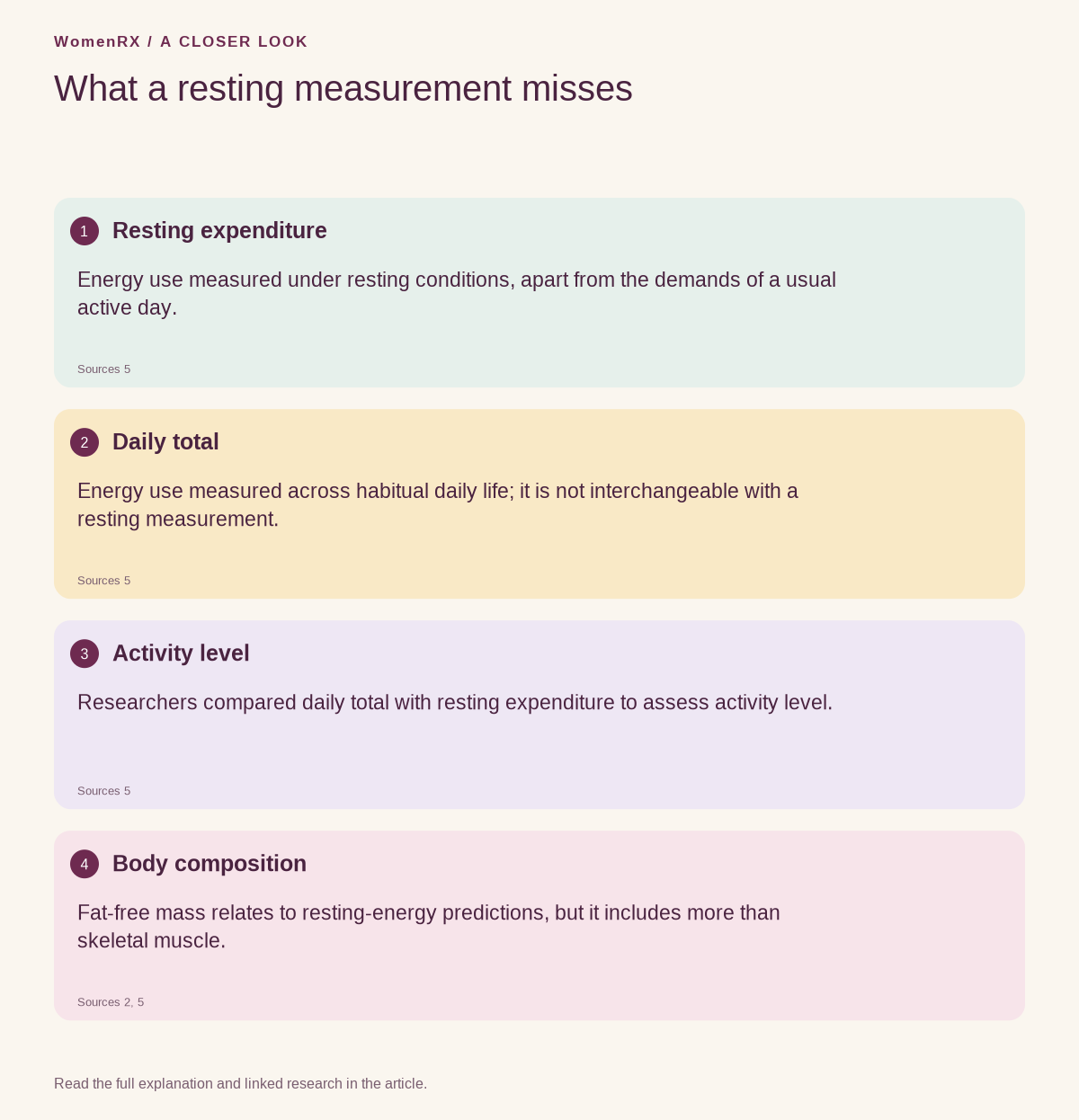
What a resting measurement misses
Resting expenditure: Energy use measured under resting conditions, apart from the demands of a usual active day.5
Daily total: Energy use measured across habitual daily life; it is not interchangeable with a resting measurement.5
Activity level: Researchers compared daily total with resting expenditure to assess activity level.5
Body composition: Fat-free mass relates to resting-energy predictions, but it includes more than skeletal muscle.25
Read the figure as text
These connected measures help explain why a change in your daily routine is not the same thing as a measured change at rest.- Resting expenditure: Energy use measured under resting conditions, apart from the demands of a usual active day.5
- Daily total: Energy use measured across habitual daily life; it is not interchangeable with a resting measurement.5
- Activity level: Researchers compared daily total with resting expenditure to assess activity level.5
- Body composition: Fat-free mass relates to resting-energy predictions, but it includes more than skeletal muscle.25
More questions, answered
Can my waist change even if my weight barely changes?
Yes. Research on the menopausal transition describes changes in fat distribution, particularly more fat around the middle. Weight alone won’t show where fat is stored or how body composition may have changed. A waist change does not establish what happened to your resting energy expenditure. 34
Sources you can check
- Dietary Supplements and Life Stages: Pregnancy - Health Professional Fact SheetAccessed 2026-09-25Return to first citation
- Greater than predicted decrease in resting energy expenditure with age: cross-sectional and longitudinal evidence.Alfonzo-González G, Doucet E, Bouchard C, Tremblay A. · European journal of clinical nutrition · 2006Return to first citation
- Menopause and Body Composition: A Complex Field.Juppi HK, Karppinen JE, Laakkonen EK. · Seminars in reproductive medicine · 2025Return to first citation
- Weight Gain in Midlife Women.Hurtado MD, Saadedine M, Kapoor E, Shufelt CL, Faubion SS. · Current obesity reports · 2024Return to first citation
- Physical activity and fat-free mass during growth and in later life.Westerterp KR, Yamada Y, Sagayama H, Ainslie PN, Andersen LF, Anderson LJ, Arab L, Baddou I, Bedu-Addo K, Blaak EE, Blanc S, Bonomi AG, Bouten CVC, Bovet P, Buchowski MS, Butte NF,... · The American journal of clinical nutrition · 2021Return to first citation