Metabolism in Your 60s: Energy, Muscle, and Weight
Energy needs can shift with age and body composition, but unexpected weight loss or declining strength shouldn’t be dismissed as a slower metabolism.
In your 60s, energy use may change as resting needs, muscle, and daily activity change, but there isn’t one calorie target that fits everyone. Weight alone can’t show whether you’ve lost fat, muscle, or fluid. If you’re losing weight without trying, or notice a sudden change, contact your health care provider; keeping muscle and strength matters as you age. 1 2
“Metabolism” isn’t one number
Your body uses energy at rest and as you move. Resting energy needs and total daily energy use can shift with age, body composition, and activity. That doesn’t mean every woman in her 60s suddenly needs less food, or that a formula can tell you exactly what to eat.
In a cross-sectional study of 108 healthy older adults, whose average age was 70, higher total energy expenditure was associated with higher energy intake and a greater percentage of muscle. Appetite ratings did not differ significantly across the study’s activity or energy-expenditure groups. These are associations, not proof that more activity causes someone to eat more. 2
For a postmenopausal woman, these overall findings about older adults don’t establish that menopause itself caused a change in metabolism or predict her individual energy needs. Women in their 60s also differ in health, mobility or disability, medication use, and activity, so age alone can’t explain an individual change.
The practical point: appetite alone may not tell you whether your body is getting what it needs. A quieter appetite alongside a change in weight, strength, or function deserves attention, not an automatic assumption that your energy needs have simply dropped.
Read the scale alongside strength
A scale can show that your total body weight changed, but it can’t tell you whether the change came from muscle, fat, bone, or water. BMI has a similar limitation: it doesn’t distinguish muscle from fat and may underestimate body fat in older people who have lost muscle. Muscle and strength are key parts of healthy weight in older adulthood. 1
That makes the kind of change important. If you meant to lose weight, consider whether you’re also becoming weaker or finding everyday tasks harder. If you didn’t mean to lose weight, don’t treat the change as a successful diet result or as an inevitable part of aging. A body-composition estimate can offer clues, but it doesn’t replace a fuller look at your health and function.
When a change needs checking
Contact your health care provider if you’re losing or gaining weight without trying. MedlinePlus advises that sudden, unexpected weight change can be a sign of a medical problem, and specifically says sudden weight loss in older adults should be checked. 1
When you describe what’s changed, include whether your appetite, strength, mobility, or usual activity has shifted too. Those details help put the number on the scale in context. If a health condition or medication change is part of the picture, mention that as well; weight alone can’t explain why the change happened.
Aim for an individual picture, not a calorie rule
Age is only one part of energy needs. Activity and body composition are related to energy expenditure, and older adults differ in health and ability to move. A number from a general calculator is an estimate, not a personal prescription. One study in healthy older adults found links between expenditure, intake, and muscle, but it cannot establish a single target for women in their 60s. 2
If weight loss is intentional, or you’re considering changing how much you eat, ask what goal makes sense for your health and strength. MedlinePlus notes that a provider can help determine a healthy body weight and may refer you to a dietitian when weight gain or loss is recommended. 1
The takeaway is not to chase a younger metabolism. Look at weight together with strength, appetite, and daily function, and get unexplained change checked rather than assuming it’s just age.
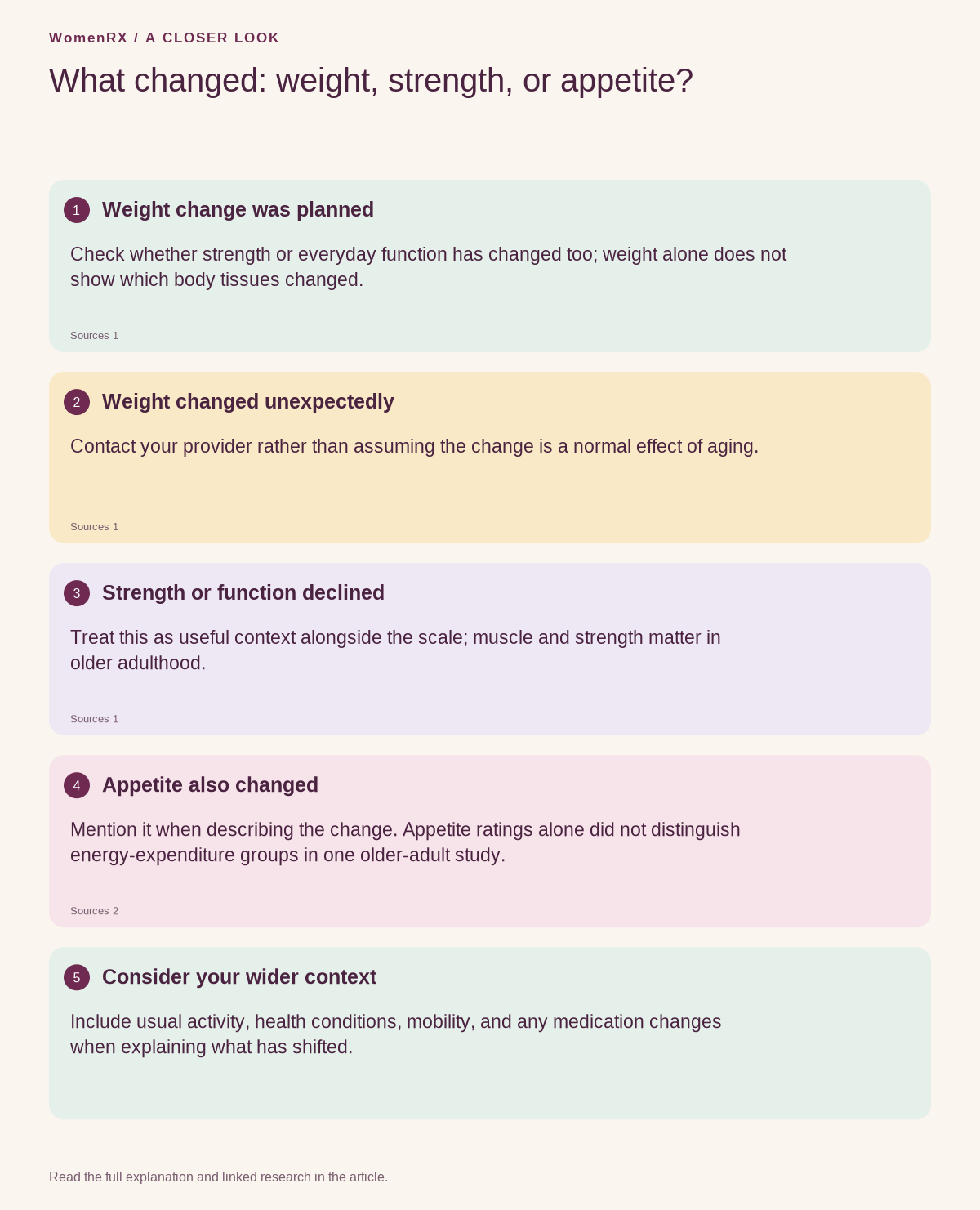
What changed: weight, strength, or appetite?
Weight change was planned: Check whether strength or everyday function has changed too; weight alone does not show which body tissues changed.1
Weight changed unexpectedly: Contact your provider rather than assuming the change is a normal effect of aging.1
Strength or function declined: Treat this as useful context alongside the scale; muscle and strength matter in older adulthood.1
Appetite also changed: Mention it when describing the change. Appetite ratings alone did not distinguish energy-expenditure groups in one older-adult study.2
Consider your wider context: Include usual activity, health conditions, mobility, and any medication changes when explaining what has shifted.
Read the figure as text
Follow the change that stands out. Weight, strength, and appetite offer different clues, and an unexpected change deserves a different response from a planned one.- Weight change was planned: Check whether strength or everyday function has changed too; weight alone does not show which body tissues changed.1
- Weight changed unexpectedly: Contact your provider rather than assuming the change is a normal effect of aging.1
- Strength or function declined: Treat this as useful context alongside the scale; muscle and strength matter in older adulthood.1
- Appetite also changed: Mention it when describing the change. Appetite ratings alone did not distinguish energy-expenditure groups in one older-adult study.2
- Consider your wider context: Include usual activity, health conditions, mobility, and any medication changes when explaining what has shifted.
More questions, answered
Can the scale tell whether I’m losing muscle?
No. Weight includes muscle, fat, bone, and water, so the number by itself can’t identify what changed. Strength and everyday function add useful context. 1
Does a lower appetite mean I need fewer calories?
Not necessarily. In one study of healthy older adults, appetite ratings didn’t differ significantly between groups with different energy expenditure. The study was cross-sectional and didn’t establish an individual calorie need. 2
Sources you can check
- Body Weight: MedlinePlusAccessed 2026-09-25Return to first citation
- Does physical activity level and total energy expenditure relate to food intake, appetite, and body composition in healthy older adults? A cross-sectional study.Dericioglu D, Methven L, Clegg ME. · European journal of nutrition · 2025Return to first citation