Tirzepatide After 50: Weight, Muscle, and Menopause
Age alone doesn’t answer whether tirzepatide fits; your health goals, strength, nutrition, and menopause care all belong in the discussion.
Tirzepatide studies in adults with overweight or obesity show that some weight lost is lean mass, but their reported results don’t establish how muscle or bone outcomes differ specifically for postmenopausal women. Ask whether treatment fits your health history and goals, how you’ll protect strength and function during weight loss, and how menopause symptoms and bone health will be addressed separately. 4 5
Start with your health goal, not an age cutoff
Being over 50 or going through menopause doesn’t, by itself, answer whether tirzepatide is a suitable option. Start by asking what you’re hoping treatment will improve, such as a health condition, mobility, or a weight-related concern, and how you and your prescriber would judge whether it’s helping. The scale is one measure, not a full picture: body weight includes muscle, bone, fat, and water, while BMI doesn’t distinguish among them. 2
Bring up your health conditions, current treatments, and medication list so the prescriber can assess the fit for your situation. Useful questions include: “What are the main benefits we’re aiming for in my case?” and “What would make us reassess the plan?”
What the muscle findings do, and don’t, tell you
Weight loss can include both fat and lean mass. In a 2026 meta-analysis of randomized trials in adults with overweight or obesity, the pooled estimate for tirzepatide was that lean mass accounted for 25.4% of total weight lost (95% confidence interval, 22.8% to 28.0%). The analysis combined studies rather than reporting an estimate specifically for women over 50 or postmenopausal women. It also found a similar proportion for lifestyle interventions without resistance training; the results don’t mean that every person will lose that share of lean mass. 5
“Lean mass” is not the same thing as a direct test of muscle strength or everyday function. A separate review described body-composition findings from two tirzepatide trial analyses, but said further research is needed to understand their longer-term functional meaning. 4
The cited tirzepatide studies don’t report muscle or bone outcomes specifically for postmenopausal women. That leaves an important question open: they don’t tell us whether menopause changes these outcomes, or whether the results for older women differ from those for other adults. Don’t treat a general adult trial result as a menopause-specific prediction.
Put strength and nourishment into the plan
Ask how you can maintain strength and function while losing weight, and what signs would prompt a closer look at your progress. MedlinePlus notes that muscle-strengthening activity can help maintain muscle mass and strength; for older adults, that can support everyday tasks such as getting out of a chair. Regular exercise can also help slow age-related loss of bone density. 3
Nutrition deserves the same practical attention. Protein helps build and maintain muscle, and the amount a person needs depends on factors including age, health, and activity level. 1 Ask what a realistic eating plan looks like if your appetite or meal pattern changes during treatment, and whether your health history calls for individual nutrition guidance. This is a conversation about meeting your needs, not a reason to assume that more protein or a supplement is automatically better.
You can also agree on measures beyond body weight. Depending on your goals, you might discuss how you’re managing daily activities, strength, or a weight-related health condition. Weight alone can’t show which tissues have changed or how you’re functioning. 2
Keep menopause and bone care in view
If you’re dealing with hot flashes, vaginal or urinary symptoms, or concerns about bone health, raise them as their own care needs rather than assuming weight treatment will resolve them.
Menopause guidance says hormone therapy is the most effective treatment for vasomotor symptoms and has been shown to prevent bone loss and fracture. Its benefit-risk balance depends on factors including age, time since menopause, and personal health risks, so it’s a separate individualized discussion, not a routine add-on to weight treatment. 6 For people who aren’t good candidates for hormone therapy or prefer not to use it, the Menopause Society lists evidence-based nonhormonal options for vasomotor symptoms. 7
Before deciding, try questions like these:
- What health outcome are we targeting, and how will we measure progress beyond the scale?
- How will we keep an eye on strength, daily function, and nutrition during weight loss?
- Do my health conditions or current treatments change whether this option makes sense for me?
- What plan should I have for menopause symptoms and bone health, separately from weight treatment?
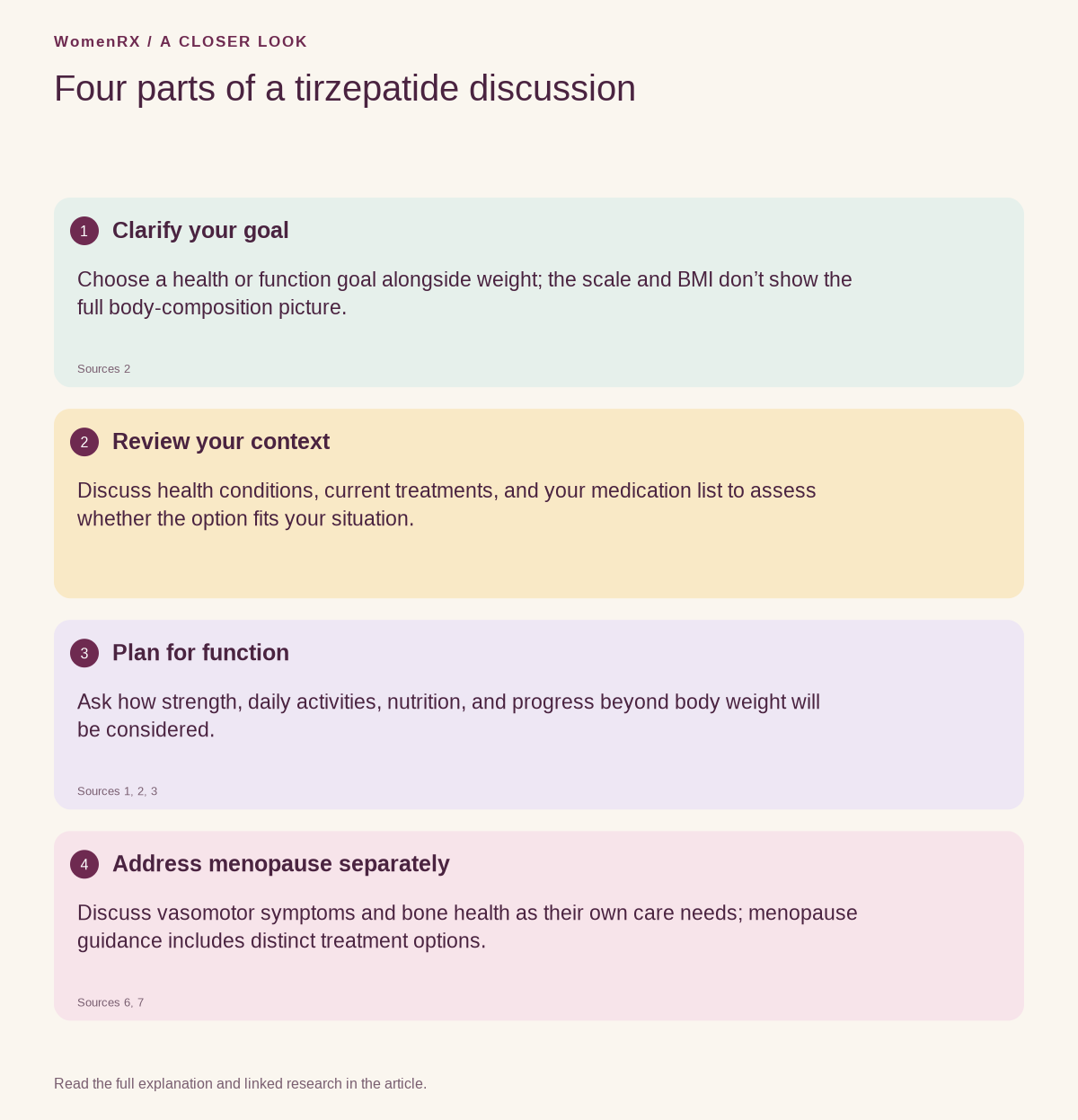
Four parts of a tirzepatide discussion
Clarify your goal: Choose a health or function goal alongside weight; the scale and BMI don’t show the full body-composition picture.2
Review your context: Discuss health conditions, current treatments, and your medication list to assess whether the option fits your situation.
Plan for function: Ask how strength, daily activities, nutrition, and progress beyond body weight will be considered.123
Address menopause separately: Discuss vasomotor symptoms and bone health as their own care needs; menopause guidance includes distinct treatment options.67
Read the figure as text
Use these prompts to keep the conversation centered on your health context, function, and menopause care, not age alone.- Clarify your goal: Choose a health or function goal alongside weight; the scale and BMI don’t show the full body-composition picture.2
- Review your context: Discuss health conditions, current treatments, and your medication list to assess whether the option fits your situation.
- Plan for function: Ask how strength, daily activities, nutrition, and progress beyond body weight will be considered.123
- Address menopause separately: Discuss vasomotor symptoms and bone health as their own care needs; menopause guidance includes distinct treatment options.67
More questions, answered
Does tirzepatide work differently after menopause?
The cited tirzepatide body-composition findings don’t report menopause-specific results, so they can’t establish whether effectiveness or muscle outcomes differ after menopause. They also don’t show that the medicine works the same or differently because of menopause. 4 5
Does the lean-mass finding mean I’ll lose muscle strength?
Not necessarily. Lean mass is a body-composition measure, not a direct test of strength or daily function. The review of tirzepatide studies says more research is needed to understand longer-term functional effects. 4
Sources you can check
- Dietary Proteins: MedlinePlusAccessed 2026-09-25Return to first citation
- Body Weight: MedlinePlusAccessed 2026-09-25Return to first citation
- Benefits of Exercise: MedlinePlusAccessed 2026-09-25Return to first citation
- Effects of Tirzepatide on Skeletal Muscle Mass in Adults: A Systematic Review.Hidalgo Ramos RA, Hong I, Ortiz M, Secades D, Dufner Krieger S, Ramos Stanziola L. · Cureus · 2025Return to first citation
- Lean Mass Changes With Incretin Therapy Versus Lifestyle Intervention: A Systematic Review and Meta-Analysis of Randomised Controlled Trials.Eisa N, Barood O. · Diabetes, obesity & metabolism · 2026Return to first citation
- The 2022 hormone therapy position statement of The North American Menopause Society.“The 2022 Hormone Therapy Position Statement of The North American Menopause Society” Advisory Panel. · Menopause (New York, N.Y.) · 2022Return to first citation
- The 2023 nonhormone therapy position statement of The North American Menopause Society.Menopause (New York, N.Y.) · 2023Return to first citation