Weight in Your 40s: Age, Menopause, and What to Check
Midlife weight changes can reflect several overlapping factors, and the scale alone can’t tell you which one is at work.
The menopause transition may be linked with a shift toward more abdominal fat and less lean mass, but the evidence doesn’t show that menopause alone explains an individual’s weight change. Aging, daily routines, health conditions, and other factors can overlap. Being 40 does not, by itself, identify your menopause stage. Look at the pattern over time, how you feel, and any recent changes rather than assuming your metabolism suddenly slowed at 40. 2 5
Menopause can change body composition, not just weight
Weight is a total: it includes fat, muscle, bone, and water. Two people at the same weight can have different body composition, and a change on the scale doesn’t reveal which part changed. 2
A 2026 study compared body-composition measurements from 325 women classified as premenopausal, perimenopausal, or postmenopausal. The postmenopausal group had lower measured lean mass and higher measures of central fat than the earlier-stage groups. That’s a useful clue that body composition may differ across menopause stages, but the study was retrospective and cross-sectional: it compared different women at one point, rather than following the same women through the transition. It can’t show that menopause itself caused the differences or predict what will happen to you. 5
So, a changing waist or clothing fit may tell you something the scale doesn’t. But neither proves that hormones are the sole cause, and the scale cannot distinguish fat from muscle or water. 2 5
Age, the transition, and everyday context overlap
Being 40 does not, by itself, identify your menopause stage. The study classified women by menopause status, but its comparisons don’t cleanly separate menopause from aging: the groups may differ in age and other ways, and different women were measured at one point. The findings support considering menopause when body composition changes, not treating age or menopause as the proven cause of an individual change. 5
Daily context can help make a weight pattern easier to understand. MedlinePlus identifies eating, activity, and stress among factors that can affect body weight. Those are useful areas to review, but noticing a change in one of them doesn’t establish that it caused your weight change. 2
Sleep deserves the same measured approach. A systematic review found an association between poorer sleep quality and higher BMI in studies of young adults ages 18 to 35, with substantial variation between studies. That evidence doesn’t establish cause and effect, and it doesn’t tell us how sleep relates to weight changes in women in their 40s or during menopause. Treat a sleep change as relevant personal context, not a diagnosis or proof of cause. 4
Make your next step fit the pattern
If weight is changing without your intention, note when it began, whether it is gradual or sudden, whether your waist or strength seems different, and whether eating, activity, or stress has changed. Bring unintentional gain or loss to a health care provider rather than assuming it calls for a change in intake. Sudden, unexpected gain or loss can sometimes signal a medical problem; MedlinePlus lists thyroid problems and certain medicines among possible causes of sudden weight loss, not as explanations for every weight change. 2
Review cycle changes alongside the weight timeline. Irregular periods can be common just before menopause, but a change in contraception can also disturb the cycle. If bleeding is heavy, note how often you need to change period products and discuss it with a doctor. A diary of symptoms throughout your cycle can help show what happens and when; if your periods stop and you’re concerned, the NHS advises speaking with a doctor. These patterns do not, on their own, identify the cause of a weight change. 1
List new medicines and dose changes alongside the weight timeline to discuss with a provider. MedlinePlus lists certain medicines among possible causes of sudden weight loss; weight gain is also a recognized concern with antipsychotic treatment specifically. Neither point establishes that a medicine caused your change or applies to every medicine. 2 3
If weight loss is a goal, start with the question of what would support your health, not only what number you want to see. MedlinePlus notes that a provider can consider health history and risk factors when discussing a healthy weight, and may refer someone for nutrition support. That can help keep the conversation focused on your circumstances rather than a one-size-fits-all target. 2
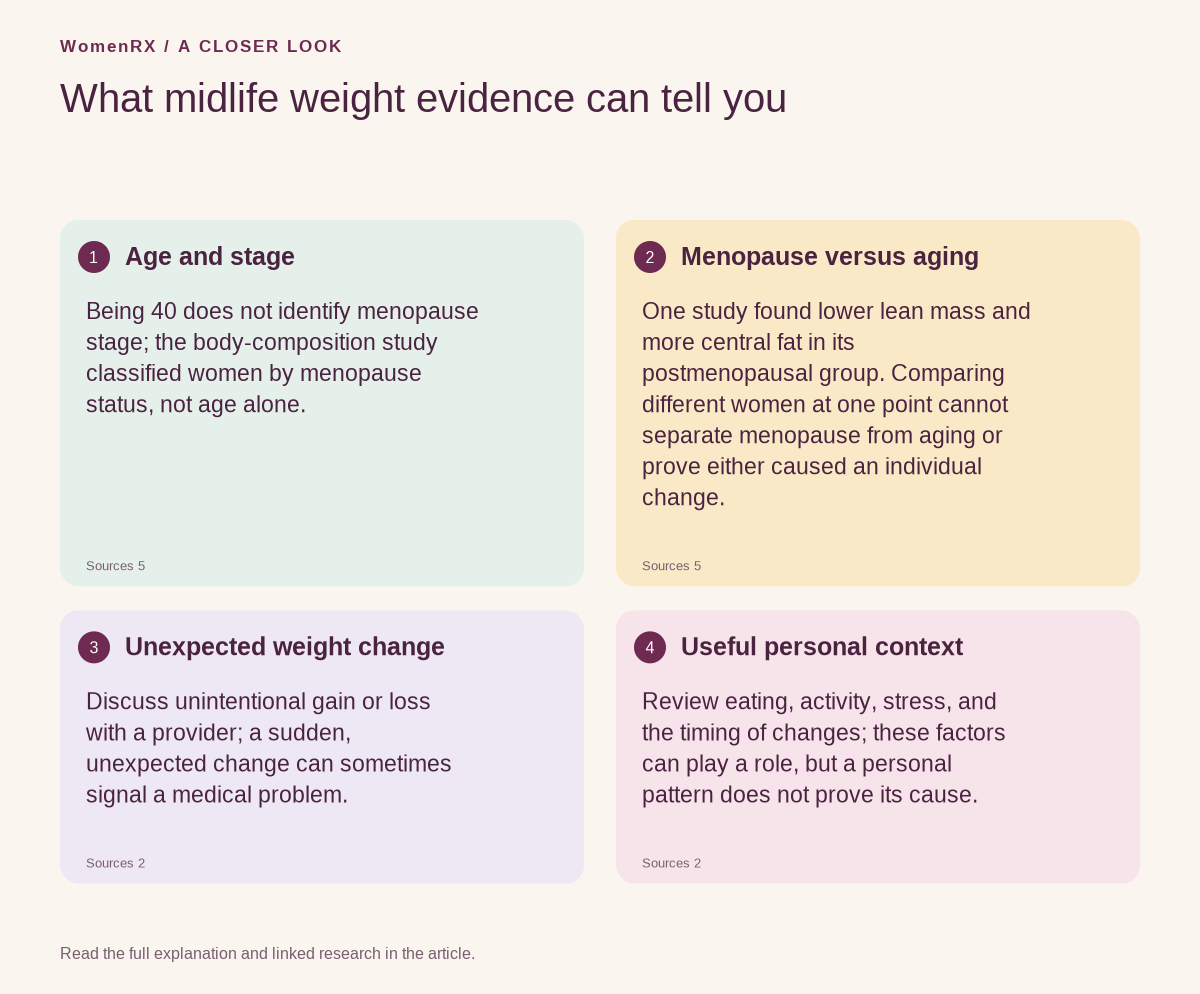
What midlife weight evidence can tell you
Age and stage: Being 40 does not identify menopause stage; the body-composition study classified women by menopause status, not age alone.5
Menopause versus aging: One study found lower lean mass and more central fat in its postmenopausal group. Comparing different women at one point cannot separate menopause from aging or prove either caused an individual change.5
Unexpected weight change: Discuss unintentional gain or loss with a provider; a sudden, unexpected change can sometimes signal a medical problem.2
Useful personal context: Review eating, activity, stress, and the timing of changes; these factors can play a role, but a personal pattern does not prove its cause.2
Read the figure as text
Age alone does not identify menopause stage, and a comparison across stages cannot establish what caused one woman’s weight change. These are the distinctions and patterns worth checking.- Age and stage: Being 40 does not identify menopause stage; the body-composition study classified women by menopause status, not age alone.5
- Menopause versus aging: One study found lower lean mass and more central fat in its postmenopausal group. Comparing different women at one point cannot separate menopause from aging or prove either caused an individual change.5
- Unexpected weight change: Discuss unintentional gain or loss with a provider; a sudden, unexpected change can sometimes signal a medical problem.2
- Useful personal context: Review eating, activity, stress, and the timing of changes; these factors can play a role, but a personal pattern does not prove its cause.2
More questions, answered
Can the scale tell whether I’ve lost muscle?
No. Weight includes muscle, fat, bone, and water, so the scale alone can’t identify which part has changed. 2
Does poor sleep explain weight gain in your 40s?
Not necessarily. A review found an association between sleep quality and BMI in young adults, but it couldn’t establish cause and effect and doesn’t directly answer the question for women in midlife. 4
Sources you can check
- Period problems - NHSAccessed 2026-09-25Return to first citation
- Body Weight: MedlinePlusAccessed 2026-09-25Return to first citation
- Comparative effects of pharmacological treatment for weight gain in patients treated with antipsychotics. A systematic review and network meta-analysis.Goetz-Kundera Z, Przekopińska B, Walichniewicz P, Niewada M, Lew-Starowicz M. · Comprehensive psychiatry · 2025Return to first citation
- Relationship of sleep quality, BMI, Dietary, and socioeconomic attributes among young adults: A systematic review.Ahn S, Zaman WSBWK, Goh SK, Chan CK. · Journal of health psychology · 2026Return to first citation
- The Impact of the Menopausal Transition on Body Composition and Abdominal Fat Redistribution.Szeliga A, Chedraui P, Meczekalski B. · Journal of clinical medicine · 2026Return to first citation