Abdominal Fat During Menopause: What Changes and What Helps
A changing waist can reflect aging, menopause-related shifts in fat distribution, or both, so one measurement can’t tell the whole story.
Weight gain in midlife is often linked more to aging, while the menopause transition may also shift body composition toward more abdominal fat and less lean mass. These changes don’t happen the same way for everyone, and studies can’t cleanly separate menopause from age and lifestyle. Regular physical activity is a reasonable step; hormone therapy isn’t presented as a weight-loss treatment in menopause guidance. 3 6 1
Why your waist may change
It’s common to notice that your shape is changing even when the scale hasn’t moved much. Weight and body composition aren’t the same thing: body composition describes how much of your body is fat, muscle, and other tissue, and where fat is carried.
A review of midlife research found that weight gain appears to be driven largely by chronological aging, while changes in body composition and fat distribution are more closely associated with ovarian aging around the menopause transition. That’s a useful distinction, not proof that menopause alone causes abdominal fat. Aging, activity, and other influences overlap, and individual changes vary. 6
In one prospective study, 94 women who transitioned through menopause were followed with body-composition and abdominal-fat measures. Changes differed between Black and white participants: some measures increased during the transition among white women, while Black women had more abdominal fat before menopause that was maintained across the transition. The study was small and observational, so it can’t establish why the patterns differed or predict what will happen to you. 5
A separate study comparing women at different menopausal stages found lower lean mass and higher measures of central fat after menopause. Because it was cross-sectional, and the postmenopausal participants were older on average, it can’t tell how much of the difference was caused by menopause rather than age or lifestyle. 3
What a waist measurement can, and can’t, tell you
A tape measure can help you notice a change over time, but it can’t show how much fat is visceral fat, which is stored deeper in the abdomen, versus subcutaneous fat, which sits under the skin. In a large study of postmenopausal women, waist and other body-size measures were moderately to strongly correlated with abdominal fat, but women with similar waist measurements or BMI could still have substantially different amounts of visceral and subcutaneous fat. 4
So, use your waist as one piece of context, not a diagnosis or a complete picture of health. A single reading can’t explain the cause of a change, and it doesn’t show whether you’ve gained or lost muscle. The pattern over time and your broader health matter more than treating one number as the answer.
What may help without promising a menopause fix
Keep regular physical activity in the picture. A review of midlife evidence describes regular, ongoing activity as a potentially useful way to counter age- and menopause-related changes in energy expenditure and abdominal fat distribution. A cross-sectional study also points to resistance and weight-bearing exercise as possible ways to support lean mass, but it did not test whether those approaches prevent muscle loss. 6 3
Choose exercise you can sustain. High-intensity interval training has been studied in women before and after menopause. A meta-analysis of 38 studies involving 959 women found overall reductions in weight and abdominal fat, but the effects on weight, total fat, and abdominal fat were statistically significant in the premenopausal analyses, not the postmenopausal ones. That means HIIT shouldn’t be presented as a proven menopause-specific fix. 2
Treat sleep as its own concern. Sleep can deserve attention for how you feel and function. Whether improving sleep reduces menopause-related abdominal fat remains uncertain. If sleep problems are getting in the way of daily activity, address them for their own sake rather than expecting a particular change in your waist.
Don’t use hormone therapy as a weight-loss strategy. The North American Menopause Society’s 2022 position statement describes hormone therapy’s role in treating bothersome hot flashes and other menopause symptoms and preventing bone loss; it does not recommend it as a treatment for abdominal fat or weight loss. That statement isn’t a trial of every possible effect on body weight, so it’s best not to infer that hormone therapy has no effect at all. Its use should be based on its established benefits, risks, and your situation, not a promise of a smaller waist. 1
A steadier way to judge progress
If your waist is changing, look beyond the scale: consider whether your strength, activity, and overall health are changing too. Waist measurements can track body size, but they don’t directly measure visceral fat or tell you what caused a shift. If a change concerns you, discuss it in the context of your health rather than assuming menopause is the only explanation. The evidence supports attention to movement and muscle health, but not a single menopause-specific routine that works for everyone.
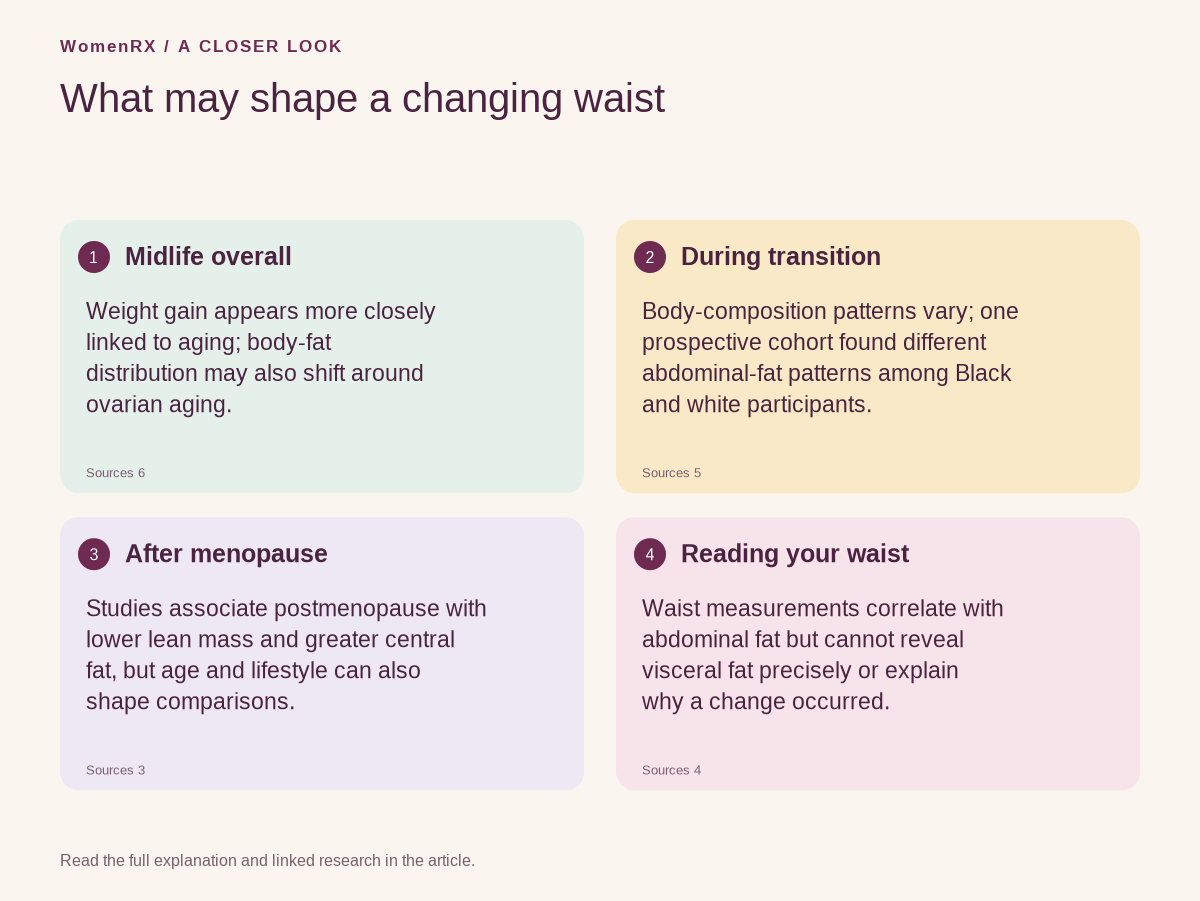
What may shape a changing waist
Midlife overall: Weight gain appears more closely linked to aging; body-fat distribution may also shift around ovarian aging.6
During transition: Body-composition patterns vary; one prospective cohort found different abdominal-fat patterns among Black and white participants.5
After menopause: Studies associate postmenopause with lower lean mass and greater central fat, but age and lifestyle can also shape comparisons.3
Reading your waist: Waist measurements correlate with abdominal fat but cannot reveal visceral fat precisely or explain why a change occurred.4
Read the figure as text
A stage-by-stage view of what research associates with midlife body changes, and what waist measurements can show.- Midlife overall: Weight gain appears more closely linked to aging; body-fat distribution may also shift around ovarian aging.6
- During transition: Body-composition patterns vary; one prospective cohort found different abdominal-fat patterns among Black and white participants.5
- After menopause: Studies associate postmenopause with lower lean mass and greater central fat, but age and lifestyle can also shape comparisons.3
- Reading your waist: Waist measurements correlate with abdominal fat but cannot reveal visceral fat precisely or explain why a change occurred.4
More questions, answered
Can menopause change body composition without changing weight?
Yes, body composition can shift even when total body weight does not. The available research associates menopause stage with differences in fat and lean mass, but cross-sectional comparisons cannot fully separate menopause from age and other influences. 3
Does hormone therapy help reduce belly fat?
The 2022 North American Menopause Society position statement describes hormone therapy for menopause symptoms and bone-loss prevention, not as a weight-loss treatment. It does not establish that hormone therapy has no effect on weight; it means weight loss shouldn’t be the reason to use it. 1
Sources you can check
- The 2022 hormone therapy position statement of The North American Menopause Society.“The 2022 Hormone Therapy Position Statement of The North American Menopause Society” Advisory Panel. · Menopause (New York, N.Y.) · 2022Return to first citation
- Effect of high intensity interval training on body composition in women before and after menopause: a meta-analysis.Dupuit M, Maillard F, Pereira B, Marquezi ML, Lancha AH, Boisseau N. · Experimental physiology · 2020Return to first citation
- The Impact of the Menopausal Transition on Body Composition and Abdominal Fat Redistribution.Szeliga A, Chedraui P, Meczekalski B. · Journal of clinical medicine · 2026Return to first citation
- Longitudinal patterns of abdominal visceral and subcutaneous adipose tissue, total body composition, and anthropometric measures in postmenopausal women: Results from the Women's Health Initiative.Banack HR, Bea JW, Chen Z, Blew RM, Nicholas S, Stefanick M, Wild RA, Manson JE, Odegaard AO. · International journal of obesity (2005) · 2023Return to first citation
- Racial differences in body composition and cardiometabolic risk during the menopause transition: a prospective, observational cohort study.Marlatt KL, Redman LM, Beyl RA, Smith SR, Champagne CM, Yi F, Lovejoy JC. · American journal of obstetrics and gynecology · 2020Return to first citation
- Association of Mid-Life Changes in Body Size, Body Composition and Obesity Status with the Menopausal Transition.Karvonen-Gutierrez C, Kim C. · Healthcare (Basel, Switzerland) · 2016Return to first citation