Belly Fat During Perimenopause: What Changes, and What Else Could Explain It?
The menopause transition can shift fat toward the waist, but research does not show that every waist change is caused by menopause or tell you exactly how long it will last.
A changing waist during perimenopause isn’t necessarily a temporary symptom. Research links the menopause transition with a shift toward more abdominal fat, while much midlife weight gain appears related to aging. Studies track body fat over months or years, not day-to-day abdominal changes, so they can’t predict how long an individual change will last or explain every episode of bloating. 2 3
Fat distribution and body weight aren’t the same change
You may see your waist change even if your total weight doesn’t shift much. That’s because body weight and where fat is stored are different measures. Reviews of midlife research describe weight gain as largely associated with chronological aging, while changes in body composition and fat distribution appear more closely associated with ovarian aging and the menopause transition. These patterns can overlap, but one doesn’t tell you exactly what’s happening with the other. 3 5
A prospective observational study followed Black and white women through the transition and measured body composition and abdominal fat. Among the women who reached menopause, white participants showed increases in weight and abdominal fat before menopause; Black participants had more abdominal fat before menopause and maintained it across the transition. This is a useful reminder that group averages don’t predict one woman’s experience, and that patterns can differ across populations. 2
What the research says about duration
There isn’t a reliable countdown for “menopause belly.” The studies in this area measure body fat and distribution at particular visits or compare groups at different menopausal stages. They show that abdominal fat can increase across the transition and may remain higher after menopause, but they don’t tell you when a particular person’s waist change will stop or reverse. 1 2 4
The study designs matter. A small cross-sectional study found more intra-abdominal fat in early-postmenopausal women than in premenopausal women, even after statistical adjustment for age and total fat mass. But a comparison at one point in time can’t show when the difference began or how long it will last. A more recent cross-sectional study also found differences in fat and lean mass across menopausal stages, while acknowledging that age differences between groups make it hard to separate menopause-related changes from aging. 1 4
So it’s reasonable to understand a changing waist as something that may continue beyond perimenopause, not as a symptom guaranteed to disappear when periods stop. That’s different from saying menopause explains your individual change or that it will follow a set course.
A fuller-looking abdomen isn’t always a change in fat
Body-composition studies use methods such as imaging or body-composition assessments to estimate fat and lean tissue. They don’t measure every cause of a fuller-looking abdomen or track how it changes over a day. In particular, these studies can’t tell whether a short-term change in abdominal size is fat gain, bloating, or another kind of distension. 1 2 4
As a practical distinction, a change that varies noticeably over a short period isn’t the same thing as the gradual fat-distribution changes these studies examine. That observation alone doesn’t identify the cause, but it can help you avoid treating every episode of abdominal fullness as evidence of new belly fat.
What you can take from the evidence
The clearest takeaway is that midlife can bring both overall weight changes and a shift toward more fat around the abdomen, but they aren’t interchangeable. The menopause transition may contribute to body-composition changes; aging and other factors also matter, and studies don’t establish a personal timeline. 3 5
If you’re trying to understand a waist change, consider whether it has been gradual or fluctuates over short periods, and whether your overall weight has changed too. Those observations don’t diagnose the cause, but they separate questions the research treats differently: body weight, fat distribution, and abdominal distension. The evidence supports taking waist changes seriously as part of a broader midlife picture, without assuming hormones are the whole explanation.
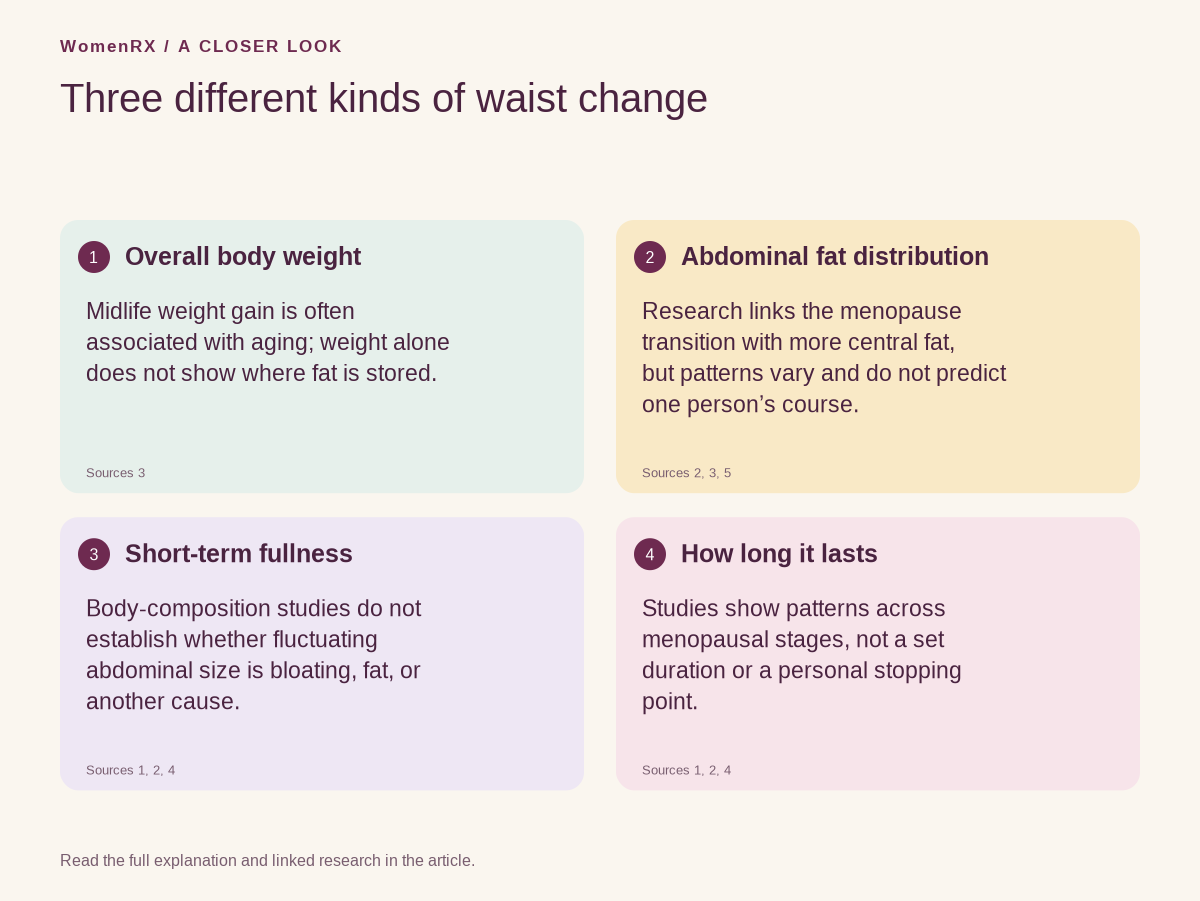
Three different kinds of waist change
Overall body weight: Midlife weight gain is often associated with aging; weight alone does not show where fat is stored.3
Abdominal fat distribution: Research links the menopause transition with more central fat, but patterns vary and do not predict one person’s course.235
Short-term fullness: Body-composition studies do not establish whether fluctuating abdominal size is bloating, fat, or another cause.124
How long it lasts: Studies show patterns across menopausal stages, not a set duration or a personal stopping point.124
Read the figure as text
The evidence is strongest for measured body-fat patterns across menopausal stages. It does not provide a personal timeline or explain every change in abdominal size.- Overall body weight: Midlife weight gain is often associated with aging; weight alone does not show where fat is stored.3
- Abdominal fat distribution: Research links the menopause transition with more central fat, but patterns vary and do not predict one person’s course.235
- Short-term fullness: Body-composition studies do not establish whether fluctuating abdominal size is bloating, fat, or another cause.124
- How long it lasts: Studies show patterns across menopausal stages, not a set duration or a personal stopping point.124
More questions, answered
Does gaining belly fat mean I’ve gained weight overall?
Not necessarily. Overall weight and fat distribution are separate measures; research describes changes in central fat distribution during the menopause transition as well as midlife weight gain. 3 5
Will belly fat go away after my periods stop?
There’s no reliable personal timeline in these studies. They show patterns across menopausal stages, not when an individual’s abdominal fat will stop changing or reverse. 1 2
Sources you can check
- The Impact of the Menopausal Transition on Body Composition and Abdominal Fat Redistribution.Szeliga A, Chedraui P, Meczekalski B. · Journal of clinical medicine · 2026Return to first citation
- Racial differences in body composition and cardiometabolic risk during the menopause transition: a prospective, observational cohort study.Marlatt KL, Redman LM, Beyl RA, Smith SR, Champagne CM, Yi F, Lovejoy JC. · American journal of obstetrics and gynecology · 2020Return to first citation
- Association of Mid-Life Changes in Body Size, Body Composition and Obesity Status with the Menopausal Transition.Karvonen-Gutierrez C, Kim C. · Healthcare (Basel, Switzerland) · 2016Return to first citation
- Effect of menopausal status on body composition and abdominal fat distribution.Toth MJ, Tchernof A, Sites CK, Poehlman ET. · International journal of obesity and related metabolic disorders : journal of the International Association for the Study of Obesity · 2000Return to first citation
- Body weight and fat mass across the menopausal transition: hormonal modulators.Moccia P, Belda-Montesinos R, Monllor-Tormos A, Chedraui P, Cano A. · Gynecological endocrinology : the official journal of the International Society of Gynecological Endocrinology · 2022Return to first citation