Why Body Fat Distribution Can Change in Midlife
A changing waist can reflect shifts in fat location, total weight, or both, and menopause is only one part of the picture.
During midlife, weight and fat distribution can change in different ways. Research links ageing with weight gain and the menopause transition with a shift toward more abdominal fat and less lean mass, but the effects overlap and vary between women. A waist change alone can’t tell you whether you’re perimenopausal or identify its cause. 4 3
The number on the scale doesn’t tell the whole story
Weight is the combined mass of fat, muscle, bone, and other tissues. Fat distribution describes where fat is stored. You might gain weight without a major change in where fat sits, or notice a fuller waist even when your weight changes little. Both can happen together.
Fat under the skin around the abdomen is called subcutaneous fat. Visceral fat is stored deeper in the abdomen around internal organs. These depots aren’t interchangeable, and a bathroom scale can’t distinguish them. Even waist circumference and BMI, which are useful measures of body size, don’t reveal exactly how much visceral or subcutaneous fat a person has. In a large study of postmenopausal women, abdominal fat measures varied substantially among women in the same BMI and waist-circumference categories. 2
Ageing and menopause may contribute in different ways
A review of midlife research found that weight gain is often associated with chronological ageing, while changes in body composition and a shift toward abdominal fat are also associated with ovarian ageing during the menopause transition. That distinction helps explain why “menopause weight gain” can oversimplify what’s happening: age, reproductive changes, and body composition can move at the same time. They’re hard to fully separate in many studies. 4
In a small prospective study that followed Black and white women through menopause, patterns differed by racial group. White participants gained abdominal fat during the transition, while Black participants already had more abdominal fat before menopause and maintained it across the transition. The study doesn’t predict what will happen for any one woman, but it shows why a single pattern shouldn’t be assumed to apply to everyone. 3
A separate study followed more than 10,000 postmenopausal women for six years and found that abdominal fat patterns differed by age, race and ethnicity, and time since menopause. For example, visceral fat increased during follow-up among women younger than 60, while it decreased among women 70 and older. These findings reinforce that “postmenopausal” doesn’t describe one uniform body-composition pattern. 2
Muscle and everyday routines matter, too
Some research associates the menopause transition with lower lean mass as well as more abdominal fat. A cross-sectional study of 325 women found lower lean-mass measures and greater central adiposity among postmenopausal women than among premenopausal and perimenopausal women. Because the study compared groups at one point in time, and the postmenopausal women were older on average, it can’t show that menopause alone caused those differences. 1
Activity is another part of the picture. A review describes regular physical activity during midlife as a possible way to help counter age- and menopause-associated changes in energy expenditure and abdominal fat. That’s a broad rationale, not proof that a particular exercise routine will prevent redistribution or selectively reduce belly fat. 4
Sleep and daily routines may be useful context to record if they change alongside your activity or eating patterns. But a record can show what happened at the same time; it can’t establish that one factor caused a waist change. The research summarized here doesn’t establish sleep as a direct cause of fat redistribution.
What to track without turning it into a verdict
If you’re trying to understand a change, choose a few measures you can compare consistently over time:
- Weight and waist: Record both, rather than treating either one as the full story. Use the same measuring approach each time if you measure your waist.
- Strength and movement: Note meaningful changes in strength, regular activity, or how everyday tasks feel. These add context that a scale can’t provide.
- Menstrual changes: If you still have periods, note changes in their pattern separately. A waist change by itself doesn’t establish that you’re in perimenopause.
- Context: You can record activity, sleep, or routine changes alongside body measurements. Treat them as clues to discuss or reflect on, not proof of cause.
A sudden or worrying change deserves attention on its own terms. For a gradual shift, looking at weight, waist, strength, activity, and menstrual pattern together gives a more useful picture than labeling it “menopause belly.”
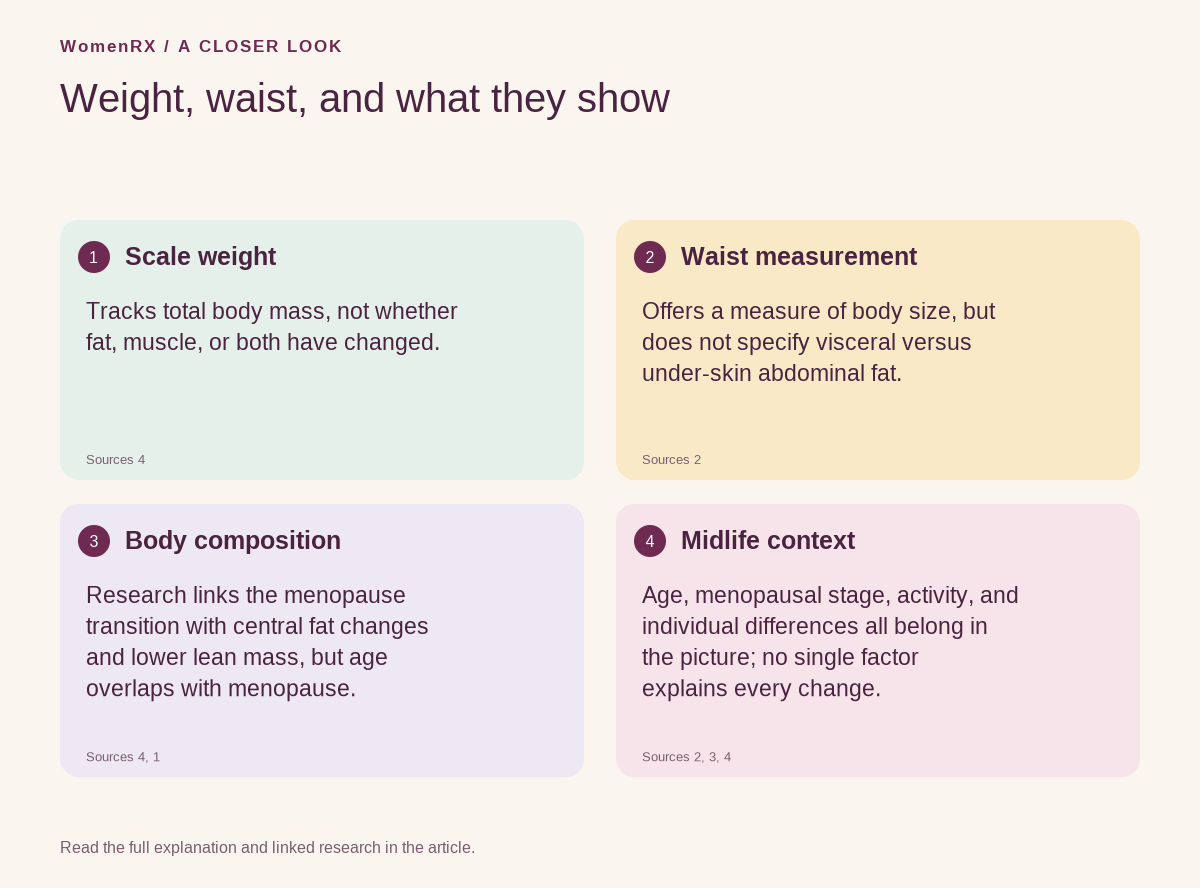
Weight, waist, and what they show
Scale weight: Tracks total body mass, not whether fat, muscle, or both have changed.4
Waist measurement: Offers a measure of body size, but does not specify visceral versus under-skin abdominal fat.2
Body composition: Research links the menopause transition with central fat changes and lower lean mass, but age overlaps with menopause.41
Midlife context: Age, menopausal stage, activity, and individual differences all belong in the picture; no single factor explains every change.234
Read the figure as text
These measures describe different parts of body composition. None, on its own, explains why a midlife change happened.- Scale weight: Tracks total body mass, not whether fat, muscle, or both have changed.4
- Waist measurement: Offers a measure of body size, but does not specify visceral versus under-skin abdominal fat.2
- Body composition: Research links the menopause transition with central fat changes and lower lean mass, but age overlaps with menopause.41
- Midlife context: Age, menopausal stage, activity, and individual differences all belong in the picture; no single factor explains every change.234
More questions, answered
Does a bigger waist mean I’m in perimenopause?
No. Abdominal fat changes are associated with the menopause transition, but ageing and other factors can contribute, too. Waist size alone can’t identify your menopausal stage. 4
Can a waist measurement show how much visceral fat I have?
Not exactly. Waist circumference gives information about body size, but research found substantial differences in visceral and subcutaneous abdominal fat among women with similar waist measurements and BMI. 2
Sources you can check
- The Impact of the Menopausal Transition on Body Composition and Abdominal Fat Redistribution.Szeliga A, Chedraui P, Meczekalski B. · Journal of clinical medicine · 2026Return to first citation
- Longitudinal patterns of abdominal visceral and subcutaneous adipose tissue, total body composition, and anthropometric measures in postmenopausal women: Results from the Women's Health Initiative.Banack HR, Bea JW, Chen Z, Blew RM, Nicholas S, Stefanick M, Wild RA, Manson JE, Odegaard AO. · International journal of obesity (2005) · 2023Return to first citation
- Racial differences in body composition and cardiometabolic risk during the menopause transition: a prospective, observational cohort study.Marlatt KL, Redman LM, Beyl RA, Smith SR, Champagne CM, Yi F, Lovejoy JC. · American journal of obstetrics and gynecology · 2020Return to first citation
- Association of Mid-Life Changes in Body Size, Body Composition and Obesity Status with the Menopausal Transition.Karvonen-Gutierrez C, Kim C. · Healthcare (Basel, Switzerland) · 2016Return to first citation