How Abdominal Fat Can Change Around Menopause
Midlife weight gain often tracks with aging, while the menopause transition may also shift where fat is stored and how much lean muscle you carry.
A changing waist around menopause doesn’t point to one cause. Research reviews suggest that overall weight gain in midlife is more closely linked to chronological aging, while the menopause transition may contribute to a shift toward more abdominal fat and less lean muscle. These changes can overlap, and observational studies can’t show that hormones alone caused them. 1
The scale and your waist measure different things
Your weight is the total of everything your body carries. Body composition describes what that weight is made of and where it is distributed. So your waist or clothing fit can change without a dramatic shift on the scale, and a scale can’t tell you whether a change came from fat, muscle, or both. 1
Researchers also distinguish between subcutaneous fat, which sits beneath the skin, and visceral fat, which is deeper in the abdomen. Waist circumference can describe a change in your middle, but it doesn’t tell you how much visceral fat you have. 1
That difference shows up in one small longitudinal study reviewed by Karvonen-Gutierrez and Kim. Across eight years, 23 women had increases in measured abdominal fat, including both subcutaneous and visceral fat, even though their weight and waist circumference did not change after adjustment for age. It’s a useful example of why no single measurement tells the whole story, not a prediction of what will happen to you. 1
Aging and the menopause transition may affect different parts of the picture
Women often gain weight through midlife. The review found that weight change was more consistently associated with chronological aging, including in women at different menopausal stages. By contrast, many studies using more detailed body-composition measures linked the menopause transition with changes in fat distribution, including a greater central or abdominal pattern. The review describes this as the majority pattern in the research, not a settled way to separate aging from ovarian changes completely. 1
Muscle is part of the picture, too. The review also describes decreases in lean muscle mass during the transition. That means a change in body shape can reflect more than a change in fat or total weight. In one Michigan site of the Study of Women’s Health Across the Nation, researchers observed a 6% increase in waist circumference, a 10% increase in fat mass, and a 1% decrease in skeletal muscle mass over six years around the final menstrual period; these changes persisted after adjustment for chronological age. This was a finding from one study site, not a forecast for every woman. 1
Hormones may contribute, but they aren’t the whole explanation
Changing reproductive hormones are one plausible part of the story. But the relationship can go both ways: fat tissue is metabolically active and is associated with changes in sex hormone-binding globulin, while reproductive hormones may also affect where fat is deposited. That makes “menopause hormones caused my belly fat” too simple an explanation for an individual change. 1
A Women’s Health Initiative analysis offers another example of what these studies can show. Among 10,184 postmenopausal women, those reporting menopause at ages 50 to 55 had, on average, 19.3 cm² less measured visceral fat than those reporting menopause before age 40, after statistical adjustment. The analysis used baseline data and self-reported reproductive history, so it shows an association, not that menopause timing caused the difference. It also can’t predict one woman’s body composition. 2
A useful way to read a change in your middle
If your shape is changing, separate three questions: Has your total weight changed? Has your waist changed? Could body composition, including muscle, have changed too? Those are related but distinct observations. A waist measurement and a scale reading can describe change, but neither identifies its cause or measures visceral fat on its own. 1
The broad picture is that age-related weight gain and menopause-related shifts in body composition can happen at the same time. Menopause may be part of why fat distribution changes, but it isn’t the only possible explanation, and the scale alone can’t sort out the difference. 1
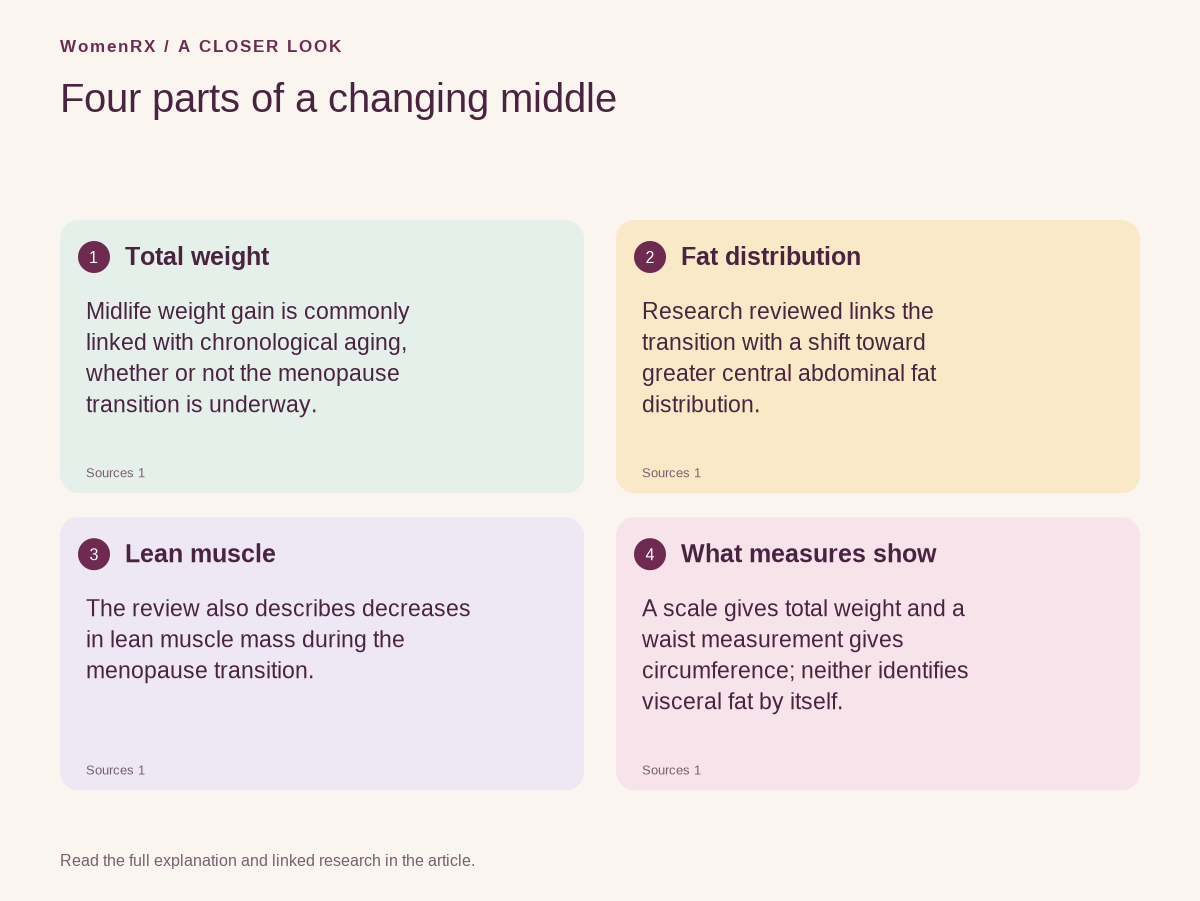
Four parts of a changing middle
Total weight: Midlife weight gain is commonly linked with chronological aging, whether or not the menopause transition is underway.1
Fat distribution: Research reviewed links the transition with a shift toward greater central abdominal fat distribution.1
Lean muscle: The review also describes decreases in lean muscle mass during the menopause transition.1
What measures show: A scale gives total weight and a waist measurement gives circumference; neither identifies visceral fat by itself.1
Read the figure as text
Weight, fat distribution, waist size, and muscle are related, but each tells you something different.- Total weight: Midlife weight gain is commonly linked with chronological aging, whether or not the menopause transition is underway.1
- Fat distribution: Research reviewed links the transition with a shift toward greater central abdominal fat distribution.1
- Lean muscle: The review also describes decreases in lean muscle mass during the menopause transition.1
- What measures show: A scale gives total weight and a waist measurement gives circumference; neither identifies visceral fat by itself.1
Sources you can check
- Association of Mid-Life Changes in Body Size, Body Composition and Obesity Status with the Menopausal Transition.Karvonen-Gutierrez C, Kim C. · Healthcare (Basel, Switzerland) · 2016Return to first citation
- The association between reproductive history and abdominal adipose tissue among postmenopausal women: results from the Women's Health Initiative.Banack HR, Cook CE, Grandi SM, Scime NV, Andary R, Follis S, Allison M, Manson JE, Jung SY, Wild RA, Farland LV, Shadyab AH, Bea JW, Odegaard AO. · Human reproduction (Oxford, England) · 2024Return to first citation