Exercise and Belly Fat: What Can, and Can’t, Change
Exercise can improve waist and abdominal-fat measures, but the results depend on what is measured and don’t promise fat loss from one chosen spot.
Exercise may reduce abdominal fat and waist circumference, but those aren’t the same outcome as weight loss, and neither guarantees a particular change in appearance. Studies in postmenopausal women found improvements after whole-body aerobic or interval exercise; they don’t show that abdominal-only exercises selectively burn belly fat. Strength work still has value for building or maintaining muscle. 1 3 5
If your goal is to change your waist, it helps to separate three things that are often lumped together: the number on the scale, the measurement around your waist, and fat stored inside the abdomen. Exercise studies don’t always measure all three, and a change in one doesn’t tell the whole story.
What “abdominal fat” can mean
Waist circumference is a simple measurement around the middle. It can help indicate where body fat is carried, but it isn’t a direct measurement of a specific fat depot. Imaging methods such as CT and MRI can estimate abdominal fat more directly, including fat beneath the skin and fat within the abdomen. Weight, meanwhile, includes muscle, bone, fat, and water, so a scale change cannot identify which tissue changed. 2 4 5
These measures can move differently. In a study, waist circumference or body weight may change while a particular imaging measure changes by a different amount. That doesn’t make one measure useless; it means each answers a different question. Waist measurement is also relevant to health: more fat carried around the abdomen rather than the hips is associated with higher risk of heart disease and type 2 diabetes. 2
What exercise studies in women have found
A pooled analysis of two randomized trials included 720 postmenopausal women and examined prescribed amounts of aerobic exercise over 12 months. The trial comparisons differed: one compared 225 minutes per week of exercise with a usual inactive lifestyle, while the other compared 150 with 300 minutes per week. In the pooled analysis, the reported weight differences for low-, mid-, and high-volume exercise categories versus controls were 1.47, 1.83, and 2.21 kg, respectively; the corresponding differences in intra-abdominal fat area were 7.44, 15.56, and 8.76 cm². These are group results, not a prediction of what any one woman will lose. The fat-area differences also weren’t progressively larger at each higher exercise volume. 5
A smaller randomized trial studied 30 inactive postmenopausal women with overweight or obesity for eight weeks. Compared with a control group, women assigned to home-based interval exercise had reductions in weight, BMI, and waist circumference. The trial did not find a significant between-group effect on its visceral adiposity index. That contrast is a useful reminder: the waist measurement and the study’s other abdominal-adiposity measure did not tell identical stories. 3
A separate 24-week exercise trial used MRI to measure fat changes in 103 adults, including 62 women. Greater exercise amount and/or intensity increased the proportion of participants whose visceral-fat changes were considered clinically meaningful. This was a mixed-sex study, and the reported results don’t provide a separate estimate for women. 4
Taken together, these studies support the idea that whole-body exercise can change abdominal-fat measures. They don’t establish one best exercise for belly fat, or promise that a particular routine will produce a visible waist change.
Why crunches aren’t a belly-fat plan
Crunches and other abdominal exercises can be part of muscle-strengthening activity, which helps build or maintain muscle. But the exercise studies described above measured abdominal-fat changes after whole-body aerobic or interval programs; they did not test whether exercising the abdominal muscles alone selectively reduces nearby fat. So it’s reasonable to choose core exercises for strength or function, but not to count on them as a way to direct fat loss to the belly. 1 3 5
A useful way to choose your focus
If you like walking, cycling, swimming, or another aerobic activity, the research in postmenopausal women gives a reason to include whole-body aerobic exercise when your aim is to improve body-composition measures. If your priority is strength, muscle, or everyday function, muscle-strengthening activity has value even if your waist or weight doesn’t change as expected. Regular exercise also supports heart health, blood-glucose management, mood, and muscle strength, so its benefits aren’t limited to the scale or waistline. 1
Menopause shouldn’t be used as a complete explanation for one person’s body-fat pattern. The studies here include postmenopausal women, but they don’t compare the same exercise program across premenopausal and postmenopausal groups. The results therefore can’t tell you that a particular waist change is caused by menopause or predict how an individual woman will respond. 3 5
A practical way to read your progress is to keep the measures separate: weight reflects total body mass, waist circumference reflects a change in waist size, and imaging can estimate specific fat depots. You don’t need all three measures to benefit from exercise. The better measure depends on the question you’re trying to answer.
Three ways to measure change
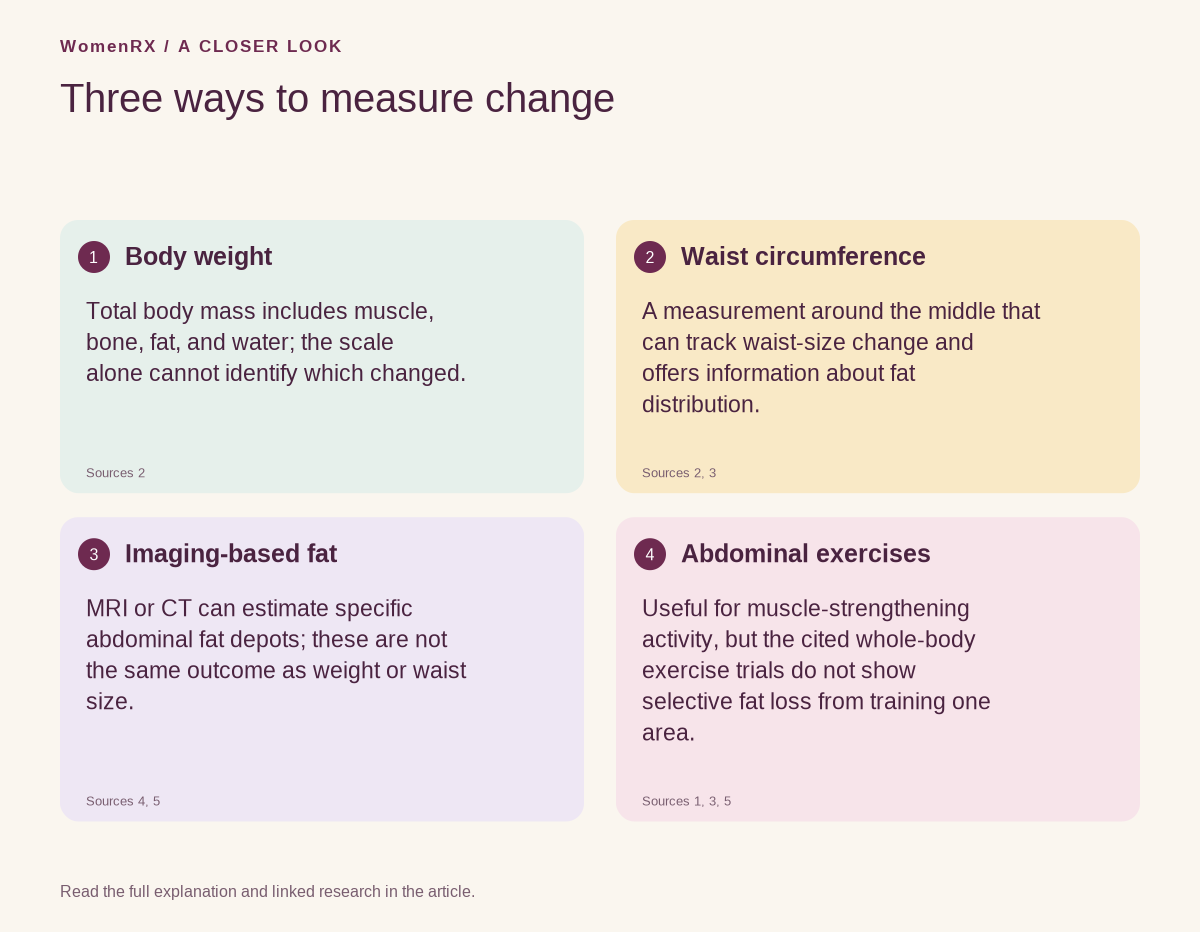
Body weight: Total body mass includes muscle, bone, fat, and water; the scale alone cannot identify which changed.2
Waist circumference: A measurement around the middle that can track waist-size change and offers information about fat distribution.23
Imaging-based fat: MRI or CT can estimate specific abdominal fat depots; these are not the same outcome as weight or waist size.45
Abdominal exercises: Useful for muscle-strengthening activity, but the cited whole-body exercise trials do not show selective fat loss from training one area.135
Read the figure as text
These measures answer different questions. Exercise results can differ depending on whether a study tracks total body weight, waist size, or fat in a specific abdominal depot.- Body weight: Total body mass includes muscle, bone, fat, and water; the scale alone cannot identify which changed.2
- Waist circumference: A measurement around the middle that can track waist-size change and offers information about fat distribution.23
- Imaging-based fat: MRI or CT can estimate specific abdominal fat depots; these are not the same outcome as weight or waist size.45
- Abdominal exercises: Useful for muscle-strengthening activity, but the cited whole-body exercise trials do not show selective fat loss from training one area.135
More questions, answered
Can exercise reduce waist size even if weight barely changes?
Waist circumference and body weight measure different things, but the cited trial in postmenopausal women found reductions in both. It doesn’t establish that waist size can fall while weight barely changes. Weight also includes muscle, bone, fat, and water. 2 3
Do the findings apply equally before and after menopause?
The postmenopausal trials show what happened in those participants, but they don’t compare premenopausal and postmenopausal women under the same exercise program. They can’t establish that results are identical across these groups. 3 5
Sources you can check
- Benefits of Exercise: MedlinePlusAccessed 2026-09-25Return to first citation
- Body Weight: MedlinePlusAccessed 2026-09-25Return to first citation
- Effect of home-based exercise with or without a Mediterranean-style diet on adiposity markers in postmenopausal women: A randomized-control trial.Tan A, Dunseath G, Thomas RL, Prior SL, Bracken RM, Churm R. · Physiological reports · 2025Return to first citation
- Individual Response to Standardized Exercise: Total and Abdominal Adipose Tissue.Brennan AM, Day AG, Cowan TE, Clarke GJ, Lamarche B, Ross R. · Medicine and science in sports and exercise · 2020Return to first citation
- Dose-response effects of aerobic exercise on adiposity markers in postmenopausal women: pooled analyses from two randomized controlled trials.Gonzalo-Encabo P, McNeil J, Pérez-López A, Valadés D, Courneya KS, Friedenreich CM. · International journal of obesity (2005) · 2021Return to first citation