Cortisol and Belly Fat: What the Evidence Shows
Stress may be part of a complicated picture, but belly fat alone can’t tell you whether cortisol is the cause.
Cortisol is involved in the body’s stress response, and a stress-weight connection is plausible. But the adult hair-cortisol study and a small study of girls don’t demonstrate that everyday stress causes abdominal fat gain through cortisol in adult women. 56 Body shape can’t diagnose cortisol excess. Concern about uncommon Cushing syndrome is greater when weight changes occur with progressive signs such as easy bruising or muscle weakness, or with long-term steroid medicine use. 123
Stress, cortisol, and abdominal fat are not the same thing
Cortisol helps the body respond to demands. That doesn’t mean feeling stressed proves your cortisol is high, or that a change in your waistline reveals what your cortisol is doing. Stress, eating patterns, activity, sleep, medications, and other health factors can overlap, so a visible change in body fat can’t identify one cause by itself.
Researchers have proposed ways stress might affect weight, including changes in appetite and eating behavior. Those are possible pathways, not proof that stress hormones directly caused a particular person’s abdominal fat. In one prospective study, 786 adults who had previously lost weight were followed for 18 months. After adjustment for lifestyle and demographic factors, baseline hair cortisol wasn’t associated with later changes in body weight or body-fat percentage. An increase in hair cortisol during the first 12 months was associated with slightly greater weight variability in the next six months, but that is not the same as showing that cortisol caused belly-fat gain. 5
The study measured hair cortisol, which reflects exposure during hair growth; blood, saliva, and urine measurements provide a more current snapshot. These measures answer different questions, and a stress-related interpretation cannot be made from body shape alone. 5
What the research can and can’t say about women
The adult weight-maintenance study included adults, but its reported results don’t give a women-specific estimate or establish how age, menopause, sleep, or particular medications affect the relationship. A separate study looked at 23 Hispanic girls ages 8 to 11, not adult women. It found that school-related stressful events were associated with abdominal fat measures among girls with a higher cortisol awakening response, but not those with a lower response. Because it was small and cross-sectional, it can’t show that stress or cortisol caused the fat differences, or tell us what happens in adult women. 56
So the honest takeaway isn’t that stress has no connection to weight. It’s that the available findings don’t make cortisol a reliable explanation for an individual woman’s abdominal fat, and they don’t settle how menopause or other factors change the relationship. That distinction matters: a theory about stress is not the same as a diagnosis of a hormone disorder.
When cortisol excess is a medical concern
Cushing syndrome is a rare condition caused by long-term exposure to too much cortisol. It can result from long-term use of steroid medicines or, less often, from a growth that leads the body to make excess cortisol. Changes in fat distribution can occur, including more fat around the trunk, neck, or upper back, sometimes with thinner-looking arms and legs. But abdominal fat by itself is not enough to identify Cushing syndrome. 12
The pattern and combination of changes matter more than a single body feature. In a German registry study of people referred for suspected Cushing syndrome, the features that were more common among those ultimately diagnosed included muscle weakness, osteoporosis, an adrenal mass found on imaging, metabolic syndrome, and multiple symptoms. Obesity or weight gain alone was more common among people in whom the condition was ruled out. Because everyone in this study had already been referred for evaluation, these findings shouldn’t be used to estimate risk in the general population. 3
Consider medical assessment if weight or body changes are progressive and occur with other concerning signs, particularly easy bruising, muscle weakness, or bone loss, or if you use steroid medicine long term. Don’t stop a prescribed steroid medicine on your own. A clinician can review your symptoms and medication history and decide whether testing is warranted. Cushing syndrome evaluation uses specific tests, such as cortisol measured in urine or saliva or blood testing after dexamethasone; a single general cortisol measurement or appearance alone doesn’t settle the diagnosis. 124
A useful way to sort the question
If your only clue is a larger waist, that doesn’t point specifically to cortisol. If several changes are appearing or progressing together, especially with steroid use, the question becomes whether a medical assessment is appropriate, not whether a supplement can “reset” cortisol. The available evidence doesn’t support treating belly fat as a cortisol test or inferring a hormone disorder from body shape.
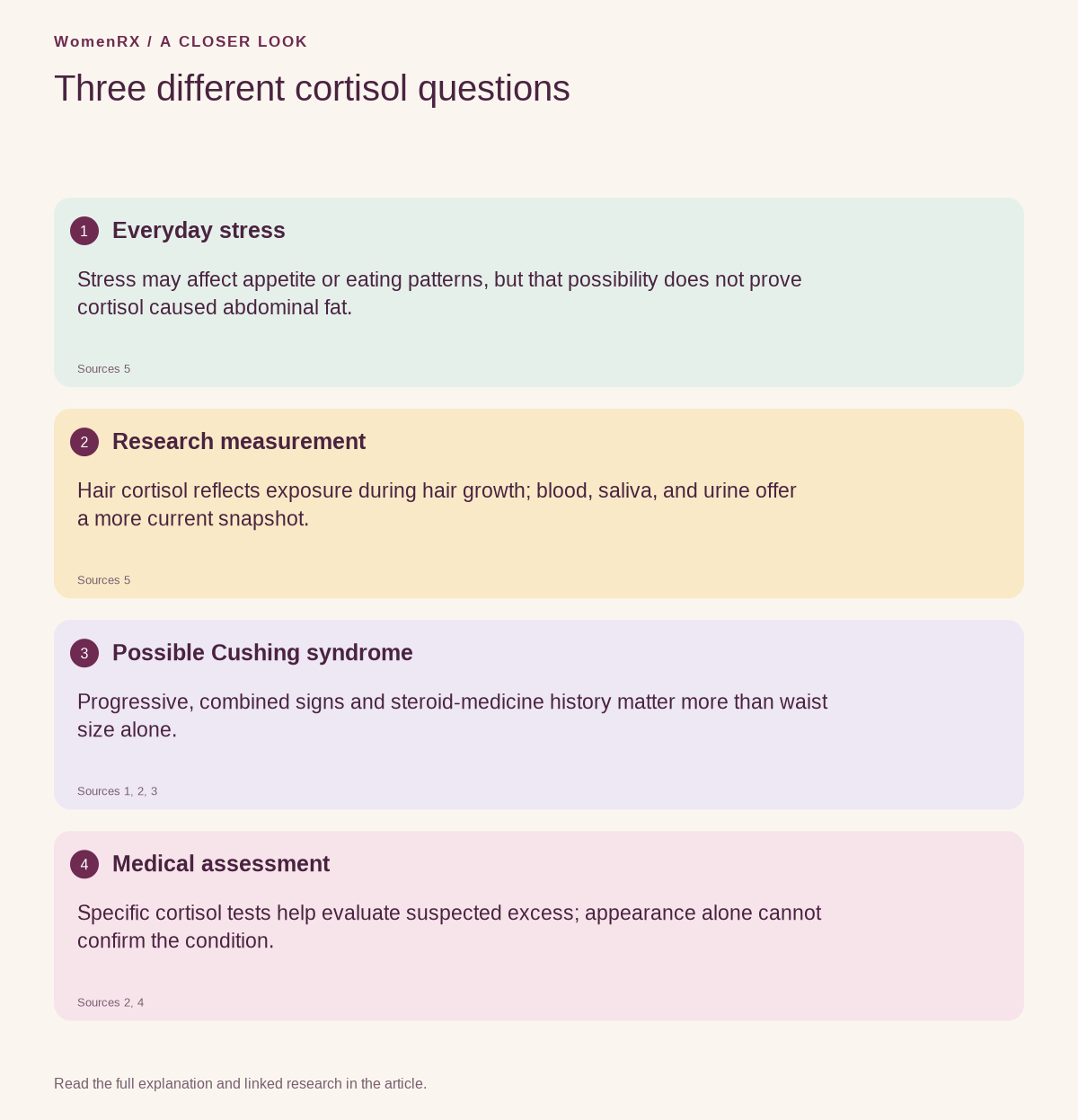
Three different cortisol questions
Everyday stress: Stress may affect appetite or eating patterns, but that possibility does not prove cortisol caused abdominal fat.5
Research measurement: Hair cortisol reflects exposure during hair growth; blood, saliva, and urine offer a more current snapshot.5
Possible Cushing syndrome: Progressive, combined signs and steroid-medicine history matter more than waist size alone.123
Medical assessment: Specific cortisol tests help evaluate suspected excess; appearance alone cannot confirm the condition.24
Read the figure as text
This comparison separates a proposed stress pathway from a research measurement and the clinical question of suspected cortisol excess.- Everyday stress: Stress may affect appetite or eating patterns, but that possibility does not prove cortisol caused abdominal fat.5
- Research measurement: Hair cortisol reflects exposure during hair growth; blood, saliva, and urine offer a more current snapshot.5
- Possible Cushing syndrome: Progressive, combined signs and steroid-medicine history matter more than waist size alone.123
- Medical assessment: Specific cortisol tests help evaluate suspected excess; appearance alone cannot confirm the condition.24
More questions, answered
Can one cortisol test tell me whether stress caused my belly fat?
No. Blood, saliva, and urine cortisol measurements reflect current cortisol rather than chronic stress exposure, and a test result needs to be interpreted in the context of the reason it was ordered. Body-fat distribution can’t establish the cause. 5
Does belly fat mean I have Cushing syndrome?
No. Cushing syndrome is rare, and abdominal fat alone is not a reliable way to identify it. Concern is more appropriate when changes are progressive and occur with other signs, or with long-term steroid medicine use. 123
Sources you can check
- Cushing Syndrome | Hypercortisolism | MedlinePlusAccessed 2026-09-25Return to first citation
- Cushing's syndrome - NHSAccessed 2026-09-25Return to first citation
- Whom Should We Screen for Cushing Syndrome? The Endocrine Society Practice Guideline Recommendations 2008 Revisited.Braun LT, Vogel F, Zopp S, Marchant Seiter T, Rubinstein G, Berr CM, Künzel H, Beuschlein F, Reincke M. · The Journal of clinical endocrinology and metabolism · 2022Return to first citation
- Clinical and Biochemical Data for the Diagnosis of Endogenous Hypercortisolism: The "Cushingomic" Approach.Ceccato F, Bavaresco A, Ragazzi E, Barbot M, Boscaro M, Basso D, Scaroni C, Antonelli G. · The Journal of clinical endocrinology and metabolism · 2025Return to first citation
- Hair Cortisol Concentration, Weight Loss Maintenance and Body Weight Variability: A Prospective Study Based on Data From the European NoHoW Trial.Larsen SC, Turicchi J, Christensen GL, Larsen CS, Jørgensen NR, Mikkelsen MK, Horgan G, O'Driscoll R, Michalowska J, Duarte C, Scott SE, Santos I, Encantado J, Palmeira AL, Stubbs ... · Frontiers in endocrinology · 2021Return to first citation
- Stress and abdominal fat: preliminary evidence of moderation by the cortisol awakening response in Hispanic peripubertal girls.Donoho CJ, Weigensberg MJ, Emken BA, Hsu JW, Spruijt-Metz D. · Obesity (Silver Spring, Md.) · 2011Return to first citation