Does “Cortisol Belly” Have a Medical Meaning?
A larger waist can be worth discussing, but it doesn’t by itself show that cortisol is high.
“Cortisol belly” is social-media shorthand, not a diagnosis. Cushing syndrome is a real, uncommon condition involving too much cortisol, but waist size alone can’t identify it. A gradual pattern of other symptoms, especially with long-term use of high-dose steroid medicine, gives a clinician more reason to consider it. Unexpected weight change also deserves attention, whatever the cause. 123
A body shape isn’t a cortisol test
“Cortisol belly” is a catchy phrase, but it isn’t a medical diagnosis. Cushing syndrome is a specific condition in which the body has too much cortisol. It’s uncommon, and its most common cause is taking high doses of steroid medicines for a long time. Less often, a growth in the pituitary or adrenal glands can lead to excess cortisol. 1
That distinction matters because a changing waist doesn’t tell you why it changed. Waist size can help assess health risks, but it can’t tell you whether cortisol is involved. Even measures such as BMI have limits: they don’t distinguish fat from muscle or bone, and they can misrepresent body fat in people who have lost muscle. 23
Weight history, activity, other health conditions, and steroid-medicine use offer different pieces of the picture. For example, a change in activity belongs in a weight assessment, while long-term use of high-dose steroids raises a more specific question about Cushing syndrome. Neither observation makes a waist measurement into a hormone test. 12
If you’re a woman, the timing of a change is useful context too. A change noticed during pregnancy or postpartum, or around perimenopause or menopause, should be described alongside what else has changed rather than automatically blamed on either female hormones or cortisol. Age-related muscle loss can also make BMI a less reliable guide to body fat. These details help frame an individual assessment; they don’t establish the cause of abdominal fat. 3
The pattern matters more than the label
Cushing syndrome symptoms can develop gradually. NHS guidance lists excessive hair growth among them and advises assessment when symptoms suggest Cushing syndrome, particularly in someone taking steroid medicine. Hair growth by itself, like weight gain by itself, doesn’t identify the cause. 1
Changes beyond body shape may matter. In a published case of a man with Cushing syndrome, central weight gain occurred alongside red abdominal stretch marks and high blood pressure; he later developed fractures. That combination illustrates why a clinician looks beyond the waist, but one case cannot show how reliably those features identify Cushing syndrome in other people. 5 A review also discusses excess cortisol in some people with difficult-to-control type 2 diabetes. That doesn’t mean diabetes or a larger waist on its own calls for cortisol testing. 7
Facial appearance can be part of the picture, but it’s a weaker shortcut than social-media comparisons suggest. A study comparing 42 people with Cushing syndrome with 42 matched controls found differences in cheek and lower-face fat distribution. It didn’t establish that someone can recognize Cushing syndrome from a photo. 6
What makes an assessment more than a label
A clinician looking into weight change may ask how it developed, review your health history and activity, and use measures such as BMI and waist size. If you take steroid medicine, that’s particularly relevant to the question of Cushing syndrome. Those details help put a change in context; they aren’t a cortisol diagnosis on their own. 123
An unexpected gain or loss is worth discussing even without other signs of Cushing syndrome. Bring the timing, any accompanying changes, and the medicines you take to the conversation. That gives a clinician a better starting point than the label “cortisol belly.” 3
What testing can, and can’t, tell you
If a clinician suspects Cushing syndrome, they may arrange testing of cortisol in blood, urine, or saliva. A high result can lead to further hormone evaluation, often with a hormone specialist. In other words, the next step depends on the clinical picture and test results, not on the online label alone. 1
Interpretation can take care. Obesity and some other health or behavioral conditions can be associated with cortisol changes that are not caused by a hormone-producing tumor, making the distinction more difficult. A review of this diagnostic challenge describes clinical assessment followed by appropriate biochemical testing as part of a stepwise approach. 4
The useful question isn’t whether your waist matches an online image. It’s whether your weight change, other symptoms, health history, and medicine use together point to a concern that needs evaluation.
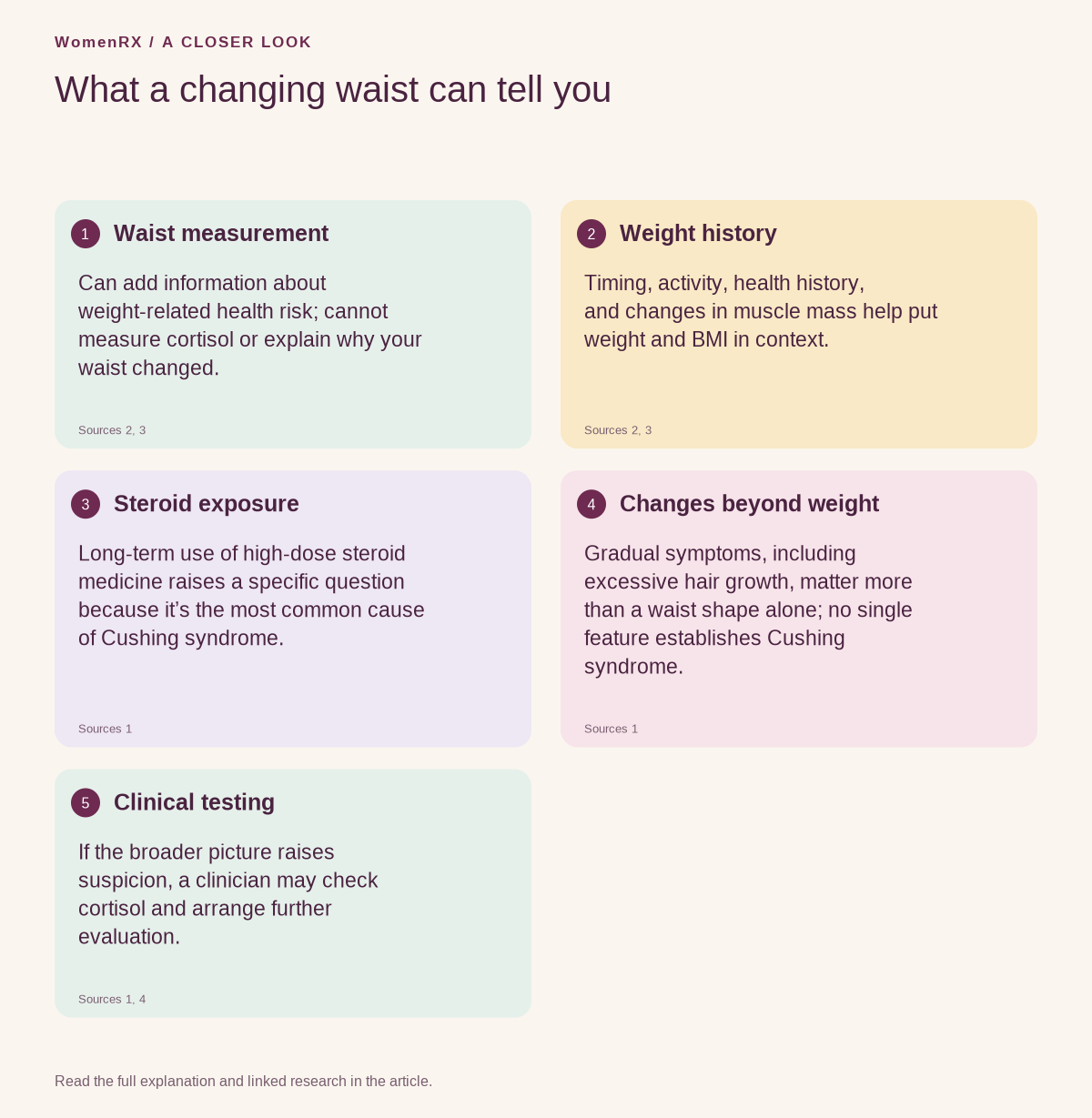
What a changing waist can tell you
Waist measurement: Can add information about weight-related health risk; cannot measure cortisol or explain why your waist changed.23
Weight history: Timing, activity, health history, and changes in muscle mass help put weight and BMI in context.23
Steroid exposure: Long-term use of high-dose steroid medicine raises a specific question because it’s the most common cause of Cushing syndrome.1
Changes beyond weight: Gradual symptoms, including excessive hair growth, matter more than a waist shape alone; no single feature establishes Cushing syndrome.1
Clinical testing: If the broader picture raises suspicion, a clinician may check cortisol and arrange further evaluation.14
Read the figure as text
A waist measurement can inform health-risk assessment. Whether Cushing syndrome needs consideration depends on more than appearance.- Waist measurement: Can add information about weight-related health risk; cannot measure cortisol or explain why your waist changed.23
- Weight history: Timing, activity, health history, and changes in muscle mass help put weight and BMI in context.23
- Steroid exposure: Long-term use of high-dose steroid medicine raises a specific question because it’s the most common cause of Cushing syndrome.1
- Changes beyond weight: Gradual symptoms, including excessive hair growth, matter more than a waist shape alone; no single feature establishes Cushing syndrome.1
- Clinical testing: If the broader picture raises suspicion, a clinician may check cortisol and arrange further evaluation.14
More questions, answered
What changes beyond a larger waist are worth mentioning?
Mention new symptoms that developed alongside the weight change, including excessive hair growth, and whether you use steroid medicine. Red abdominal stretch marks and high blood pressure appeared together with central weight gain in one published Cushing syndrome case, but that case doesn’t make those features a diagnostic checklist. 15
Can steroid medicines be related to Cushing syndrome?
Yes. Long-term use of high doses of steroid medicines is the most common cause described in NHS guidance. If you take a steroid and are concerned about changes, tell the prescriber rather than changing it on your own; reducing steroid treatment when it’s the cause may need to be gradual. 1
Can I tell whether cortisol is high from my waist measurement?
No. Waist size can help assess weight-related health risks, but it does not measure cortisol or identify the cause of abdominal fat. A clinician considers the broader picture before deciding whether cortisol testing is warranted. 12
Sources you can check
- Cushing's syndrome - NHSAccessed 2026-09-25Return to first citation
- Obesity: MedlinePlusAccessed 2026-09-25Return to first citation
- Body Weight: MedlinePlusAccessed 2026-09-25Return to first citation
- Differential diagnosis between endogenous Cushing´s syndrome and pseudo-Cushing.Abdul-Aziz AA. · Vitamins and hormones · 2026Return to first citation
- Difficult Diagnosis and Management of Concealed Cushing.Salcuni AS, Marchese F, Cellini M, Brunetti A, Kara E, Manso J, Tonelli V, Cipri C, Carpentieri M, Sciannimanico SM, Galasso S, Agus S, Vescini F. · Endocrine, metabolic & immune disorders drug targets · 2024Return to first citation
- The Face of Excess Cortisol: Clinical and Morphologic Insights Into Cushing Syndrome.Qiang J, Liu R, Lu L, Long X, Pan H, Huang J, Chen S. · Endocrine practice : official journal of the American College of Endocrinology and the American Association of Clinical Endocrinologists · 2026Return to first citation
- Cushing Syndrome, Hypercortisolism, and Glucose Homeostasis: A Review.DeFronzo RA, Auchus RJ. · Diabetes · 2025Return to first citation