“Cortisol Belly”: What Body Changes Can and Cannot Tell You
A change around your middle may be worth discussing, but your body shape can’t tell you whether cortisol is high.
“Cortisol belly” isn’t a medical diagnosis. A larger waist can be relevant to health, but it can’t identify excess cortisol. Other changes, such as easy bruising, fragile skin, purple stretch marks, or muscle weakness, give a clinician more useful information. So do difficult-to-control blood pressure or blood sugar and a history of an adrenal growth. 1 2
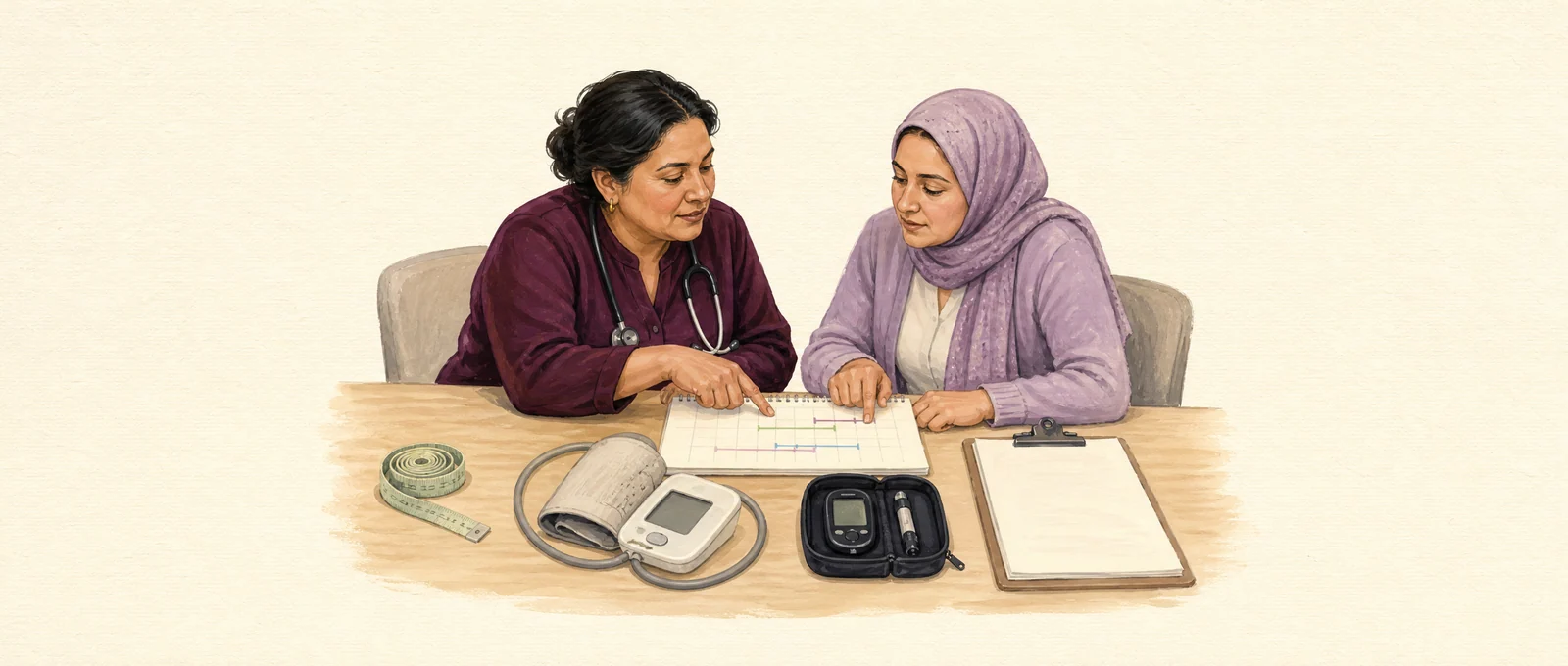
A waist change isn’t a cortisol test
If your middle has changed, it’s understandable to wonder why. But “cortisol belly” puts a specific cause on something appearance alone can’t explain. Waist size can help describe risk for weight-related health problems; it doesn’t show which hormone, if any, contributed to the change. 1
Long-term cortisol excess can increase fat stored around the abdomen and affect blood sugar and blood pressure. The reverse conclusion doesn’t follow: abdominal fat doesn’t mean you have cortisol excess. An endocrine review describes how obesity can be associated with increased cortisol production and increased cortisol clearance, without blood free cortisol necessarily rising as body weight increases. Body composition and cortisol can be related without your shape serving as a hormone test. 2 4
Changes that make the question more specific
Clinicians consider the whole pattern rather than one body feature. Signs described in overt Cushing syndrome include easy bruising, fragile skin, purple stretch marks, weakness in muscles close to the trunk, and marked facial redness. If you’ve noticed changes like these along with a change around your middle, describe them rather than relying on the label “cortisol belly.” None of these signs, on its own, establishes the cause. 2
Your medical history matters too. A review focused on people with difficult-to-control type 2 diabetes describes targeted consideration of cortisol evaluation when blood sugar stays high despite intensive treatment, blood pressure is resistant to treatment, imaging has found an adrenal growth, or physical findings suggest cortisol excess. These are reasons to assess an individual situation, not reasons to screen everyone with a larger waist. 2
Milder forms of cortisol excess may occur without the classic appearance of Cushing syndrome. They’re discussed particularly in connection with adrenal growths and cardiometabolic conditions. That’s another reason not to use appearance either to diagnose cortisol excess or to rule it out. 2 3
Bring the timeline, not just the label
When you describe a body change, start with what changed and when. Mention any other physical changes, relevant blood pressure or blood sugar concerns, and whether imaging has ever shown an adrenal growth. A health and weight history is part of a broader assessment of weight-related concerns. 1 2
If the change happened during pregnancy, after birth, or around a midlife transition, include that timing as context. It doesn’t establish a cortisol cause. It simply gives a clearer account of what you’ve noticed than a body-shape label does.
Why testing depends on context
Cortisol evaluation uses biochemical tests, not a visual assessment. Test results also need careful interpretation: medications, sleep disruption, obesity, alcohol use, and psychiatric conditions are among the factors that can complicate it. A single result taken out of context isn’t the same as a diagnosis. 2 3
A waist change may still deserve attention even when cortisol excess isn’t suspected. More fat carried around the waist, rather than the hips, is associated with greater risk of weight-related health problems. That’s a useful distinction: your waist may say something about health risk, while other symptoms and your medical history help determine whether a cortisol evaluation is warranted. 1 2
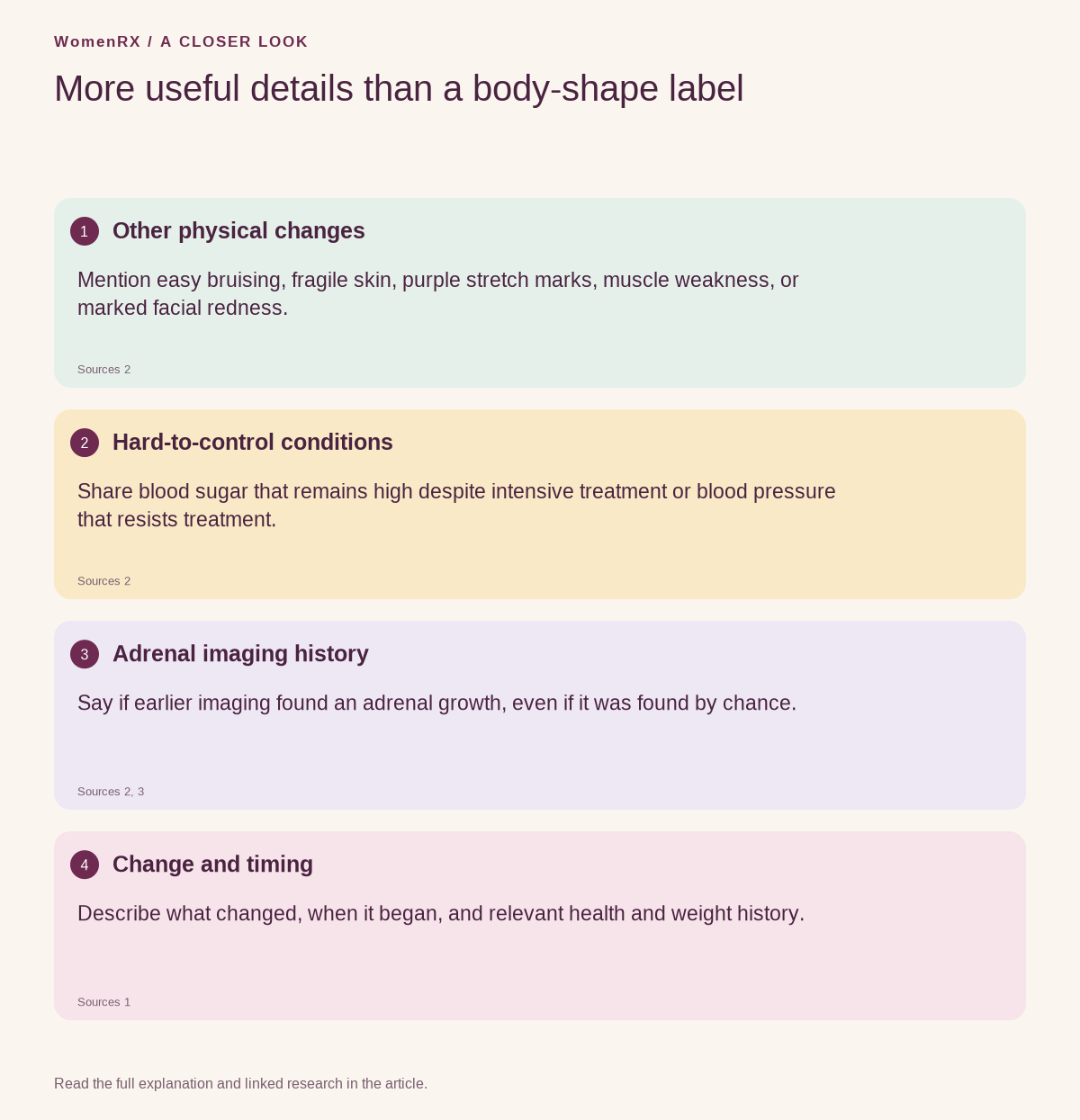
More useful details than a body-shape label
Other physical changes: Mention easy bruising, fragile skin, purple stretch marks, muscle weakness, or marked facial redness.2
Hard-to-control conditions: Share blood sugar that remains high despite intensive treatment or blood pressure that resists treatment.2
Adrenal imaging history: Say if earlier imaging found an adrenal growth, even if it was found by chance.23
Change and timing: Describe what changed, when it began, and relevant health and weight history.1
Read the figure as text
These are details to describe if an abdominal change has raised questions about cortisol. This is not a diagnostic checklist.- Other physical changes: Mention easy bruising, fragile skin, purple stretch marks, muscle weakness, or marked facial redness.2
- Hard-to-control conditions: Share blood sugar that remains high despite intensive treatment or blood pressure that resists treatment.2
- Adrenal imaging history: Say if earlier imaging found an adrenal growth, even if it was found by chance.23
- Change and timing: Describe what changed, when it began, and relevant health and weight history.1
Sources you can check
- Obesity: MedlinePlusAccessed 2026-09-25Return to first citation
- How Common Is Hypercortisolism in Patients With Type 2 Diabetes? Risk Factors, Epidemiology, and Making a Diagnosis Using a Dexamethasone Suppression Test.Stone JY, Bailey TS. · Diabetes, obesity & metabolism · 2026Return to first citation
- Mild autonomous cortisol secretion: Diagnosis.Pinto L, Donato S. · Vitamins and hormones · 2026Return to first citation
- [Endocrine function in obesity].Álvarez-Castro P, Sangiao-Alvarellos S, Brandón-Sandá I, Cordido F. · Endocrinologia y nutricion : organo de la Sociedad Espanola de Endocrinologia y Nutricion · 2011Return to first citation