Cortisol Supplements and Belly Fat: What the Evidence Shows
A supplement trial reported changes in cortisol and waist circumference, but that doesn’t establish that lowering cortisol reduces abdominal fat.
There’s a plausible-sounding idea that supplements lower cortisol and, in turn, reduce belly fat. But those are separate claims. One 8-week trial in 80 overweight subjects with suboptimal fasting plasma glucose reported an improvement in waist circumference from baseline and an improvement in serum cortisol compared with placebo. The reported results don’t establish that cortisol changes caused fat loss or that the supplement targets abdominal fat. 3
The claim has three separate links
The promise that a supplement will “lower cortisol and burn belly fat” bundles together three questions: Does it change cortisol? Does it change abdominal fat? And did a change in cortisol cause a change in fat?
A study that reports only one or two of those outcomes can’t answer all three. Waist circumference is a measure of abdominal size and can help assess health risk. It is different from imaging methods such as CT or MRI, which are used to examine intra-abdominal fat. A change in waist circumference alone also can’t show what caused the change. 123
That distinction matters because cortisol levels and responses don’t tell a simple story about body size. In one study comparing 60 people with obesity and 54 lean controls, the group with obesity had lower baseline serum and salivary cortisol and a lower cortisol response to an ACTH test. The study doesn’t show that cortisol can never contribute to health problems; it does show why belly fat by itself isn’t evidence of high cortisol. 4
What a curcumin trial did, and didn’t, show
A randomized, double-blind, placebo-controlled trial studied 80 overweight subjects with suboptimal fasting plasma glucose for eight weeks. Participants received either placebo or a particular phytosomal curcumin preparation that also contained phosphatidylserine, phosphatidylcholine, and piperine. The active group had a reported improvement in waist circumference compared with its own baseline. The authors also reported an improvement in serum cortisol compared with placebo. 3
Those findings are worth describing accurately, but they don’t establish the advertised chain of effects. The reported results don’t show that a cortisol change caused the waist change, or that the waist change represented a reduction in visceral fat. The reported findings also don’t provide a women-only result. And because the product combined several ingredients, the trial can’t tell you which ingredient, if any, accounted for the reported effects. 3
So this trial is a preliminary signal about a specific combination in a specific group, not evidence that supplements as a category target belly fat. It also doesn’t establish the same effect in people with normal fasting glucose, in women specifically, or over the longer term. 3
Menopause can affect fat distribution, but it isn’t a cortisol test
Body-fat distribution may shift around menopause. A review of studies in premenopausal and postmenopausal women found evidence suggesting more central, particularly intra-abdominal, fat after menopause. But findings differed depending on how fat was measured, and the review noted that the effects of age and overall fatness weren’t fully clear. 2
That can help make sense of a changing waist without assigning the change to one hormone. Menopause-related body-composition changes don’t show that an individual woman has high cortisol, and the available curcumin trial results don’t establish a menopause-specific benefit. 23
A more useful way to judge the promise
When you see a cortisol-and-belly-fat claim, ask what the study actually measured. A cortisol result is a hormone result. A waist measurement is a circumference result. Neither, on its own, proves that a supplement reduced visceral fat through cortisol.
For a supplement to support the full promise, research would need to show a reliable effect on cortisol, a direct measure of abdominal fat, and evidence that the cortisol change explains the fat change. The trial described here doesn’t establish that full sequence. Its result may be interesting, but it’s not a reason to treat a larger waist as proof of a cortisol problem or to expect a supplement to selectively reduce belly fat.
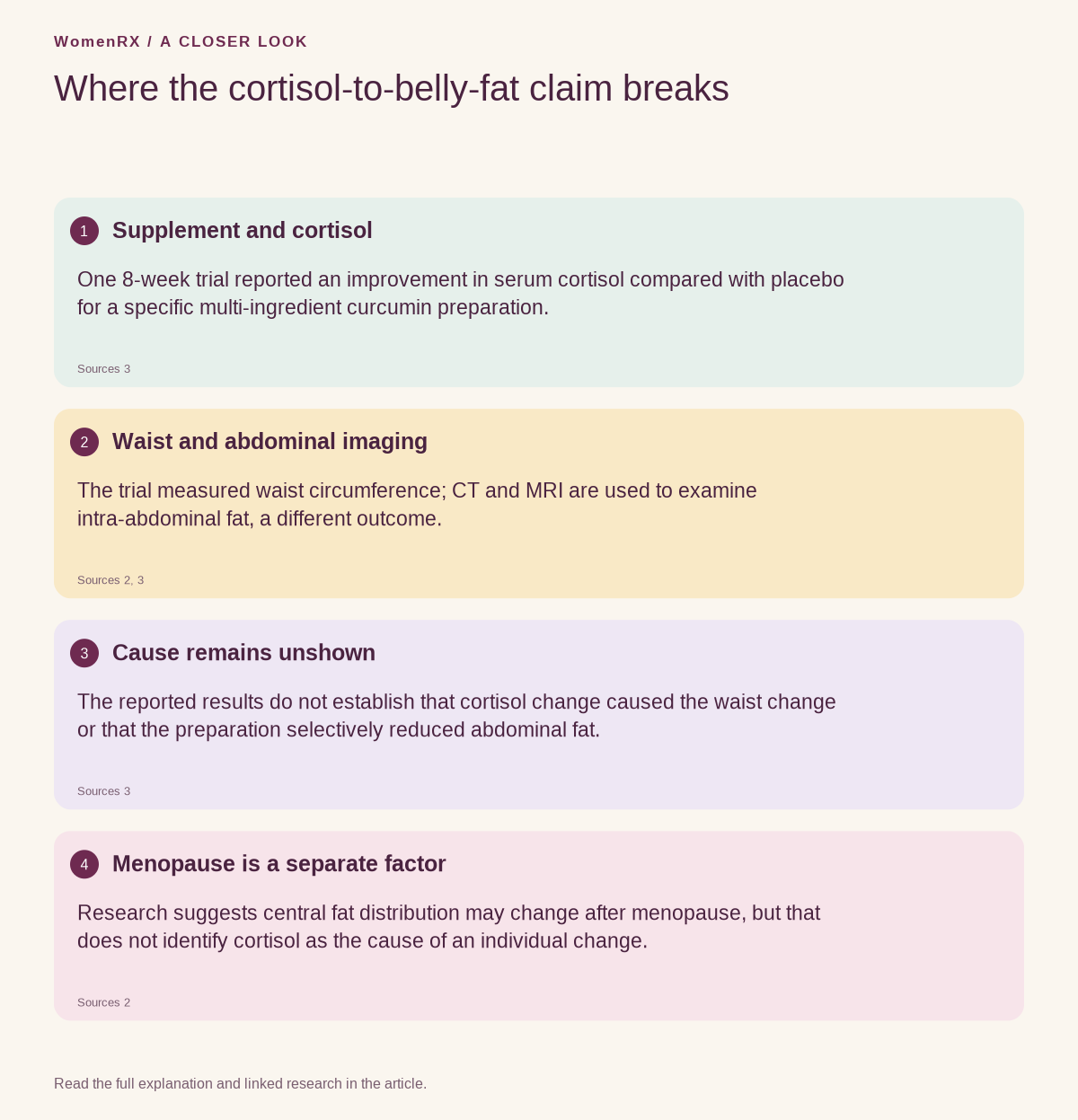
Where the cortisol-to-belly-fat claim breaks
Supplement and cortisol: One 8-week trial reported an improvement in serum cortisol compared with placebo for a specific multi-ingredient curcumin preparation.3
Waist and abdominal imaging: The trial measured waist circumference; CT and MRI are used to examine intra-abdominal fat, a different outcome.23
Cause remains unshown: The reported results do not establish that cortisol change caused the waist change or that the preparation selectively reduced abdominal fat.3
Menopause is a separate factor: Research suggests central fat distribution may change after menopause, but that does not identify cortisol as the cause of an individual change.2
Read the figure as text
The proposed chain combines a hormone change, a body-fat change, and a cause-and-effect link. These are distinct findings, and waist circumference is not the same outcome as imaging-based examination of intra-abdominal fat.- Supplement and cortisol: One 8-week trial reported an improvement in serum cortisol compared with placebo for a specific multi-ingredient curcumin preparation.3
- Waist and abdominal imaging: The trial measured waist circumference; CT and MRI are used to examine intra-abdominal fat, a different outcome.23
- Cause remains unshown: The reported results do not establish that cortisol change caused the waist change or that the preparation selectively reduced abdominal fat.3
- Menopause is a separate factor: Research suggests central fat distribution may change after menopause, but that does not identify cortisol as the cause of an individual change.2
More questions, answered
Does having belly fat mean your cortisol is high?
No. Waist size can help assess health risk, but it doesn’t measure cortisol. In one study, people with obesity had lower baseline cortisol and lower responses to an ACTH test than lean controls, illustrating that the relationship isn’t as simple as “more belly fat means more cortisol.” 14
Did the curcumin study prove it reduced visceral fat?
The reported results describe an improvement in waist circumference from baseline, not an imaging-based measure of intra-abdominal fat or proof that cortisol caused the change. 23
Sources you can check
- Obesity: MedlinePlusAccessed 2026-09-25Return to first citation
- Menopause-related changes in body fat distribution.Toth MJ, Tchernof A, Sites CK, Poehlman ET. · Annals of the New York Academy of Sciences · 2000Return to first citation
- Effects of phytosomal curcumin on anthropometric parameters, insulin resistance, cortisolemia and non-alcoholic fatty liver disease indices: a double-blind, placebo-controlled clinical trial.Cicero AFG, Sahebkar A, Fogacci F, Bove M, Giovannini M, Borghi C. · European journal of nutrition · 2020Return to first citation
- Cortisol Secretion in Obesity Revisited: Lower Basal Serum and Salivary Cortisol with Diminished Cortisol Response to the Low Dose ACTH Challenge.Sofer Y, Osher E, Ahmad WA, Greenman Y, Moshe Y, Shaklai S, Yaron M, Serebro M, Tordjman K, Stern N. · Obesity facts · 2025Return to first citation