Cortisol and Belly Fat: What Before-and-After Claims Prove
A photo can show a change in appearance, but it can’t reveal cortisol levels or prove what caused the change.
A before-and-after image can show a visible difference, not whether cortisol changed or caused it. Human studies find different results depending on how cortisol and body fat are measured. Cushing syndrome is a distinct, rare condition involving excess cortisol; abdominal fat or everyday stress alone doesn’t establish it. 1 2
What a photo can, and can’t, show
A pair of images may show that someone’s midsection looks different. But appearance alone can’t identify cortisol levels, distinguish visceral fat from fat under the skin, or show what caused the difference. A caption that credits cortisol is a claim about cause, and the images don’t supply that evidence.
To assess a body-change claim about cortisol, look for actual cortisol measurements, a clearly defined measure of body fat, and a study design that can distinguish association from cause. Even then, ask whether the results apply to the person or group in the claim.
Cushing syndrome isn’t another name for everyday stress
Cushing syndrome is a rare condition involving too much cortisol. Long-term use of high doses of steroid medicines is its most common cause; growths in the pituitary or adrenal glands can also cause it. Possible features include increased fat around the tummy, chest, upper back, and neck, sometimes alongside thinner-looking arms and legs, a round red face, or excessive hair growth. A photo or one body feature can’t diagnose the condition. 1
If you notice several of these changes, particularly while taking steroid medicine, it’s worth raising them with a clinician. When Cushing syndrome is suspected, assessment can include cortisol testing using blood, urine, or saliva, with further testing if indicated. That’s different from inferring a hormone disorder from stress, a waist measurement, or a transformation post. 1
The research depends on what gets measured
A 2021 meta-analysis compared studies using the cortisol awakening response, a measure of cortisol activity around waking, with studies using hair cortisol, a marker of longer-term activity. Measures of adiposity were not associated with the awakening response, but were positively associated with hair cortisol. The review also found inconsistencies in how studies sampled cortisol and calculated the awakening response, making comparisons difficult. These associations don’t show that cortisol caused the fat differences. 2
One study shows why the details matter. Researchers measured cortisol and used MRI to assess abdominal fat in 165 African-American and Latino adolescents with overweight, ages 13 to 18; 66% were female. Cortisol was associated with MRI-measured visceral fat among participants reporting higher sugar intake, but not among those reporting lower intake. The study found no association with waist circumference or total body fat. Because it measured participants at one point in time, it can’t establish what came first or prove cause and effect. And although most participants were female, the reported finding wasn’t a female-only result. 3
These findings don’t support a simple rule that everyday stress produces a particular belly-fat pattern. Results vary with the cortisol measure, the fat measure, and the group studied. They also don’t establish a distinct effect for adult women or for a particular reproductive stage.
Four questions that test the claim
- Was cortisol actually measured? A photo or a statement about feeling stressed isn’t a cortisol measurement. Ask what was measured and how; different methods haven’t produced identical findings. 2
- What does “abdominal fat” mean here? A waist measurement and an imaging-based measure of visceral fat aren’t interchangeable. In the adolescent study, the cortisol association appeared with visceral fat in one subgroup, but not with waist circumference. 3
- Does the study show cause, or only a link? Finding that two measures occur together doesn’t establish that one caused the other. The adolescent study could not determine whether cortisol preceded the fat difference. 3
- Does the population match the claim? Findings in adolescents or men don’t automatically apply to adult women. Check whether a study reports results separately by sex, age, or reproductive stage before treating a hormone explanation as specific to you.
A personal transformation may be real and meaningful. But without measurements and evidence for the proposed cause, “cortisol belly” remains an interpretation of appearance, not a conclusion the image can prove.
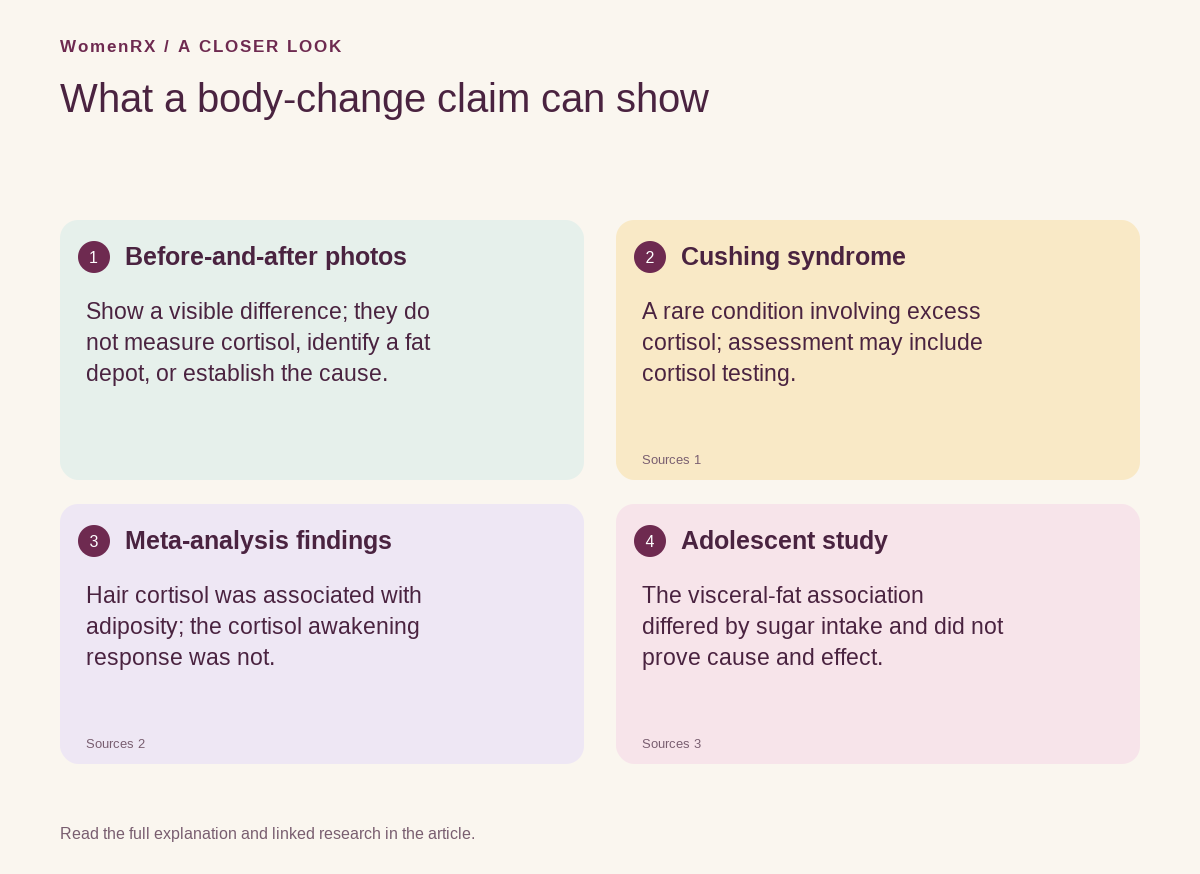
What a body-change claim can show
Before-and-after photos: Show a visible difference; they do not measure cortisol, identify a fat depot, or establish the cause.
Cushing syndrome: A rare condition involving excess cortisol; assessment may include cortisol testing.1
Meta-analysis findings: Hair cortisol was associated with adiposity; the cortisol awakening response was not.2
Adolescent study: The visceral-fat association differed by sugar intake and did not prove cause and effect.3
Read the figure as text
Compare a visible change with clinical assessment and research findings to see what each can establish about cortisol and abdominal fat.- Before-and-after photos: Show a visible difference; they do not measure cortisol, identify a fat depot, or establish the cause.
- Cushing syndrome: A rare condition involving excess cortisol; assessment may include cortisol testing.1
- Meta-analysis findings: Hair cortisol was associated with adiposity; the cortisol awakening response was not.2
- Adolescent study: The visceral-fat association differed by sugar intake and did not prove cause and effect.3
More questions, answered
Can a waist measurement show that cortisol caused abdominal fat?
No. Waist circumference doesn’t measure cortisol or establish why someone’s waist changed. In one study of adolescents, cortisol was associated with MRI-measured visceral fat in a subgroup, but not with waist circumference. 3
Does abdominal fat by itself mean someone has Cushing syndrome?
No. Cushing syndrome is rare and involves excess cortisol; abdominal fat alone doesn’t establish it. Several characteristic changes, particularly while taking steroid medicine, are a reason to discuss the possibility with a clinician. 1
Sources you can check
- Cushing's syndrome - NHSAccessed 2026-09-25Return to first citation
- Deciphering the Association Between Hypothalamus-Pituitary-Adrenal Axis Activity and Obesity: A Meta-Analysis.Ostinelli G, Scovronec A, Iceta S, Ouellette AS, Lemieux S, Biertho L, Bégin C, Michaud A, Tchernof A. · Obesity (Silver Spring, Md.) · 2021Return to first citation
- Modifying influence of dietary sugar in the relationship between cortisol and visceral adipose tissue in minority youth.Gyllenhammer LE, Weigensberg MJ, Spruijt-Metz D, Allayee H, Goran MI, Davis JN. · Obesity (Silver Spring, Md.) · 2014Return to first citation