Is “Cortisol Belly” a Medical Condition?
A fuller middle can’t reveal your cortisol level; doctors look for a broader pattern before testing for Cushing syndrome.
“Cortisol belly” isn’t a diagnosis, and abdominal shape alone can’t show whether cortisol is high. Cushing syndrome is a rare condition involving too much cortisol. A clinician may consider it when weight changes occur with other signs or a history of long-term, high-dose steroid medicine, then use cortisol tests if appropriate. 1 5

Your waist isn’t a hormone test
“Cortisol belly” is a popular phrase, not a way to diagnose high cortisol. Abdominal fat can be relevant to health risk, but where fat sits or how your abdomen looks doesn’t identify its cause or measure a hormone. Body weight can also be affected by factors such as genetics, medicines, and health conditions. 2 3
Cushing syndrome is a rare condition caused by too much cortisol. Long-term use of high-dose steroid medicines is its most common cause; less commonly, a growth involving the pituitary or adrenal glands can lead to excess cortisol. 1
So abdominal weight gain can be part of Cushing syndrome, but it isn’t enough on its own to point to that explanation. 4 5
When the whole pattern matters
A clinician may take a closer look when abdominal weight gain comes with other changes, particularly if those changes are developing over time. Cushing disease, a pituitary-related form of Cushing syndrome, can involve easy bruising, abdominal stretch marks, a rounded face, weakness, high blood pressure, diabetes, or menstrual irregularities. 5 Excess hair growth can occur with Cushing syndrome. 1 These features aren’t a checklist that proves the condition; the overall pattern and your health history matter.
The medication history is especially relevant. Tell your clinician if you use steroid medicine, including the name and how long you’ve taken it. Long-term use of high-dose steroids is the most common cause of Cushing syndrome. If steroid medicine is causing the condition, treatment may involve gradually reducing it, so discuss your concerns with the clinician who prescribes it. 1
If Cushing syndrome seems possible, a clinician can arrange cortisol testing using blood, urine, or saliva. Further tests may follow if results suggest excess cortisol. A waist measurement can help describe body composition and health risk, but it can’t take the place of this evaluation. 1 2
Keep waist changes and cortisol as separate questions
If Cushing syndrome isn’t suspected, waist or weight changes can still be discussed as their own health question. A clinician can consider your overall health, history, and goals rather than treating your waist as a hormone test. BMI has limits because it doesn’t distinguish fat from muscle or bone, and waist size is a risk clue, not a diagnosis. 2 3
For example, if you first noticed a waist change after pregnancy or around menopause, that timing is useful to mention, but it doesn’t establish what caused the change or whether cortisol is high. Body composition is a separate consideration: BMI can underestimate body fat in older people or others who have lost muscle, regardless of when a waist change began. 2 3 Cushing syndrome is more common in women than men, yet it still calls for assessment based on the broader pattern and testing when appropriate. 1
A sudden, unexpected weight change is worth discussing, whether or not you have other symptoms. If you’re concerned about a more gradual change, mention how it has developed, any other new symptoms, and any steroid medicines you use. Those details help keep the conversation focused on the right question: whether cortisol needs investigation, or whether the change should be considered more broadly. 1 3
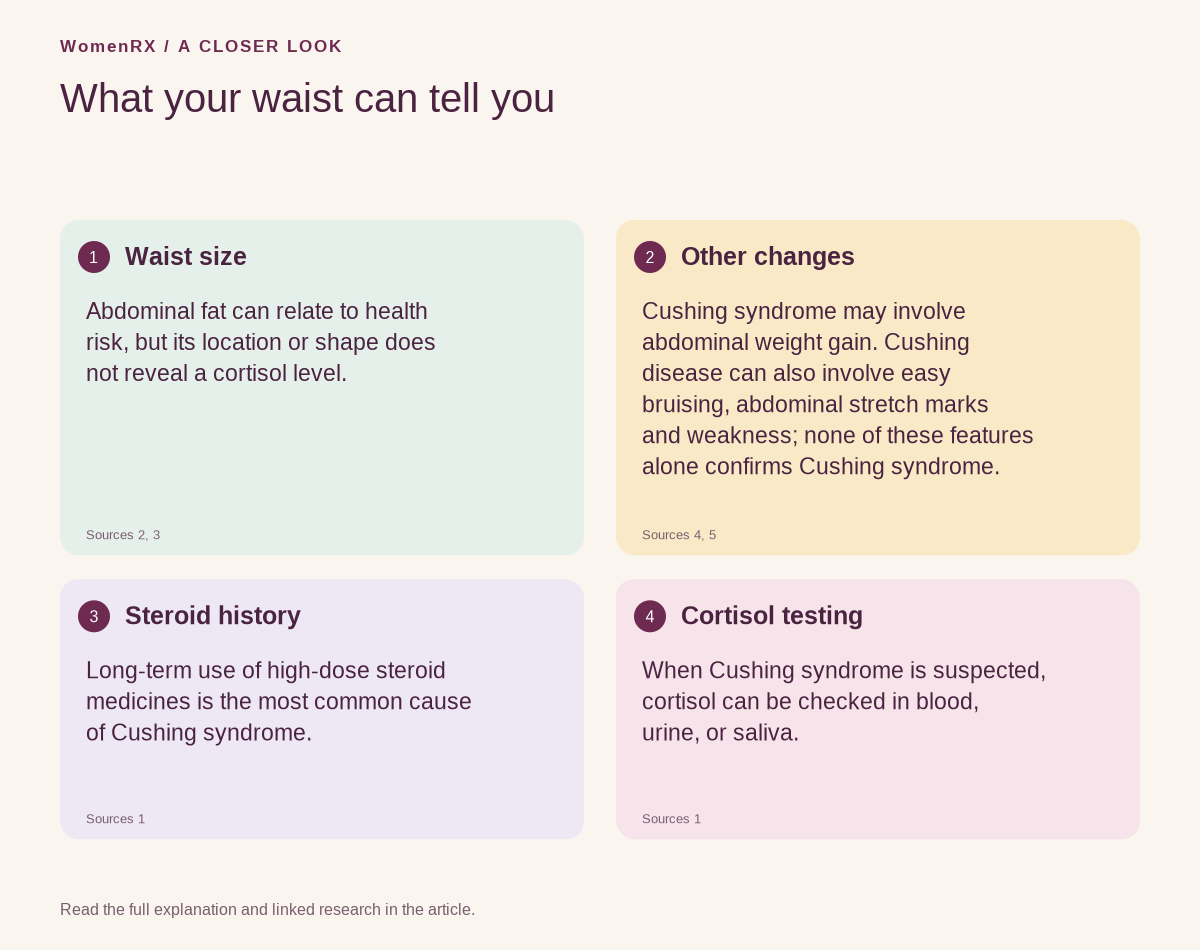
What your waist can tell you
Waist size: Abdominal fat can relate to health risk, but its location or shape does not reveal a cortisol level.23
Other changes: Cushing syndrome may involve abdominal weight gain. Cushing disease can also involve easy bruising, abdominal stretch marks and weakness; none of these features alone confirms Cushing syndrome.45
Steroid history: Long-term use of high-dose steroid medicines is the most common cause of Cushing syndrome.1
Cortisol testing: When Cushing syndrome is suspected, cortisol can be checked in blood, urine, or saliva.1
Read the figure as text
Separate what waist size can suggest from what is needed to assess possible cortisol excess.- Waist size: Abdominal fat can relate to health risk, but its location or shape does not reveal a cortisol level.23
- Other changes: Cushing syndrome may involve abdominal weight gain. Cushing disease can also involve easy bruising, abdominal stretch marks and weakness; none of these features alone confirms Cushing syndrome.45
- Steroid history: Long-term use of high-dose steroid medicines is the most common cause of Cushing syndrome.1
- Cortisol testing: When Cushing syndrome is suspected, cortisol can be checked in blood, urine, or saliva.1
More questions, answered
Does stress-related belly fat show that cortisol is high?
No. Belly fat doesn’t measure cortisol. When Cushing syndrome is suspected, clinicians assess the broader pattern and can arrange cortisol tests; body shape alone can’t establish the cause. 1 2
Sources you can check
- Cushing's syndrome - NHSAccessed 2026-09-25Return to first citation
- Obesity: MedlinePlusAccessed 2026-09-25Return to first citation
- Body Weight: MedlinePlusAccessed 2026-09-25Return to first citation
- Zinc alpha-2 glycoprotein is overproduced in Cushing's syndrome.Escoté X, Aranda GB, Mora M, Casals G, Enseñat J, Vidal O, Esteban Y, Halperin I, Hanzu FA. · Endocrinologia, diabetes y nutricion · 2017Return to first citation
- Cushing DiseaseKairys N, Anastasopoulou C, Schwell A. · 2026Return to first citation