Can Stress and Cortisol Explain Abdominal Fat?
Stress affects your body, but a changing waistline can’t tell you whether cortisol is the cause.
Cortisol is part of the body’s response to stress, and some studies have found associations between stress-related measures and abdominal fat in specific groups. Those findings don’t establish that stress caused the fat or that abdominal shape signals a cortisol problem. Weight and waist changes can have several influences, so appearance alone can’t explain what changed. 2 3 5 6
A stress response isn’t a body-shape diagnosis
When something demands your attention, your body releases hormones that help you respond. That response can raise your heart rate, blood pressure, and blood sugar. Stress that continues over time can affect health, so it’s worth taking seriously. But the existence of a stress response doesn’t mean every change around your middle is caused by cortisol. 2
The phrase “cortisol belly” skips a crucial step: appearance doesn’t measure a hormone or reveal why fat is distributed a certain way. Abdominal fat can be relevant to health. Having more fat around the abdomen than the hips may be associated with higher risk of heart disease and type 2 diabetes, but that finding doesn’t identify cortisol as the cause. 3
What the research actually connects
One small study measured stressful life events, the cortisol response after waking, and abdominal fat in 23 Hispanic girls ages 8 to 11. More school-related stressful events were associated with more abdominal fat among girls with a higher cortisol awakening response, but not among those with a lower response. It was a cross-sectional study, so it cannot show that stress caused the difference in fat or tell us what happens in adult women. 6
A study of 269 adolescents in India found a different association: a higher waist-to-hip ratio was linked to a smaller cortisol response at two points after a laboratory stressor. BMI wasn’t associated with the cortisol response. These findings aren’t necessarily in conflict because the studies measured different stress responses in different groups. Together, they show why a simple rule such as “more abdominal fat means more cortisol” doesn’t hold up. 5 6
There’s also a direction of the relationship that’s easy to miss. In a preliminary study of 45 women with overweight or obesity, experiences of weight stigma were associated with cortisol measures even after accounting for abdominal fat. An experiment involving 110 female undergraduates found that exposure to weight stigma was followed by a sustained cortisol elevation among participants who perceived themselves as heavy. Neither study showed that cortisol subsequently increased abdominal fat. They do show why blaming someone’s body shape on stress can overlook stress caused by the way people are treated. 4 7
Midlife changes deserve a wider lens
A cross-sectional study of 114 women ages 40 to 64 measured perceived stress, cortisol patterns, and body composition. Its reported findings do not establish that cortisol caused abdominal fat gain. 8
A waist measurement describes where you carry weight; a scale measures muscle, bone, fat, and water together. Neither identifies the reason for a change. Diet and family history can play a role, too. For example, if your clothes fit differently but your weight is steady, that observation alone cannot tell you what changed in your body composition, much less whether cortisol changed. 3
If weight gain or loss is sudden and you weren’t trying to change your weight, bring it up with a health care provider. An unexpected change can have a medical cause. Otherwise, it’s reasonable to address ongoing stress for your well-being without treating your waistline as a cortisol test. 2 3
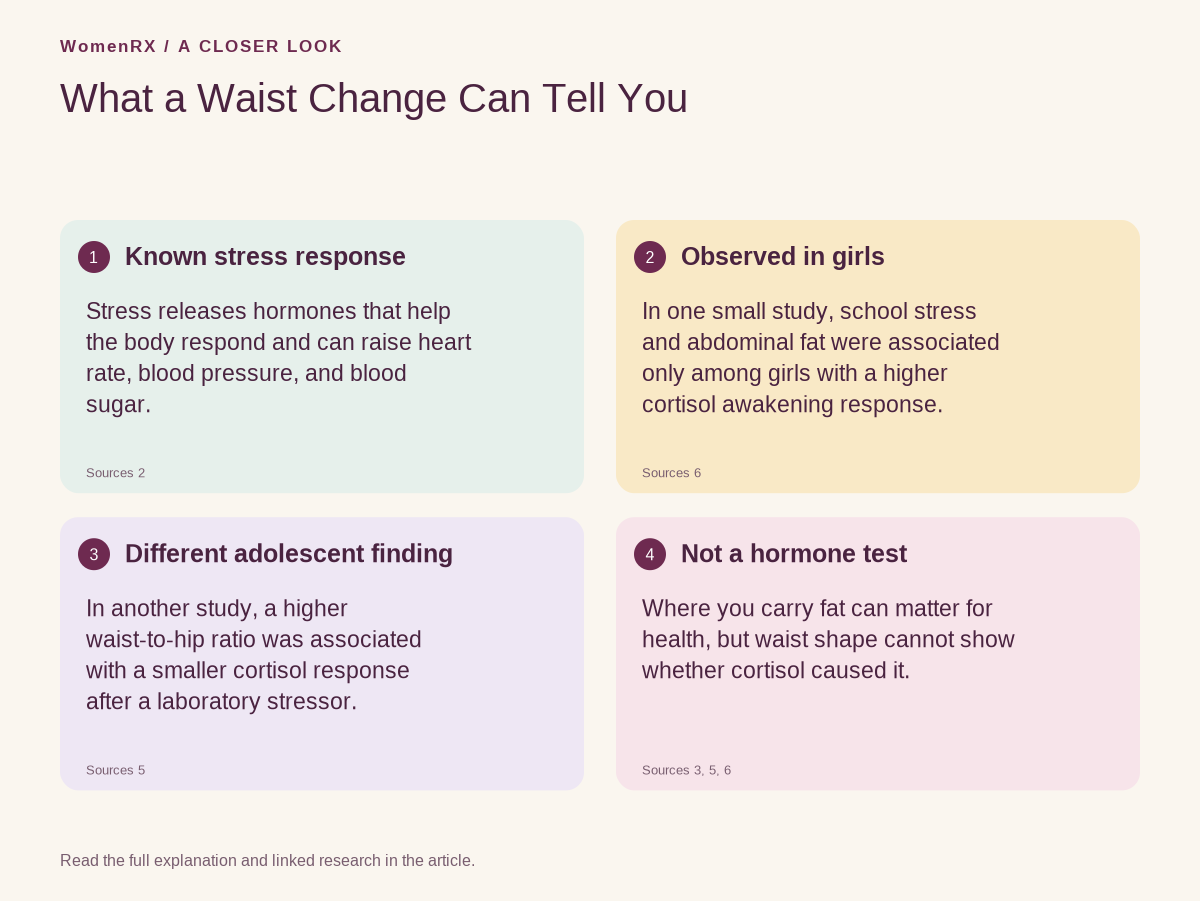
What a Waist Change Can Tell You
Known stress response: Stress releases hormones that help the body respond and can raise heart rate, blood pressure, and blood sugar.2
Observed in girls: In one small study, school stress and abdominal fat were associated only among girls with a higher cortisol awakening response.6
Different adolescent finding: In another study, a higher waist-to-hip ratio was associated with a smaller cortisol response after a laboratory stressor.5
Not a hormone test: Where you carry fat can matter for health, but waist shape cannot show whether cortisol caused it.356
Read the figure as text
An evidence map separating measured stress responses, observed associations, and conclusions that appearance cannot support.- Known stress response: Stress releases hormones that help the body respond and can raise heart rate, blood pressure, and blood sugar.2
- Observed in girls: In one small study, school stress and abdominal fat were associated only among girls with a higher cortisol awakening response.6
- Different adolescent finding: In another study, a higher waist-to-hip ratio was associated with a smaller cortisol response after a laboratory stressor.5
- Not a hormone test: Where you carry fat can matter for health, but waist shape cannot show whether cortisol caused it.356
More questions, answered
Does lowering cortisol mean I’ll lose abdominal fat?
Not necessarily. Some short-term trials of ashwagandha extracts reported lower cortisol and perceived stress than placebo, but those results do not establish abdominal fat loss. A change in a stress measure is not the same outcome as a change in body composition. 1
Sources you can check
- Ashwagandha: Is it helpful for stress, anxiety, or sleep? - Health Professional Fact SheetAccessed 2026-09-25Return to first citation
- Stress: MedlinePlusAccessed 2026-09-25Return to first citation
- Body Weight: MedlinePlusAccessed 2026-09-25Return to first citation
- Associations of weight stigma with cortisol and oxidative stress independent of adiposity.Tomiyama AJ, Epel ES, McClatchey TM, Poelke G, Kemeny ME, McCoy SK, Daubenmier J. · Health psychology : official journal of the Division of Health Psychology, American Psychological Association · 2014Return to first citation
- Adiposity and Cortisol Response to Stress in Indian Adolescents.Krishnaveni GV, Jones A, Veena SR, Somashekara R, Karat SC, D Fall CH. · Indian pediatrics · 2018Return to first citation
- Stress and abdominal fat: preliminary evidence of moderation by the cortisol awakening response in Hispanic peripubertal girls.Donoho CJ, Weigensberg MJ, Emken BA, Hsu JW, Spruijt-Metz D. · Obesity (Silver Spring, Md.) · 2011Return to first citation
- The weight of stigma: cortisol reactivity to manipulated weight stigma.Himmelstein MS, Incollingo Belsky AC, Tomiyama AJ. · Obesity (Silver Spring, Md.) · 2015Return to first citation
- Higher morning cortisol is associated with lower intuitive eating in midlife women.Owens BA, Sabik NJ, Tovar A, Ward-Ritacco CL, Melanson K, Guerrieo Z, Oaks BM. · Psychoneuroendocrinology · 2024Return to first citation