Stress and Abdominal Fat: What Human Studies Show
Some studies find a link, but they don’t establish that stress itself causes abdominal fat to change.
Human studies have reported associations between stress and measures of body fat, but they don’t show that stress reliably causes abdominal fat gain. The studies measure different things, from perceived stress to reactions during a task or past trauma, and use outcomes such as waist circumference or imaging. Those measures answer different questions, and findings in a narrow group of women may not apply to women at other life stages. 2 3 4 5

A link is not the same as a cause
Stress prompts bodily responses, including the release of hormones that help you respond to a demand. That response alone doesn’t show that stress will lead to fat accumulating around the abdomen. To make a causal case, researchers need more than a finding that stress and body fat occur together: they need to establish how the measures change over time and consider other factors that could influence both. 1 3
“Stress” can mean a person’s report of ongoing pressure, a short-term reaction to a stressful task, or a history of trauma. “Abdominal fat” can mean waist circumference or a more specific estimate of fat under the skin or around internal organs. Waist circumference measures the size of the waist; imaging can distinguish fat compartments. These measures aren’t interchangeable. 2 3 5 6
What the human findings show
In a study of 1,243 Mexican adults, researchers assessed chronic self-perceived stress with a single question. The study reported a difference in subcutaneous abdominal fat between stress groups. But after adjustments, the reported independent association was between chronic stress and obesity in men. It did not establish an independent abdominal-fat effect in women, or show that stress came before the difference. 3
A small task-based study measured stress reactivity in 63 children, including 27 girls, and assessed central adiposity using abdominal girth. It found associations involving stress reactivity and adiposity. That offers a possible clue about stress responses, but it cannot tell us whether long-term stress changes abdominal fat in adult women. The researchers suggested that eating and activity could be pathways to investigate, not that their study had proved those explanations. 2
A study with a clearer timeline followed 113 young adults receiving psychotropic treatment for early psychosis. Participants with trauma during adolescence had greater waist circumferences during follow-up than those without trauma in the comparison group. The researchers adjusted for several factors, including medication and baseline BMI, but this was a specific clinical setting involving treatment associated with weight gain. It doesn’t establish that everyday stress causes waist gain in the general population. 5
A cross-sectional study of university students found a concurrent association between perceived stress and an abdominal-fat index in one subgroup, female biomedical-science students. The pattern was not consistent across the other student groups or among men. A finding limited to one subgroup, measured at one time, can’t establish cause or be treated as a general rule for women. 4
Taken together, these results support a possible connection worth studying, not a dependable cause-and-effect claim. Observational studies can adjust for measured factors, but they can’t rule out every difference between people with higher and lower stress. Stress might affect eating or activity for some people; health, circumstances, or treatment might also affect stress reports and body measurements. These are plausible explanations to test, not established pathways from these findings. 2 3 5
What this means for women at different life stages
The studies don’t establish how a stress-and-abdominal-fat relationship differs across cycling years, perimenopause, and postmenopause. One study of postmenopausal Japanese American and white women used imaging to assess visceral and subcutaneous abdominal fat, but it examined eating behaviors rather than stress. It shows why the specific outcome matters; it doesn’t show that stress changes those fat compartments or how findings compare across life stages. 6
So if a headline says stress is “linked to belly fat,” check four things: how stress was measured, what the study counted as abdominal fat, who took part, and whether researchers followed participants over time. A same-time association can show that two things occur together. It can’t, on its own, tell you which came first or whether the result applies to women outside that study group.
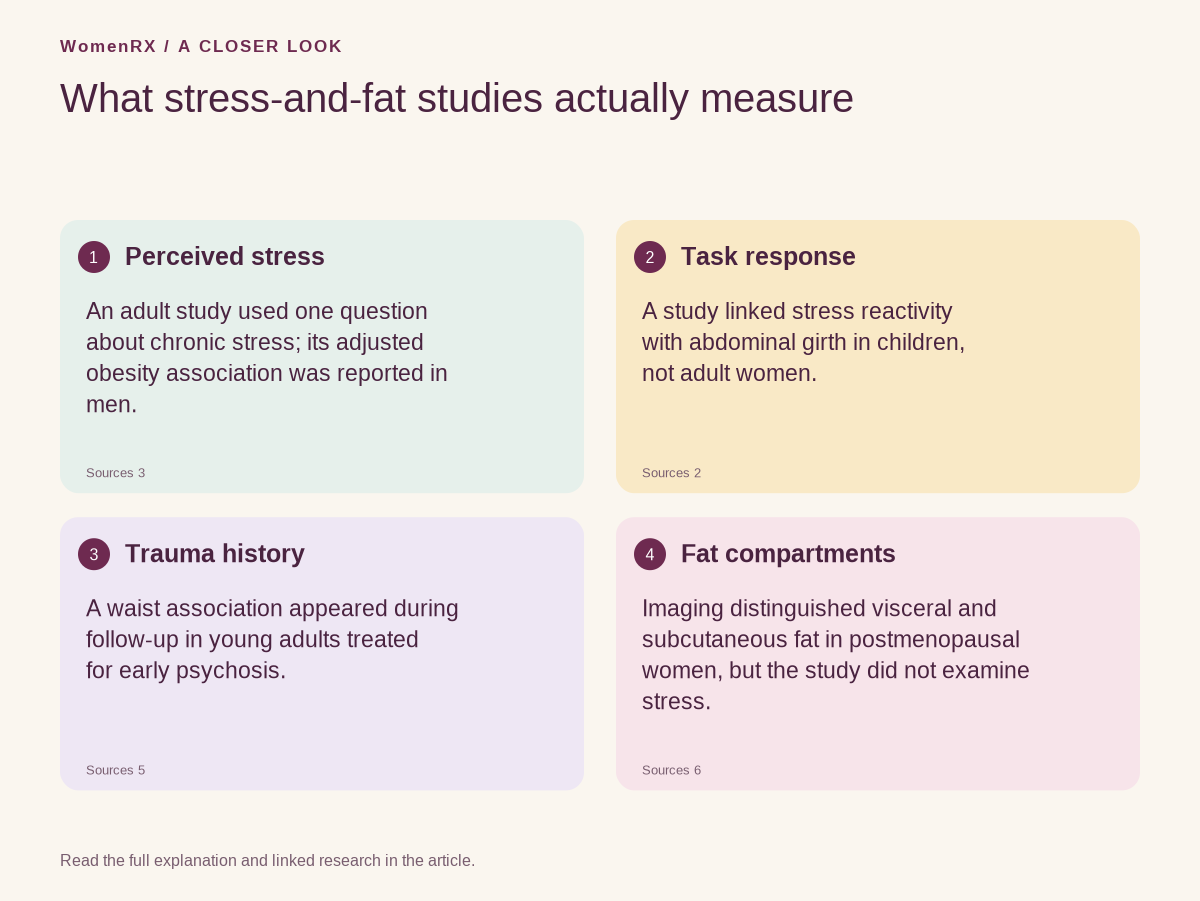
What stress-and-fat studies actually measure
Perceived stress: An adult study used one question about chronic stress; its adjusted obesity association was reported in men.3
Task response: A study linked stress reactivity with abdominal girth in children, not adult women.2
Trauma history: A waist association appeared during follow-up in young adults treated for early psychosis.5
Fat compartments: Imaging distinguished visceral and subcutaneous fat in postmenopausal women, but the study did not examine stress.6
Read the figure as text
The stress measure, fat outcome, and study group change what each finding can tell you.- Perceived stress: An adult study used one question about chronic stress; its adjusted obesity association was reported in men.3
- Task response: A study linked stress reactivity with abdominal girth in children, not adult women.2
- Trauma history: A waist association appeared during follow-up in young adults treated for early psychosis.5
- Fat compartments: Imaging distinguished visceral and subcutaneous fat in postmenopausal women, but the study did not examine stress.6
Sources you can check
- Stress: MedlinePlusAccessed 2026-09-25Return to first citation
- Stress reactivity and adiposity of youth.Roemmich JN, Smith JR, Epstein LH, Lambiase M. · Obesity (Silver Spring, Md.) · 2007Return to first citation
- Self-perceived stress is associated with adiposity and atherosclerosis. The GEA Study.Ortega-Montiel J, Posadas-Romero C, Ocampo-Arcos W, Medina-Urrutia A, Cardoso-Saldaña G, Jorge-Galarza E, Posadas-Sánchez R. · BMC public health · 2015Return to first citation
- Multivariable Associations of Anthropometric and Psychosocial Markers with an Elevated Abdominal Volume Index Among University Students: A Sex- and Academic Program-Stratified Analysis.Tomulescu IM, Marian MI, Brisc C. · Healthcare (Basel, Switzerland) · 2026Return to first citation
- Psychological trauma occurring during adolescence is associated with an increased risk of greater waist circumference in Early Psychosis patients treated with psychotropic medication.Alameda L, Levier A, Gholam-Rezaee M, Golay P, Vandenberghe F, Delacretaz A, Baumann P, Glatard A, Dubath C, Herane-Vives A, Rodriguez V, Solida A, Do KQ, Eap CB, Conus P. · PloS one · 2020Return to first citation
- Associations between weight-related eating behaviors and adiposity in postmenopausal Japanese American and white women.Schembre SM, Albright CL, Lim U, Wilkens LR, Murphy SP, Novotny R, Ernst T, Chang L, Kolonel LN, Le Marchand L. · Physiology & behavior · 2012Return to first citation