Can Food Choices Reduce Abdominal Fat?
Diet patterns may influence waist size and abdominal fat over time; the evidence cited here doesn’t show that a food selectively reduces visceral fat.
Diet can be part of changing abdominal fat, but the evidence cited here doesn’t show that a particular food selectively reduces visceral fat. A meta-analysis of tomato-based interventions found a small average reduction in waist circumference, which is not the same as proving selective visceral-fat loss. Waist size, visceral fat, and subcutaneous fat are different outcomes. 7 5 6
“Belly fat” can mean different things
A waist measurement tells you the circumference of your middle. It doesn’t tell you exactly how much fat is visceral versus subcutaneous. Those are distinct fat compartments, and studies that assess them separately may use body-composition imaging. So a change in waist circumference is useful information, but it isn’t the same result as a measured change in visceral fat. 4 5 6
That distinction matters when you read a headline about a food or diet “reducing belly fat.” The study may have measured waist size, body weight, or a calculated index rather than visceral fat itself. Check which outcome was measured before deciding what the finding means for you.
What dietary-pattern studies suggest
A 2026 cohort study followed 6,845 adults in the UK, 51% of them women, with dietary and body-composition assessments at two time points. A 10-point increase in adherence to the planetary health diet index was associated with changes of about 0.55 cm less in waist circumference and 40 g less in visceral fat. These are associations across the study population, not a promise that one person will see those exact changes. Because it was a cohort study, it can’t establish that the diet changes caused them. 5
Another UK cohort study included 7,256 adults, 51.7% female, and found that improvements in Mediterranean-diet score and physical activity were each associated with more favorable changes in adiposity over an average follow-up of 7.2 years. The two behaviors together were associated with the greatest decrease in adiposity measures. These findings support considering an overall pattern and activity habits, rather than crediting a single ingredient, but they also don’t prove cause and effect. 6
For a practical starting point, think in terms of the pattern you can sustain: regular sources of fiber such as vegetables, fruit, and whole grains, alongside protein sources that fit your preferences. Fiber can help you feel full and support digestion; protein helps maintain body tissues. Neither fact means that adding one nutrient selectively removes abdominal fat. 1 2 3
Why a “fat-burning food” claim falls short
A food can be nutritious without being a targeted treatment for visceral fat. In a large trial summarized in a 2026 report, 1 avocado a day for 6 months did not change visceral adiposity compared with participants’ usual diets, although some secondary outcomes improved. That’s a useful reminder that the health value of a food and its effect on one specific body-fat measure are different questions. 8
A meta-analysis of tomato-based interventions found a small average reduction in waist circumference, about 1.15 cm, across randomized trials, but no consistent effect on body weight or BMI. That result doesn’t establish tomatoes as a way to target visceral fat, and it doesn’t make them a substitute for an overall eating pattern. 7
Age and menopause are part of the picture
After menopause, women may be more susceptible to abdominal obesity and related cardiometabolic risk. That doesn’t mean abdominal fat gain is inevitable, or that a particular diet has a special effect in every woman after menopause. 4
One small randomized trial tested home-based interval exercise with or without a Mediterranean-style diet for eight weeks in 30 postmenopausal women with overweight or obesity. Waist circumference and body weight decreased in the exercise groups compared with control, but the primary outcome, a visceral-adiposity index, did not show a significant between-group difference. Since exercise was part of the intervention groups and the trial was small and short, it can’t isolate a clear diet-only effect. 4
Set a goal that matches the evidence
If you’re making food changes, a realistic goal is a pattern you can keep, not a specific food that promises to flatten your middle. If you choose to track progress, know what you’re tracking: waist circumference is not a direct measurement of visceral fat. Weight and waist can be useful measures, but they describe different things, and neither alone tells the whole story.
The evidence supports a measured expectation: dietary quality is associated with healthier adiposity patterns, and trials of particular foods or diets don’t guarantee a specific abdominal-fat result. You can still choose foods for their overall nutrition and fit with your life, without expecting any one of them to “melt” fat from your waist.
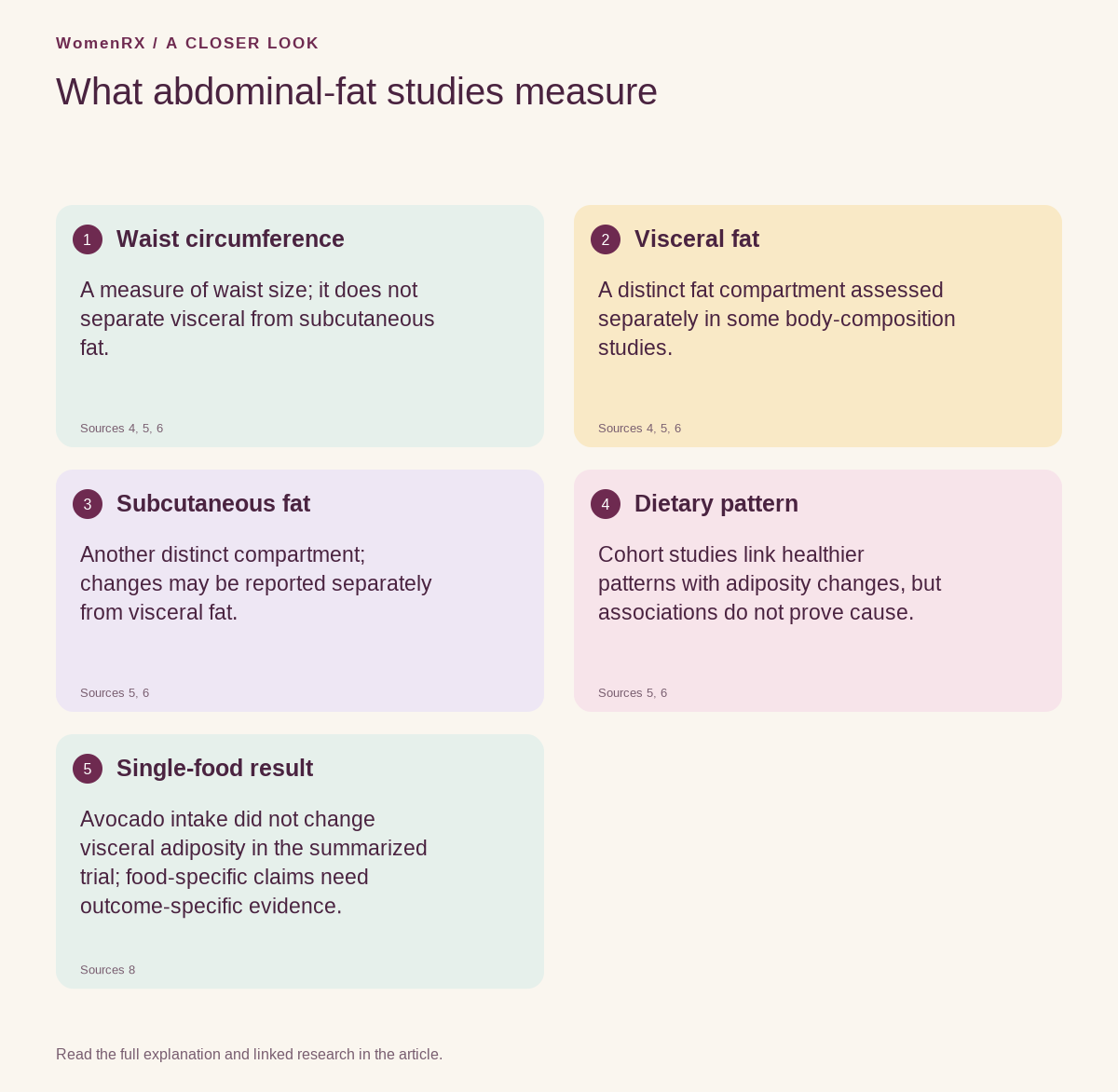
What abdominal-fat studies measure
Waist circumference: A measure of waist size; it does not separate visceral from subcutaneous fat.456
Visceral fat: A distinct fat compartment assessed separately in some body-composition studies.456
Subcutaneous fat: Another distinct compartment; changes may be reported separately from visceral fat.56
Dietary pattern: Cohort studies link healthier patterns with adiposity changes, but associations do not prove cause.56
Single-food result: Avocado intake did not change visceral adiposity in the summarized trial; food-specific claims need outcome-specific evidence.8
Read the figure as text
The result depends on the measure: waist circumference, directly assessed fat compartments, and body weight answer different questions.- Waist circumference: A measure of waist size; it does not separate visceral from subcutaneous fat.456
- Visceral fat: A distinct fat compartment assessed separately in some body-composition studies.456
- Subcutaneous fat: Another distinct compartment; changes may be reported separately from visceral fat.56
- Dietary pattern: Cohort studies link healthier patterns with adiposity changes, but associations do not prove cause.56
- Single-food result: Avocado intake did not change visceral adiposity in the summarized trial; food-specific claims need outcome-specific evidence.8
More questions, answered
Does a smaller waist prove visceral fat has decreased?
No. Waist circumference is a measurement of size, while some studies assess visceral and subcutaneous fat as separate body-composition outcomes. A change in waist doesn’t tell you exactly how either compartment changed. 4 5 6
Should I add more fiber or protein to target belly fat?
Fiber-rich foods can help with fullness and digestion, and protein supplies material the body uses to build and maintain tissues. Those are useful nutrition roles, but the evidence cited here doesn’t establish either nutrient as a way to selectively reduce abdominal fat. 1 2
Sources you can check
- Dietary Fiber: MedlinePlusAccessed 2026-09-25Return to first citation
- Dietary Proteins: MedlinePlusAccessed 2026-09-25Return to first citation
- Nutrition: MedlinePlusAccessed 2026-09-25Return to first citation
- Effect of home-based exercise with or without a Mediterranean-style diet on adiposity markers in postmenopausal women: A randomized-control trial.Tan A, Dunseath G, Thomas RL, Prior SL, Bracken RM, Churm R. · Physiological reports · 2025Return to first citation
- Association between changes in adherence to the planetary health diet and adiposity and body fat distribution: a cohort study.Ibsen DB, Sowah SA, Imamura F, De Lucia Rolfe E, Brage S, Griffin SJ, Wareham NJ, Forouhi NG. · The Lancet regional health. Europe · 2026Return to first citation
- Concurrent Changes in Diet Quality and Physical Activity and Association With Adiposity in Adults.Aryannezhad S, Imamura F, De Lucia Rolfe E, Griffin SJ, Wareham NJ, Brage S, Forouhi NG. · JAMA network open · 2025Return to first citation
- Impact of tomatoes and tomato-derived products on obesity and cardiometabolic health: a systematic review and meta-analysis.Sani L, Mounien L, Landrier JF. · Food & function · 2026Return to first citation
- The Habitual Diet and Avocado Trial (HAT): A Collaborative Multicenter Model for Large-Scale, Privately Funded Nutrition Research Consortia.Kris-Etherton PM, Li Z, Matthan NR, Rajaram S, Sabaté J, Reboussin DM, Ford N, Barnes S, Petersen KS. · Current developments in nutrition · 2026Return to first citation