Belly Fat, Health, and What Weight Loss Can Target
A waist measurement can flag a health question, but it can’t tell you what kind of abdominal fat you have.
Fat around your middle includes subcutaneous fat under the skin and visceral fat deeper in the abdomen. Visceral fat is linked with metabolic risk, but a changing waistline doesn’t reveal how much of either type you have. Nutrition and exercise can support weight loss; scale and waist measurements cannot show which abdominal fat compartment has changed. Your broader health picture matters more than appearance alone. 245
What’s beneath a changing waistline?
Two people can have similar waist measurements and different amounts of abdominal fat. Subcutaneous fat sits beneath the skin. Visceral fat lies deeper in the abdomen, around internal organs. Researchers can distinguish these compartments on CT images, but you can’t identify their proportions by looking in the mirror or wrapping a tape measure around your waist. 47
The distinction matters because fat location can add information about health risk. Visceral fat is metabolically active and has been associated with conditions such as abnormal blood lipids and impaired blood-sugar regulation. That doesn’t make subcutaneous fat irrelevant, or visceral fat the sole explanation for someone’s health. In a cross-sectional study of 199 research volunteers, total body fat explained a substantial portion of the variation in fasting insulin in both women and men; adding abdominal fat compartments improved the explanation only slightly. The study measured associations, not what would happen if a person lost fat from one compartment. 56
What your measurements can tell you
A waist measurement gives a clue about fat distribution, not a diagnosis. Carrying more fat around the abdomen rather than the hips may be associated with higher risk of heart disease and type 2 diabetes. The measurement can’t separate visceral from subcutaneous fat, though, and it doesn’t explain why your abdomen looks or feels different today. 24
A scale answers a different question: what your whole body weighs. That total includes muscle, bone, fat, and water. BMI compares weight with height, but it doesn’t distinguish those components or show where fat is stored. For example, if your weight stays steady while your waist changes, neither number alone tells you what changed inside your abdomen. 24
There’s a women-specific wrinkle even within subcutaneous fat. In the study of 199 volunteers, women had 51% of their abdominal subcutaneous fat in its deeper layer, compared with 66% for men. That finding describes the study groups, not a way to read an individual woman’s waist measurement or set a diagnosis from it. 6
More detailed imaging can distinguish fat compartments, but a research measurement is not automatically a better everyday goal. In a cross-sectional study of 7,805 adults in China, most of whom were patients undergoing CT for clinical reasons, CT-measured visceral fat was associated with metabolic dysfunction-associated steatotic liver disease in both women and men. That finding supports the relevance of fat distribution, but it doesn’t establish that an individual needs a CT scan or that one measurement predicts her future health. 7
What a weight or waist change actually shows
Good nutrition and exercise can help with weight loss, and even a small change in weight may lower the risk of certain diseases. But weight lost on a scale is not a readout of visceral-fat loss. Likewise, a smaller waist tells you that your measurement changed, not precisely which tissue changed. 24
If weight loss is your goal, the practical choices are about an overall routine you can keep. You might, for example, reduce the portion of a food you regularly eat as part of a lower-calorie eating pattern and add a walk you can repeat. Those are examples of changing food intake and exercising, not a tested combination that promises belly-fat loss. In a three-month trial, 66 women followed reduced-calorie diets; all groups lost weight and had smaller waists, whether or not beta-glucan was added. Because every group followed a reduced-calorie diet, the trial doesn’t isolate the diet’s effect from other changes over those months. 12
Be wary of turning that uncertainty into a promise. A supplement marketed for “belly fat” would need evidence for that specific claim, not just evidence that an ingredient affects body weight. The NIH Office of Dietary Supplements finds that evidence for many weight-loss supplement ingredients is limited or inconsistent. In the three-month trial of 66 women following a reduced-calorie diet, waist measurements decreased across groups, but adding oat-bran beta-glucan did not produce a significant difference between groups. That result doesn’t test every supplement; it shows why a change in waist size shouldn’t automatically be credited to the product added to a routine. 1
If your goal is health rather than a particular silhouette, put a waist measurement in context with factors such as blood pressure, cholesterol, blood-sugar health, and your medical history. Those give a more useful picture than judging progress by how your abdomen looks. 26
Life stage and symptoms change the question
A change around the middle isn’t automatically a menopause effect. A five-year study followed 58 women through the menopausal transition and found that changes in waist circumference correlated with changes in some inflammatory markers. It did not establish that a particular woman’s new waist measurement represents visceral fat, or that menopause alone caused it. 9
Pregnancy also calls for a different frame than an ordinary weight-loss goal: nutritional needs change during pregnancy. If you’re comparing your waist before and after a past pregnancy, that comparison alone cannot identify which tissue changed or explain the change. 34
Finally, not every abdominal change is a fat change. If weight is rising or falling unexpectedly, seek a medical assessment rather than assuming it’s simply a change in abdominal fat. Get medical help immediately for sudden, sharp abdominal pain or abdominal pain accompanied by pain in the chest, neck, or shoulder. Mild abdominal pain lasting a week or more also deserves attention. 28
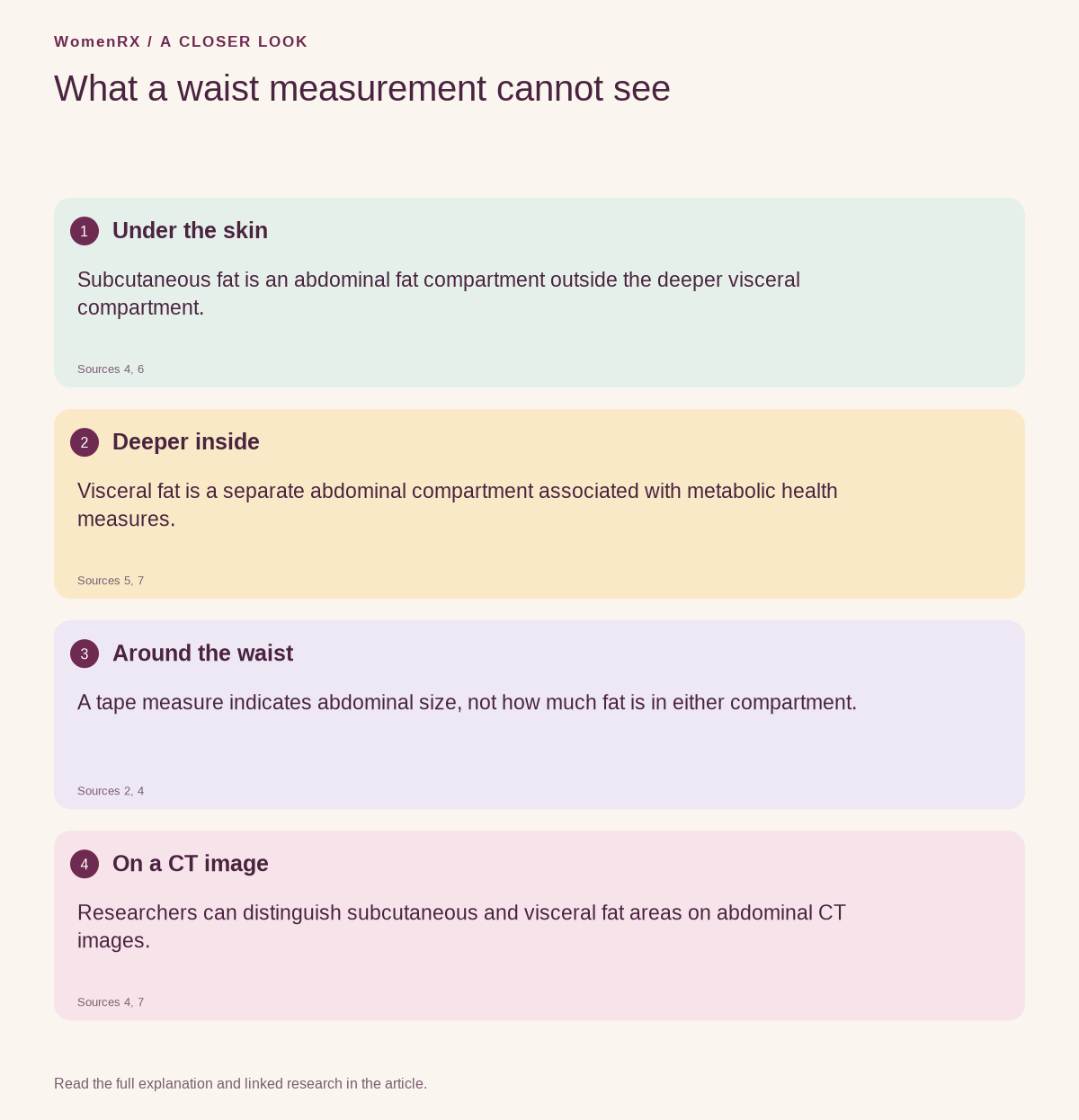
What a waist measurement cannot see
Under the skin: Subcutaneous fat is an abdominal fat compartment outside the deeper visceral compartment.46
Deeper inside: Visceral fat is a separate abdominal compartment associated with metabolic health measures.57
Around the waist: A tape measure indicates abdominal size, not how much fat is in either compartment.24
On a CT image: Researchers can distinguish subcutaneous and visceral fat areas on abdominal CT images.47
Read the figure as text
A simple cross-section and measurement key distinguish the two abdominal fat compartments from the clues available without imaging.- Under the skin: Subcutaneous fat is an abdominal fat compartment outside the deeper visceral compartment.46
- Deeper inside: Visceral fat is a separate abdominal compartment associated with metabolic health measures.57
- Around the waist: A tape measure indicates abdominal size, not how much fat is in either compartment.24
- On a CT image: Researchers can distinguish subcutaneous and visceral fat areas on abdominal CT images.47
Sources you can check
- Dietary Supplements for Weight Loss - Health Professional Fact SheetAccessed 2026-09-25Return to first citation
- Body Weight: MedlinePlusAccessed 2026-09-25Return to first citation
- Dietary Supplements and Life Stages: Pregnancy - Health Professional Fact SheetAccessed 2026-09-25Return to first citation
- Deep learning for abdominal adipose tissue segmentation with few labelled samples.Wang Z, Hounye AH, Zhang J, Hou M, Qi M. · International journal of computer assisted radiology and surgery · 2022Return to first citation
- [Different adipose tissue depots and metabolic syndrome in human].Wang R, Li XN. · Sheng li xue bao : [Acta physiologica Sinica] · 2017Return to first citation
- Contributions of total body fat, abdominal subcutaneous adipose tissue compartments, and visceral adipose tissue to the metabolic complications of obesity.Smith SR, Lovejoy JC, Greenway F, Ryan D, deJonge L, de la Bretonne J, Volafova J, Bray GA. · Metabolism: clinical and experimental · 2001Return to first citation
- CT-assessed abdominal visceral adiposity and MASLD: a sex-stratified cross-sectional analysis.Xu L, Chen T, Xie Y, Xiang X, Liu Y, Xu C, Wang S. · Frontiers in nutrition · 2026Return to first citation
- Abdominal Pain | MedlinePlusAccessed 2026-09-25Return to first citation
- Effect of the menopausal transition and physical activity energy expenditure on inflammatory markers: a MONET group study.Razmjou S, Bastard JP, Doucet E, Rabasa-Lhoret R, Fellahi S, Lavoie JM, Prud'homme D. · Menopause (New York, N.Y.) · 2016Return to first citation