Belly Fat After Menopause: What the Scale Misses
A changing waist and a steady weight can coexist because the scale doesn’t show body composition or where fat is stored.
After menopause, body-composition studies find differences in lean mass and abdominal fat between groups of women, even within the same weight categories. The scale, a waist measurement, and strength each tell you something different. Regular activity supports overall health and muscle strength, but these studies don’t establish how much a particular routine changes abdominal fat after menopause. 1 2 3
Why your middle may change without a big change on the scale
If your clothes fit differently but your weight looks familiar, you’re not imagining a contradiction. The scale shows total weight. It can’t tell you how much is lean tissue, how much is fat, or where that fat is stored.
In a retrospective study comparing 325 premenopausal, perimenopausal, and postmenopausal women, the postmenopausal group generally had lower lean-mass measures and more central adiposity. The size and direction of some fat measures varied by body-mass category. Because researchers compared women at one point in time, the study can’t tell us how any one woman’s body changed through menopause or separate the effects of menopause from aging. 3
Abdominal fat also isn’t one uniform tissue. Researchers distinguish visceral fat, deeper in the abdomen, from subcutaneous fat, beneath the skin. An analysis of 10,184 postmenopausal women assessed those fat depots alongside total body fat and body-size measures. Those are related measurements, but none is a substitute for all the others. 2
Pick a measure that answers your question
If you want to know whether your overall weight is changing, the scale answers that question. If you want to notice a change in abdominal size, a waist measurement is more relevant, though it won’t tell you how much visceral fat you have. Body-composition assessments estimate fat and lean tissue; these studies used different methods, so their results aren’t interchangeable. 2 3
Strength answers another question: what can your body do? Being able to carry groceries more comfortably, for example, may matter to you even if your waist size doesn’t move. It’s a useful goal, not a hidden measurement of belly fat. Muscle-strengthening activity can help maintain or increase muscle mass and strength. 1
The practical takeaway is to compare like with like. A stable weight doesn’t prove your body composition is unchanged. A smaller waist doesn’t tell you precisely how much deeper abdominal fat has changed. And getting stronger is progress on strength, whether or not it changes either number.
Build a routine for more than one payoff
Regular activity can help with weight management and offers benefits that don’t depend on a smaller waist, including support for heart health, blood-sugar management, muscle strength, and sleep. Starting with more everyday movement, such as walking during a break or taking the stairs when that works for you, is one option. Muscle-strengthening activities address a different goal: maintaining or building strength. 1
Make the routine fit your actual week. For example, choose a walk you can repeat, add everyday movement when it suits you, and include a muscle-strengthening activity you’re willing to keep doing. You can mix activities to avoid getting bored, or keep a simple activity log to see what you’re doing and help set goals. Starting slowly is a reasonable way to build movement into your life. 1
Food and activity both play a role in overall weight management. Whether a particular routine changes waist size or deeper abdominal fat after menopause is a different question. The postmenopausal studies discussed here examined body composition and reproductive history; they didn’t test food or activity changes. Their findings can’t predict a waist change from a routine, and general weight-management benefits don’t establish targeted fat loss. 1 2 3
So choose a routine you can live with, then notice what it actually changes. If your aim is strength, pay attention to strength. If it’s sleep or day-to-day stamina, those outcomes count too. You don’t have to treat a waist measurement as the verdict on every healthy thing you do. 1
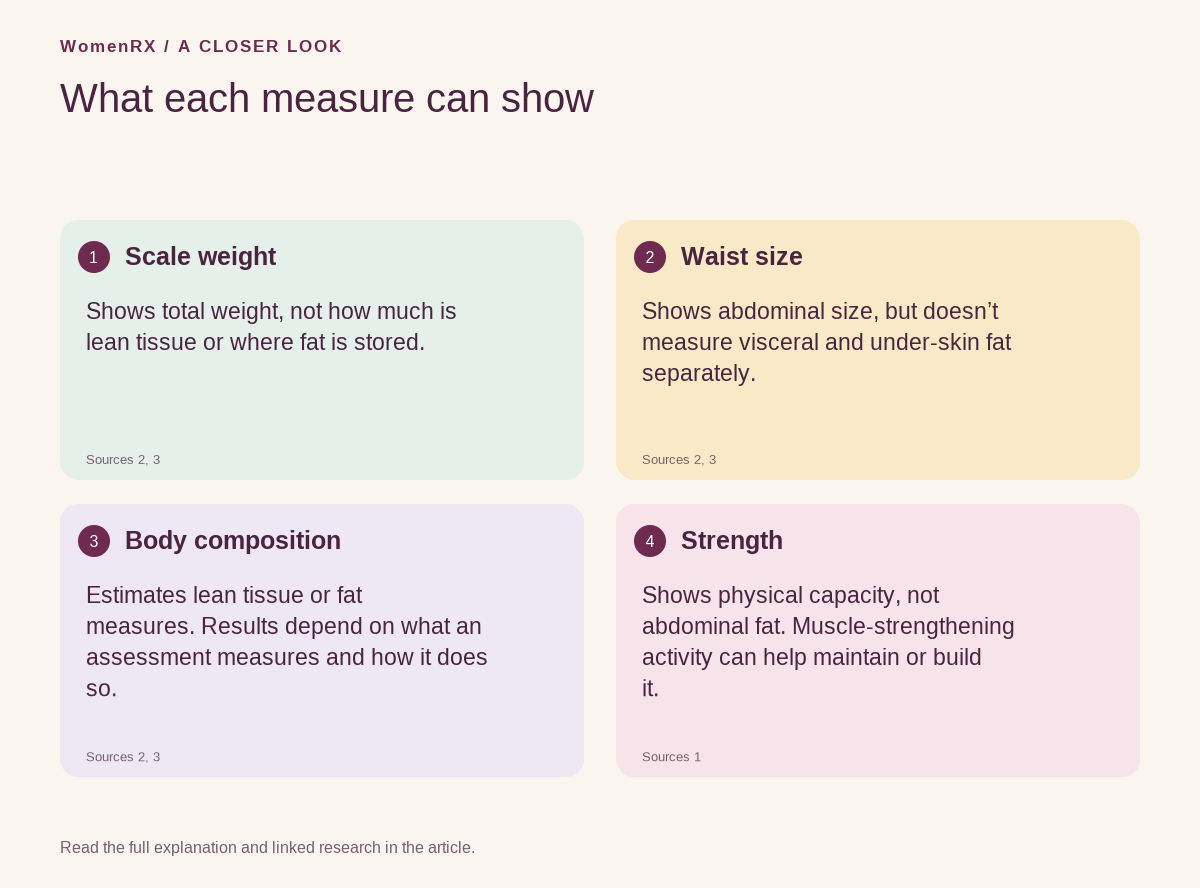
What each measure can show
Scale weight: Shows total weight, not how much is lean tissue or where fat is stored.23
Waist size: Shows abdominal size, but doesn’t measure visceral and under-skin fat separately.23
Body composition: Estimates lean tissue or fat measures. Results depend on what an assessment measures and how it does so.23
Strength: Shows physical capacity, not abdominal fat. Muscle-strengthening activity can help maintain or build it.1
Read the figure as text
These four measures answer different questions. Improvement in one doesn’t establish a change in the others.- Scale weight: Shows total weight, not how much is lean tissue or where fat is stored.23
- Waist size: Shows abdominal size, but doesn’t measure visceral and under-skin fat separately.23
- Body composition: Estimates lean tissue or fat measures. Results depend on what an assessment measures and how it does so.23
- Strength: Shows physical capacity, not abdominal fat. Muscle-strengthening activity can help maintain or build it.1
Sources you can check
- Benefits of Exercise: MedlinePlusAccessed 2026-09-25Return to first citation
- The association between reproductive history and abdominal adipose tissue among postmenopausal women: results from the Women's Health Initiative.Banack HR, Cook CE, Grandi SM, Scime NV, Andary R, Follis S, Allison M, Manson JE, Jung SY, Wild RA, Farland LV, Shadyab AH, Bea JW, Odegaard AO. · Human reproduction (Oxford, England) · 2024Return to first citation
- The Impact of the Menopausal Transition on Body Composition and Abdominal Fat Redistribution.Szeliga A, Chedraui P, Meczekalski B. · Journal of clinical medicine · 2026Return to first citation