What a Changing Waist Can Tell You in Midlife
Your waist can reveal a change that the scale misses, but it can’t tell you exactly where abdominal fat is stored.
A changing waist is worth noticing, even if your weight hasn’t changed much. Waist size shows the size of your middle, not how much fat is deep in your abdomen or whether perimenopause caused the change. Compare measurements taken the same way, then consider the trend alongside blood pressure, blood sugar, and cholesterol rather than treating it as a verdict on your health. 2 1
A skirt that fits differently can raise a fair question: has something changed around your middle, even if the scale looks familiar? A waist measurement can help you follow that change. What it can’t do is identify the fat beneath the tape measure or explain why your shape changed.
The scale and tape measure answer different questions
Weight tells you how much your body weighs overall. Waist circumference tells you the size of your middle. Neither separates visceral fat, which sits deeper in the abdomen, from subcutaneous fat beneath the skin.
That difference isn’t just technical. In a six-year analysis of 10,184 postmenopausal participants in the US Women’s Health Initiative, researchers compared body-size measurements with measures of visceral and subcutaneous abdominal fat. The measures were related, but women in the same waist or BMI categories still had substantially different amounts of each type of abdominal fat. A waist measurement is a useful clue, not a reading of your visceral fat. 2
Is perimenopause responsible?
Midlife timing alone can’t answer that. In the Women’s Health Initiative analysis, abdominal fat patterns differed by age, race and ethnicity, and years since menopause. Visceral fat increased during follow-up among women younger than 60, while it decreased among women 70 and older. These were patterns observed in women who were already postmenopausal, not a test of what perimenopause causes. 2
So if your waist changes during perimenopause, you don’t have to dismiss what you’re noticing. You also don’t have to assume hormones explain all of it. The measurement tells you what changed, not why.
Make a waist trend useful, not consuming
If you want to track it, pick one place on your waist to measure and use the same tape position and posture each time. Keep the tape snug without pulling it tight. Write down the date and measurement, and compare readings taken the same way. That gives you a more meaningful personal trend than comparing a careful measurement today with a rough guess from months ago. You can track weight too, but don’t expect it to tell the same story as your waist.
Then put those observations beside information you can check directly. Blood pressure, blood sugar, and cholesterol provide different pieces of the cardiometabolic picture. In a cross-sectional survey of 638 women in five South Asian countries, age, BMI, and waist circumference were associated with metabolic syndrome across the surveyed group; blood sugar and lipid measures were also associated with it. Those findings support looking beyond waist size, not using it to diagnose your own risk. 1
Here’s a practical way to respond: if you’ve noticed a sustained waist change, check when your blood pressure, blood sugar, and cholesterol were last measured. If you already have results, look at which measure, if any, needs attention. For example, a blood pressure result outside your agreed range calls for a conversation about blood pressure, while an out-of-range blood sugar or cholesterol result calls for a plan around that finding. You don’t need to wait for your waist to change again before following up on a result that matters to your health. 1
No measurement can tell you how to shrink fat in just one place. The studies here describe body-fat patterns and health associations; they don’t test a perimenopause-specific routine that targets belly fat. 2 1 Your more useful goal is to notice a change without letting one number define it, and to act on the health information you can actually measure.
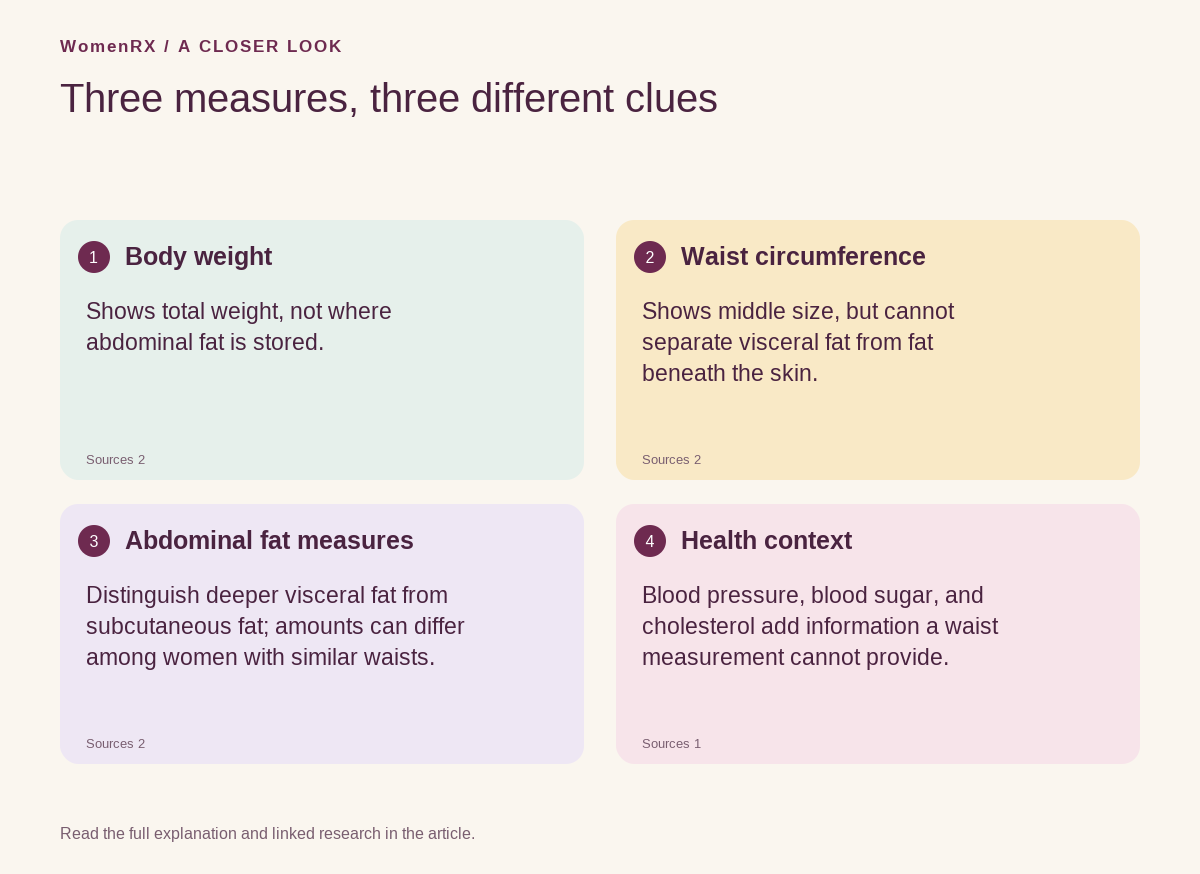
Three measures, three different clues
Body weight: Shows total weight, not where abdominal fat is stored.2
Waist circumference: Shows middle size, but cannot separate visceral fat from fat beneath the skin.2
Abdominal fat measures: Distinguish deeper visceral fat from subcutaneous fat; amounts can differ among women with similar waists.2
Health context: Blood pressure, blood sugar, and cholesterol add information a waist measurement cannot provide.1
Read the figure as text
Weight and waist size describe body size; abdominal fat measures describe where fat is stored.- Body weight: Shows total weight, not where abdominal fat is stored.2
- Waist circumference: Shows middle size, but cannot separate visceral fat from fat beneath the skin.2
- Abdominal fat measures: Distinguish deeper visceral fat from subcutaneous fat; amounts can differ among women with similar waists.2
- Health context: Blood pressure, blood sugar, and cholesterol add information a waist measurement cannot provide.1
Sources you can check
- A Survey on Relation of Menopause to Metabolic Syndrome - SAFOMS STUDY (South Asian Federation of Menopause Societies) - Interim Analysis.Ahuja M, Sharma JB, Perumal V, Sharma P, Bansal R, Sarkar A, Agrawal M. · Journal of mid-life health · 2023Return to first citation
- Longitudinal patterns of abdominal visceral and subcutaneous adipose tissue, total body composition, and anthropometric measures in postmenopausal women: Results from the Women's Health Initiative.Banack HR, Bea JW, Chen Z, Blew RM, Nicholas S, Stefanick M, Wild RA, Manson JE, Odegaard AO. · International journal of obesity (2005) · 2023Return to first citation