Hungrier in Midlife? Look Beyond Menopause
A change in appetite may have more than one explanation, and the pattern around it can help you choose what to try next.
If you feel hungrier than usual in midlife, don’t assume menopause is the direct cause. Start with what changed: your sleep, meals, mood, or medicines. Sleep-restriction trials in adults link shorter sleep with greater food intake, while women in a small menopause focus-group study described snacking, cravings, and feeling less satisfied by food.35 If your weight changes without trying, arrange a health check.1
First, separate appetite from weight
Hunger, snacking, cravings, and weight change can happen together, but they don’t tell you the same thing. You might feel hungry sooner after meals, want a particular food, find yourself eating later because your day has shifted, or notice a weight change without feeling hungrier at all. That distinction gives you a better starting point than treating every change as “menopause hunger.” Body weight also reflects muscle, bone, fat, and water, so a change on the scale cannot explain appetite by itself.1
In online focus groups with 40 women living in Ireland, participants described increased snacking, sugar or salt cravings, and a perceived loss of fullness alongside changes in weight and body shape. Some also described reduced food pleasure and self-confidence. These are accounts of what women experienced, not evidence that menopause hormones directly caused those eating changes or that every woman will experience them.5
If hunger follows a rough night, look at sleep
A useful question is whether you’re hungrier on days after disrupted sleep. In a review of adult sleep-intervention studies, partial sleep restriction was associated with higher daily food intake than the comparison conditions. The review did not establish an effect specifically in midlife women, and measuring food intake isn’t quite the same as explaining one person’s hunger.3
That makes sleep a practical factor to review, not a diagnosis. If nights have become irregular, try returning to a regular sleep routine rather than responding to daytime hunger with stricter food rules. If hot flashes or night sweats are waking you, you can also discuss treatment for those symptoms. Menopause guidance recommends regular sleep routines, and hormone therapy is an established treatment for bothersome hot flashes and night sweats.74
There isn’t a settled, simple story in which poor sleep changes one “hunger hormone” and explains everyone’s appetite. Earlier research discussed in a review of sex and sleep restriction found inconsistent links between shorter sleep and appetite-regulating hormones. You can take your sleep pattern seriously without needing a hormone-level explanation for it.2
If your meals changed, make eating easier to manage
Look at the circumstances around the new appetite. For example, has a busy morning turned breakfast into coffee alone, leaving you looking for food in the afternoon? Are you eating at different times because work or caregiving has changed? These are prompts to compare your current routine with your usual one, not proof that a missed meal caused a particular craving.
If you need food between meals, a satisfying snack is a reasonable response. MedlinePlus gives examples that combine fiber-rich foods with a protein source, such as vegetables with hummus, an apple with cheese, or yogurt with fruit. Beans, lentils, tofu, nuts, and seeds are other protein choices you can build into meals you enjoy. You don’t need to turn an appetite change into a restrictive diet to learn whether a steadier eating routine feels better.6
Notice mood, medicines, and weight changes, too
Menopause can coincide with disrupted sleep and changes in mood, but those experiences shouldn’t be used to explain away a new appetite pattern. If your mood or stress has changed, consider how it is affecting your days and meals. If low mood or anxiety is troubling you, cognitive behavioral therapy is one option menopause guidance identifies for mood and sleep problems.7
Also ask whether you started or changed a medicine around the time your appetite changed. The timing is worth bringing to a health check, especially if the change persists or comes with other new symptoms. It’s a question to investigate, not a reason to assume the medicine or menopause is the cause.
A weight change you didn’t intend is a stronger reason to arrange a health check, whether or not you feel hungrier. MedlinePlus advises talking with a healthcare provider about weight loss or gain that happens without trying because an unexpected change can signal a medical problem.1 You can describe the pattern plainly: for example, “I’m hungry soon after meals and have lost weight without trying,” or “My appetite feels unchanged, but my weight is going up.” Those two situations call for different questions, even though both deserve attention.
The aim is not to prove whether menopause is involved. It’s to choose a next move that fits what’s happening: support a disrupted sleep routine, make meals or snacks more workable, discuss troubling mood or nighttime symptoms, or get an unexpected weight change assessed.
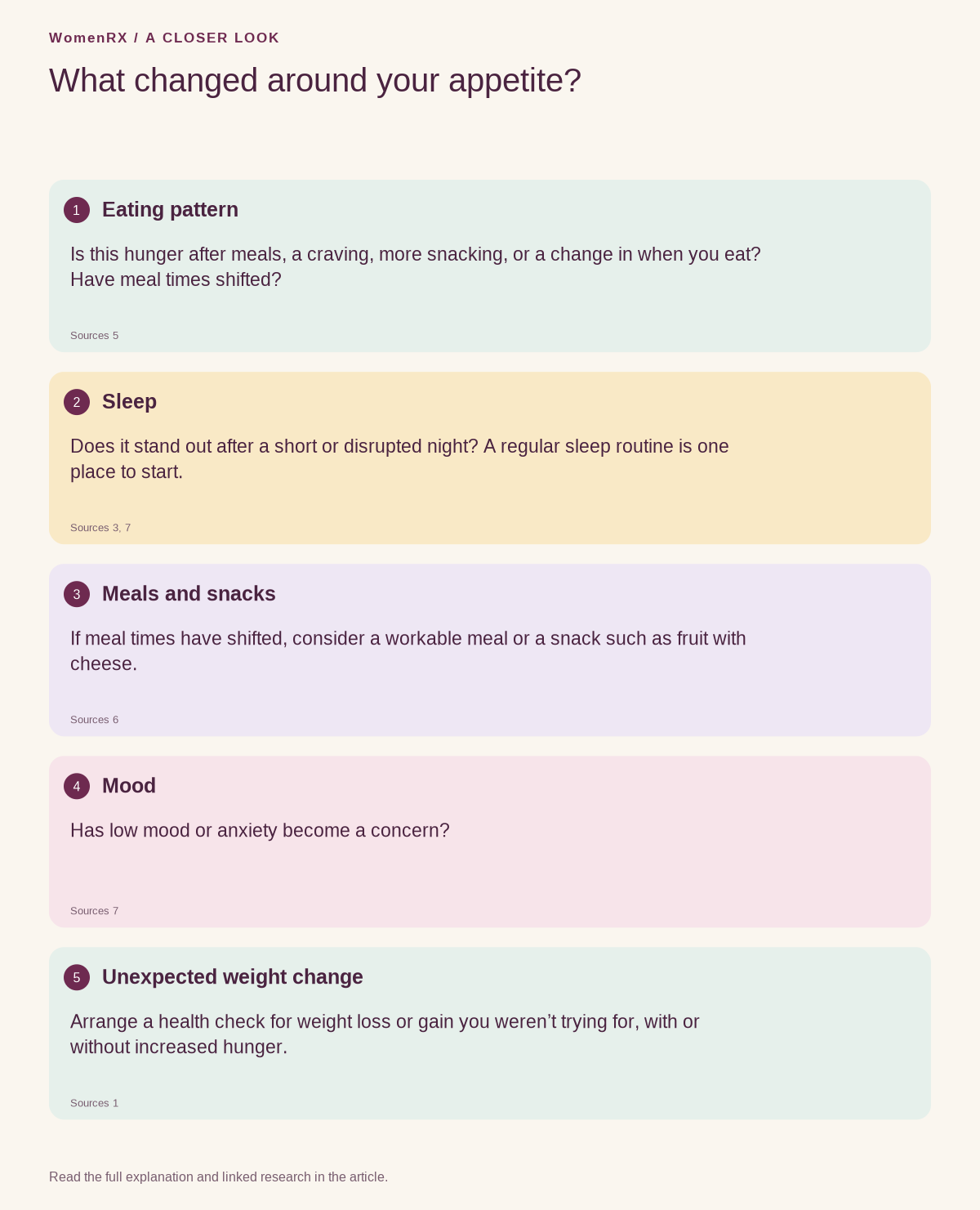
What changed around your appetite?
Eating pattern: Is this hunger after meals, a craving, more snacking, or a change in when you eat? Have meal times shifted?5
Sleep: Does it stand out after a short or disrupted night? A regular sleep routine is one place to start.37
Meals and snacks: If meal times have shifted, consider a workable meal or a snack such as fruit with cheese.6
Mood: Has low mood or anxiety become a concern?7
Unexpected weight change: Arrange a health check for weight loss or gain you weren’t trying for, with or without increased hunger.1
Read the figure as text
Use these prompts to decide whether to try a routine change or arrange a health check. They are not a diagnostic test. Also note whether a medicine changed around the same time as your appetite.- Eating pattern: Is this hunger after meals, a craving, more snacking, or a change in when you eat? Have meal times shifted?5
- Sleep: Does it stand out after a short or disrupted night? A regular sleep routine is one place to start.37
- Meals and snacks: If meal times have shifted, consider a workable meal or a snack such as fruit with cheese.6
- Mood: Has low mood or anxiety become a concern?7
- Unexpected weight change: Arrange a health check for weight loss or gain you weren’t trying for, with or without increased hunger.1
More questions, answered
Will menopausal hormone therapy stop increased hunger?
There’s no basis here to expect hormone therapy to stop hunger. The North American Menopause Society identifies it as an effective treatment for hot flashes and night sweats. If those symptoms are disrupting your sleep, you can discuss treating them without assuming your appetite will change.4
Sources you can check
- Body Weight: MedlinePlusAccessed 2026-09-25Return to first citation
- The Role of Sex in the Impact of Sleep Restriction on Appetite- and Weight-Regulating Hormones in Healthy Adults: A Systematic Review of Human Studies.Alfikany M, Sakhr K, Kremers S, El Khatib S, Adam T, Meertens R. · Clocks & sleep · 2025Return to first citation
- The influence of sleep health on dietary intake: a systematic review and meta-analysis of intervention studies.Fenton S, Burrows TL, Skinner JA, Duncan MJ. · Journal of human nutrition and dietetics : the official journal of the British Dietetic Association · 2021Return to first citation
- The 2022 hormone therapy position statement of The North American Menopause Society.“The 2022 Hormone Therapy Position Statement of The North American Menopause Society” Advisory Panel. · Menopause (New York, N.Y.) · 2022Return to first citation
- From Disruption to Control: Insights from Focus Groups Exploring Nutrition and Chemosensory Changes During Menopause.O'Donovan S, Monaghan S, Murphy A, Conroy PM. · Nutrients · 2025Return to first citation
- MedlinePlus: Managing weight with healthy eatingAccessed 2026-09-25Return to first citation
- Things you can do to help menopause and perimenopause symptoms - NHSAccessed 2026-09-25Return to first citation