Hair Thinning in Midlife: When to Look Beyond Menopause
A widening part, sudden shedding, and a new patch of hair loss call for different questions, even if they appear around menopause.
Gradual thinning over the crown or a widening part can fit female pattern hair loss, which becomes more common with age. But don’t assume menopause explains a new patch or a rapid change: arrange an assessment rather than waiting to see if it settles. Seek prompt assessment if the scalp is also red or scaly, since some scarring conditions need early diagnosis. 1 2 3 4
Start with where and how your hair is changing
If you’ve noticed hair thinning during the menopause transition, the timing may feel like an explanation. It isn’t a diagnosis. Female pattern hair loss becomes more common with age, but it can occur without elevated androgen levels, and other kinds of hair loss can appear at the same stage of life. 2 3
Gradual thinning over the crown or a widening part can fit female pattern hair loss. It usually develops slowly, often with the front hairline relatively preserved. Some women with this pattern notice increased shedding too, so seeing hairs come out doesn’t rule it in or out. 2
Shedding across the scalp raises a different question, especially if the amount coming out has changed noticeably. Chronic telogen effluvium is an important alternative clinicians consider when evaluating hair loss in women. The distinction isn’t always obvious from what you see at home, which is why the history and scalp examination matter. 2 3
A new, distinct patch isn’t the usual gradual crown-thinning pattern. Arrange an assessment rather than attributing it to menopause or waiting for it to spread. Likewise, if your hair loss changes rapidly, make an appointment and describe how quickly it happened. Neither a patch nor speed alone identifies the cause, but both give a clinician a reason to look beyond a slowly developing pattern. 1 2 3
Hair loss concentrated at the temples needs its own look. Traction-related loss, female pattern hair loss, and scarring conditions are among the possibilities in that area; location alone cannot separate them. 4
Scalp changes make the assessment more time-sensitive
If thinning or a patch comes with scalp redness or scaling, seek a prompt assessment. These signs don’t prove that hair loss is scarring, but they can occur in scarring conditions, where prompt diagnosis matters to preventing further loss. A clinician may need to examine the scalp closely to distinguish these conditions from more common forms of thinning. 4 5
You don’t have to wait for a scalp symptom to justify an appointment. If the change worries you, is progressing, appears in a new patch, or has happened rapidly, it’s reasonable to have it assessed. A clinician may be able to identify the cause by looking at your hair and scalp; a fuller history and evaluation may be needed to distinguish female pattern loss from other causes. 1 3
Describe the change, not just the amount
Before the visit, think back to when you first noticed a difference. Was it a part that widened gradually, hair coming out across the scalp, a distinct patch, or a change at the temples? Did it happen slowly or quickly? Mention any redness or scaling and any new acne, increased facial or body hair, or irregular periods. Those accompanying changes can affect what else a clinician considers; they don’t mean everyone with thinning hair has high androgen levels. 2 3 4
You may hear that losing 50 to 100 hairs a day is normal. That general range isn’t a practical test for what’s causing a noticeable change in your hair. Where the loss is happening, how it has progressed, and what the scalp looks like are more useful starting points. 1 2 3
If the assessment points to female pattern hair loss, treatment is a separate conversation from diagnosis. Minoxidil is an option used for this condition, while the first step for a patch, rapid change, or concerning scalp signs is to find out what kind of hair loss you’re dealing with. 1 3
What the pattern of hair loss can tell you
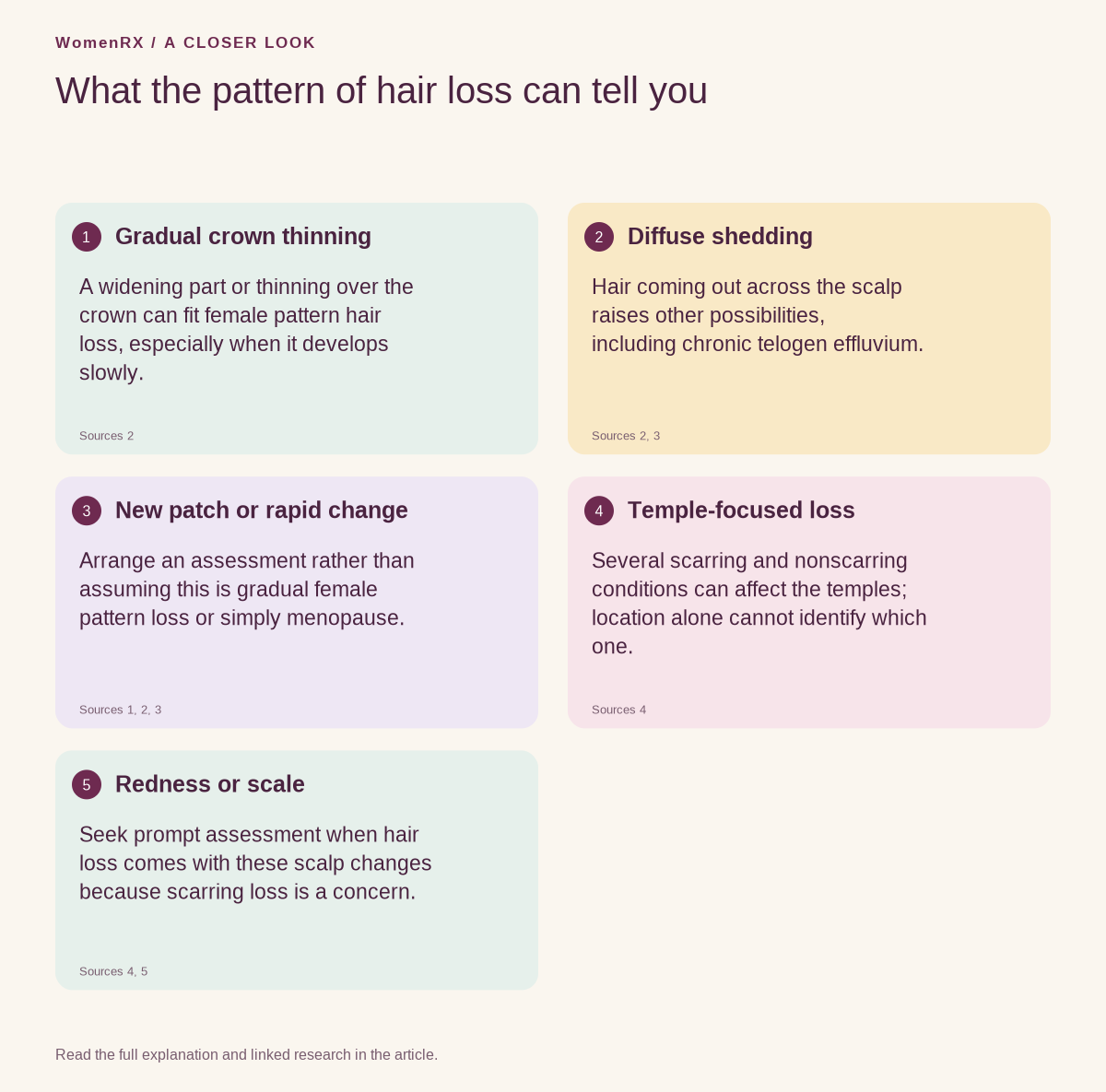
Gradual crown thinning: A widening part or thinning over the crown can fit female pattern hair loss, especially when it develops slowly.2
Diffuse shedding: Hair coming out across the scalp raises other possibilities, including chronic telogen effluvium.23
New patch or rapid change: Arrange an assessment rather than assuming this is gradual female pattern loss or simply menopause.123
Temple-focused loss: Several scarring and nonscarring conditions can affect the temples; location alone cannot identify which one.4
Redness or scale: Seek prompt assessment when hair loss comes with these scalp changes because scarring loss is a concern.45
Read the figure as text
These differences help you describe the change and decide when to arrange an assessment. They cannot diagnose the cause.- Gradual crown thinning: A widening part or thinning over the crown can fit female pattern hair loss, especially when it develops slowly.2
- Diffuse shedding: Hair coming out across the scalp raises other possibilities, including chronic telogen effluvium.23
- New patch or rapid change: Arrange an assessment rather than assuming this is gradual female pattern loss or simply menopause.123
- Temple-focused loss: Several scarring and nonscarring conditions can affect the temples; location alone cannot identify which one.4
- Redness or scale: Seek prompt assessment when hair loss comes with these scalp changes because scarring loss is a concern.45
More questions, answered
Does female pattern hair loss mean my hormones are too high?
No. It often occurs without elevated androgen levels. Changes such as increased facial or body hair, acne, or irregular periods are worth mentioning because they may prompt a clinician to consider androgen excess as part of the evaluation. 2 3
Sources you can check
- Hair loss - NHSAccessed 2026-09-25Return to first citation
- Female pattern hair loss.Herskovitz I, Tosti A. · International journal of endocrinology and metabolism · 2013Return to first citation
- Female pattern hair loss.Singal A, Sonthalia S, Verma P. · Indian journal of dermatology, venereology and leprology · 2013Return to first citation
- Bitemporal Scalp Hair Loss: Differential Diagnosis of Nonscarring and Scarring Conditions.De Souza B, Tovar-Garza A, Uwakwe LN, McMichael A. · The Journal of clinical and aesthetic dermatology · 2021Return to first citation
- Fibrosing Alopecia in a Pattern Distribution (FAPD) in 16 African-Descent and Hispanic Female Patients: A Challenging Diagnosis.Teixeira MS, Gavazzoni Dias MFR, Trüeb RM, Rochael MC, Vilar EAG. · Skin appendage disorders · 2019Return to first citation