Hair Thinning During Menopause: How to Find the Cause
A widening part, increased shedding, and patchy loss point to different questions, even when they appear during menopause.
Hormonal changes around menopause can affect hair, but they don’t explain every new change. Gradual thinning over the top of the head may fit female pattern hair loss; shedding across the scalp can have other causes, including illness. Patchy loss or scalp changes need a closer look. The pattern and your health history can guide which evaluation and treatment discussion makes sense. 1 2 3 6
Start with what changed
Maybe your part looks wider than it used to. Maybe you’re finding more hair in the shower. Those observations are more useful than assuming that any thinning in midlife is menopause hair loss.
A review describes hormonal changes during the menopause transition and after menopause that may affect hair density, thickness, and texture. Female pattern hair loss, diffuse shedding, and other hair-loss conditions are also seen in postmenopausal women. More than one process can be present at once, so the timing alone cannot identify your cause. 2 6
More shedding, or less coverage?
Shedding across the scalp means you’re noticing more hairs coming out rather than one area slowly looking thinner. Telogen effluvium is a form of diffuse, non-scarring shedding; illness can also be followed by temporary hair loss. Tell a clinician when the change began and whether you were ill around that period. Those details may help explain the shedding, but they aren’t a diagnosis on their own. 1 2
Gradual thinning over the top is more characteristic of female pattern hair loss. You may notice a widening part or less coverage around it. Family history is worth mentioning, but it cannot settle the diagnosis: early female pattern loss can resemble chronic diffuse shedding, and the two can coexist. Increased shedding can even occur before a clear pattern emerges. 2
Patches or changes to the scalp call for a different look. Patchy loss can reflect several conditions, including some that need different treatments; certain scarring hair-loss conditions can progress. Arrange an examination rather than putting a new patch or noticeable scalp change down to menopause. 3
Why an assessment may be targeted
A clinician can examine where coverage has changed and ask about its pace, recent illness, and family history. A magnified scalp examination called trichoscopy may help distinguish conditions that look alike. It supports the clinical assessment rather than replacing it. 1 2 3
Bring up changes in medications or supplements, without assuming one caused the loss. One specific exposure to mention if it applies to you is androgenic or anabolic steroid use: a review links these substances to female pattern hair loss, while noting limited research specifically in female athletes. 4
Blood tests depend on what the history and examination suggest. For example, in one hospital-based study, clinicians checked ferritin to assess iron status when they suspected telogen effluvium. They used thyroid function tests when diffuse loss came with features suggesting an endocrine cause. That approach illustrates why iron status or thyroid health may come up in a hair-loss assessment, not why everyone needs the same tests. 3
Match the next step to the finding
If the assessment points to female pattern hair loss, minoxidil is a treatment option to discuss. Ask what benefit is realistic, whether ongoing use suits you, and how you would judge whether it’s helping. Treatment does not work for everyone, and minoxidil’s effect depends on continued use. 1
If shedding is the main finding, the more useful first question may be whether an illness or another health factor needs attention. If the loss is patchy or the scalp itself has changed, establishing the diagnosis matters before choosing a treatment. 1 3
You might also be weighing hormone therapy for menopause symptoms. The 2022 North American Menopause Society position statement discusses its use for concerns such as hot flashes, genitourinary symptoms, and prevention of bone loss. Keep the hair-loss assessment as a separate question so treatment can be matched to what’s happening on your scalp. 5 2
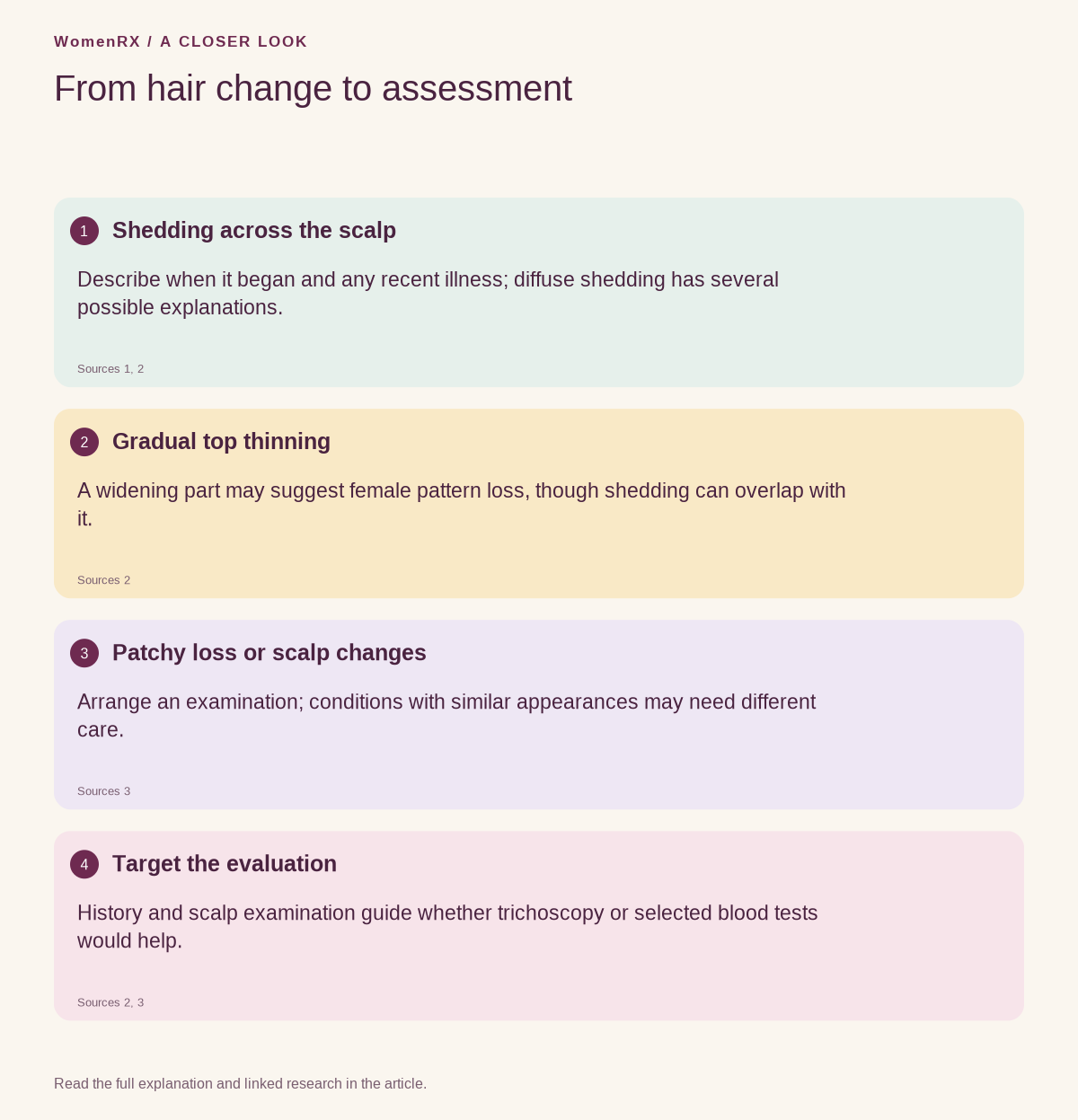
From hair change to assessment
Shedding across the scalp: Describe when it began and any recent illness; diffuse shedding has several possible explanations.12
Gradual top thinning: A widening part may suggest female pattern loss, though shedding can overlap with it.2
Patchy loss or scalp changes: Arrange an examination; conditions with similar appearances may need different care.3
Target the evaluation: History and scalp examination guide whether trichoscopy or selected blood tests would help.23
Read the figure as text
Start with the change you can see, then use it to guide a discussion rather than a self-diagnosis.- Shedding across the scalp: Describe when it began and any recent illness; diffuse shedding has several possible explanations.12
- Gradual top thinning: A widening part may suggest female pattern loss, though shedding can overlap with it.2
- Patchy loss or scalp changes: Arrange an examination; conditions with similar appearances may need different care.3
- Target the evaluation: History and scalp examination guide whether trichoscopy or selected blood tests would help.23
More questions, answered
Can I have both shedding and female pattern thinning?
Yes. Chronic diffuse shedding and female pattern hair loss can coexist, and increased shedding may appear before patterned thinning becomes obvious. Describe both changes rather than trying to choose one label yourself. 2
Sources you can check
- Hair loss - NHSAccessed 2026-09-25Return to first citation
- Trichoscopic Features, Clinical Correlates, and Risk Prediction in Female Pattern Hair Loss: A Retrospective Case-Control Study.Long B, Long Q, Pan W, Chen S, Ye Z, Guo H. · Clinical, cosmetic and investigational dermatology · 2026Return to first citation
- Diagnostic Yield and Clinical Impact of Trichoscopy in Alopecia: A Cross-Sectional Study From a Rural Tertiary Care Centre.Jagalur H, Devaraj Y, Swaroop MR, Gurudev S, Nagaraj LG, Chauwan RS, S A, Thakur A. · Cureus · 2026Return to first citation
- Alopecia in Female Athletes Using Androgenic and Anabolic Steroids: Pathophysiology and Management.Brinks AL, Needle CD, Spindler AJ, Brody AM, Scandagli I, Oh C, Shapiro J, Lo Sicco KI, Tawanwongsri W. · International journal of dermatology · 2025Return to first citation
- The 2022 hormone therapy position statement of The North American Menopause Society.“The 2022 Hormone Therapy Position Statement of The North American Menopause Society” Advisory Panel. · Menopause (New York, N.Y.) · 2022Return to first citation
- Menopause and hair loss in women: Exploring the hormonal transition.Gupta AK, Economopoulos V, Mann A, Wang T, Mirmirani P. · Maturitas · 2025Return to first citation